wayground logo

Free Printable Worksheets

Font size

S
M
L
XL
Worksheets

Fall Review Chemistry

Total questions: 170

Worksheet time: 6hrs 32mins

Name
Class
Date
1.
1.  The number of significant figures in the measurement 170.040 km is ___.
a)
Three
b)
Four
c)
Five
d)
Six
2.
1.  The number of significant figures in the measurement 170.040 km is ___.
a)
Three
b)
Four
c)
Five
d)
Six
3.

Flammable materials, like alcohol, should never be dispensed or used near

a)

Open Flam

b)

another student

c)

open door

d)

sink

4.

If a laboratory fire erupts, immediately

a)

open the windows

b)

thrown water on the fire

c)

run for the fire extinguisher

d)

notify your instructor

5.

Approved eye protection devices (such as goggles) are worn in the laboratory

a)

only if you don't have corrective glasses

b)

to avoid eye strain

c)

any time chemicals, heat or glasswear are used

d)

to improve your vision

6.

You are heating a piece of glass and now want to pick it up. You should

a)

pour cold water on it

b)

use a rag or paper towel

c)

use tongs

d)

pick up the end that looks cooler

7.

You have been injured in the laboratory (cut, burn, etc.). First you should

a)

visit the school nurse after class

b)

see a doctor after school

c)

tell the science instructor at once

d)

apply firstr aid yourself

8.

If you do not understand a direction or part of a lab procedure, you should

a)

figure it out as you do the lab

b)

try several methods until something works

c)

skip it and go on to the next step

d)

ask the instructor before proceeding

9.

After completing an experiment, all chemical wastes should be

a)

taken home

b)

disposed of according to instructor directions

c)

dumpd in the sink

d)

left at your lab station for the next class

10.

Personal eyeglasses provide as much protection as

a)

safety glasses

b)

splashproof chemical googles

c)

face shield

d)

none of these

11.

In a laboratory, the following should not be worn.

a)

all are correct

b)

dangling jewelry

c)

loose clothing

d)

sandals

12.
The density of pyrite is 5g/cm. This is an example of 
a)
physical intensive property
b)
physical extensive property
c)
chemical change
d)
chemical property
13.
Wood burning is an example of _______
a)
physical intensive property
b)
physical extensive property
c)
chemical change
d)
Physical change
14.
Crumpling paper is an example of 
a)
physical change
b)
chemical change
c)
physical property
d)
chemical property
15.
Physical properties of a substance include _________
a)
color and odor
b)
melting and boiling points
c)
density 
d)
all of the choices are correct
16.
The rose is red. This is an example of a 
a)
physical extensive property
b)
Chemical property
c)
physical intensive property
d)
physical change
17.
All of these are examples of chemical properties except...
a)
Flammability
b)
Combusting
c)
Fizzing
d)
Boiling Point
18.
The mass of a lead cube is 64 grams. This is an example of 
a)
physical intensive property
b)
physical extensive property
c)
chemical change
d)
physical change
19.
Which of the following is a Physical Property?
a)
Color
b)
Burning
c)
Corroding 
d)
Rusting
20.
If it has mass and takes up space it can be considered
a)
Matter
b)
Physical Property
c)
Chemical Property
d)
Density
21.
What is a kind of matter that cannot be broken down into any other kind of substance?
a)
Elements
b)
Mixtures
c)
Compounds
d)
Density
22.
Water and methane are examples of ...
a)
Elements
b)
Solutions
c)
Compounds
d)
Mixtures
23.
Which of these is not an element?
a)
Iron
b)
Gold
c)
Silver
d)
Iron Oxide
24.
What is a mixture that has no visible differences in composition?
a)
Element
b)
Compound
c)
Heterogeneous Mixture
d)
Homogeneous Mixture
25.
Flammability is a
a)
Chemical Property
b)
Physical Property
26.
Which property is extensive?
a)
density
b)
mass
c)
color
d)
none of the above
27.
Luster (how shiny something is) is considered a
a)
Physical property
b)
Chemical Property
28.
Frank has a paper clip. It has a mass of 9g and a volume of 3cm3. What is its density?
a)
3 g/cm3
b)
1/3 g/cm3
c)
27 g/cm3
d)
39 g/cm3
29.
A balloon is filled with gas. Inside the balloon the gas particles .......
a)
Are avoiding each other
b)
Are moving slowly
c)
Are moving very quickly
d)
Are not moving
30.
This state of matter has a changeable shape but the volume does not change. What is it?
a)
Solid
b)
Liquid
c)
Gas
d)
Energy
31.
Which state of matter has particles that are tightly packed?
a)
liquid
b)
gas
c)
solid
32.

Subatomic particles with a negative charge

a)

Electrons

b)

Neutrons

c)

Protons

d)

Quarks

33.
Most of the mass in an atom is made up of _____________________?
a)
protons and electrons
b)
protons and neutrons
c)
neutrons and electrons
d)
electrons and quarks
34.
Water is an element
a)
true
b)
false
35.
DIFFERENT kinds of atoms chemically combined to form a substance are
a)
Mixture
b)
Element
c)
Compound
d)
Substance
36.

In which way are protons and electrons the same in an atom?

a)

same mass

b)

same number of particles

c)

same charges

37.
The mass number of an isotope is equal to the number of ______ in an atom.
a)
Protons
b)
Neutrons
c)
Protons + Neutrons
d)
 Electrons
38.

Which subatomic particle determines the identity of an element?

a)

protons

b)

neutrons

c)

electrons

39.

Which subatomic particle determines the charge of an atom?

a)

protons

b)

neutrons

c)

electrons

40.

The electron is not included in the calculations for the atomic mass because

a)

It has negative charge

b)

It is located in the outer energy levels of the atom

c)

Its mass is basically zero

d)

It attracts neutral particles

41.
What is the number of protons that the element in this image contain?
a)
14
b)
7
c)
15
d)
18
42.
The atomic number tells you what?
a)
number of electrons
b)
number of protons
c)
number of neutrons
d)
both electrons and protons in an atom.
43.
Elements which are shiny, conduct electricity and heat are called
a)
metal
b)
nonmetal
c)
metalloid
d)
nonexistent
44.
Which is a halogen?
a)
Helium
b)
Chlorine
c)
Oxygen
d)
Neptune
45.
Which is an alkali metal?
a)
Magnesium
b)
Iron
c)
Sodium
d)
Europium
46.
If an atom had the same properties as fluorine (F), it would probably be located in
a)
period 1.
b)
period 2.
c)
group 2.
d)
group 17.
47.
Atoms with similar properties are most likely located...
a)
in the same period.
b)
in the same group.
c)
in different periods.
d)
to the right and left of each other.
48.
What is the element symbol for boron? 
a)
B
b)
Bo
c)
Bn
d)
W
49.
Each element is unique based on its number of protons, also known as the...
a)
atomic mass
b)
valence number
c)
atomic symbol
d)
atomic number
50.
The atomic number of this pictured element is
a)
28
b)
58.6934
c)
Ni
d)
Nickel
51.
what does the 6 represent?
a)
Atomic mass
b)
atomic number
c)
chemical symbol
d)
element name
52.
Group Name and Number for Neon
a)
Alkaline Earth Metals 2 or 2A
b)
Noble Gases 18 or 8A
c)
Halogens 17 or 7A
d)
Alkali Metals 1 or 1A
53.
Group Name and Number for Flourine
a)
Transition Metals 3-12
b)
Noble Gases 18 or 8A
c)
Halogens 17 or 7A
d)
Alkali Metals 1 or 1A
54.
Group Name and Number for Magnesium
a)
Alkaline Earth Metals 2 or 2A
b)
Noble Gases 18 or 8A
c)
Halogens 17 or 7A
d)
Alkali Metals 1 or 1A
55.
A proton is....
a)
A negatively charged subatomic particle
b)
A positively charged subatomic particle
c)
A neutrally charged subatomic particle
d)
The only subatomic particle located in the nucleus
56.
A neutron has a charge of
a)
+2
b)
No charge
c)
-1
d)
+1
57.
Which elements have the most similar chemical properties?
a)
K and Na
b)
K and Ca
c)
K and Cl
d)
K and S
58.
What is the atomic mass of Neon?
a)
10
b)
30
c)
10.18
d)
20.18
59.
Which is a neutron?
a)
A
b)
B
c)
C
60.
Who first developed the Periodic Table?
a)
Mendeleev
b)
Mosely
c)
Mendella
d)
Murphy
61.
What is the formula to solve for the neutron?
a)
Mass + Atomic Number= Neutrons
b)
Mass x Atomic Number = Neutrons
c)
Mass - Atomic Number = Neutrons
d)
Mass + Number of Protons = Neutron
62.

Which of the following has the shortest wavelength?

a)

microwaves

b)

UV rays

c)

Infrared

d)

the color blue

63.

Which of the following has the most energy?

a)

Red

b)

Blue

c)

Green

d)

Violet

64.

Which of the following has the most energy?

a)

X-rays

b)

The color green

c)

Microwaves

d)

ultraviolet

65.

Which of the following has the longest wavelength?

a)

Infrared

b)

The color Indigo

c)

gamma rays

d)

TV

66.

Which of the following has the least amount of energy?

a)

UV rays

b)

The color yellow

c)

infrared

d)

Gamma rays

67.

Which of the following has the shortest wavelength?

a)

Gamma rays

b)

The color blue

c)

AM radio

d)

Infrared

68.

Which of the following has the highest frequency?

a)

TV

b)

Microwaves

c)

the color indigo

d)

ultraviolet rays

69.

Which of the following would have the lowest frequency?

a)

infrared

b)

The color red

c)

X-rays

d)

TV

70.

Which of the following has the lowest energy?

a)

The color yellow

b)

The color blue

c)

The color indigo

d)

The color orange

71.

Which of the following has the lowest frequency?

a)

The color blue

b)

The color green

c)

The color yellow

d)

The color violet

72.

What electron configuration matches an oxygen atom?

a)

1s22s22p63s2, 3p64s23d104p5

b)

1s22s22p4

c)

1s22s22p6

d)

1s22s22p63s23p64s23d1

73.

Identify the Electron Configuration for Aluminum (Al)

a)

1s2 2s2 2p6 3s2 3p1

b)

1s2 2s2 2p6 3s2 3p3

c)

1s2 2s2 2p6 3s2 4p1

74.

What atom matches this electron configuration?

1s22s22p63s23p64s23d10

a)

Zinc

b)

Copper

c)

Nickel

d)

Germanium

75.

What atom matches this electron configuration?

1s22s22p63s2

a)

Neon

b)

Magnesium

c)

Aluminum

d)

Potassium

76.

Valence electrons are located...

a)

inside the nucleus

b)

in outer space

c)

on the outermost orbit of an atom

77.
a)

10

b)

2

c)

8

d)

18

78.
a)

14

b)

4

c)

3

d)

28

79.

This is a correct dot diagram for fluorine (F)

a)

true

b)

false

80.

This is a correct dot diagram for oxygen (O)

a)

true

b)

false

81.

The elements in this group all have 5 valance electrons.

a)

Group 5

b)

Group 15

c)

Group 3

d)

Group 18

82.

What is the correct Lewis Dot Structure for ammonia NH3

a)
b)
c)
d)
83.

Which is the correct molecular structure for carbon dioxide?

a)
b)
c)
d)
84.
Which of the following is the correct Lewis dot structure for the molecule fluorine (F2)?
a)
A
b)
B
c)
C
d)
D
85.

Is this the correct structure for CH2O?

a)

Yes

b)

No

86.
Which of the following is an acceptable Lewis structure for CH3Cl?
a)
Option A
b)
Option B
c)
Option C
d)
Option D
87.
Which of the following is the correct Lewis structure for water?
a)
A
b)
B
c)
C
88.
Which of the following is the correct Lewis structure for the compound PBr3?
a)
structure A
b)
structure B
c)
structure C
d)
structure D
89.
Three pairs of electrons are shared in a
a)
Single bond
b)
Double bond
c)
Triple bond
90.
What is the correct formula for this molecule?
a)
Si4F
b)
SiF4
c)
SiF
d)
Si4F4
91.

Which of the following compounds has only single bonds?

a)

I only

b)

II only

c)

III only

d)

I and III

e)

III and IV

92.

What is the correct structure for BF3?

a)

Option A.

b)

Option B.

c)

Option C.

d)

Option D.

93.

By replacing the element symbol, this could be a diagram of which element?

a)

Li

b)

Al

c)

C

d)

Be

94.
According to the octet rule most elements need _______ valence electrons.
a)
2
b)
8
c)
6
d)
18
95.
Each line in a Lewis Structure represents __________ electron(s).
a)
3
b)
2
c)
1
d)
4
96.

Which image could be a representation of NH3?

a)

A

b)

B

c)

C

97.
What is the name of this element?
a)
Helium
b)
Hydrogen
c)
Argon
d)
Silver
98.
What is the name of this element?
a)
Lithium
b)
Boron
c)
Carbon
d)
Neon
99.
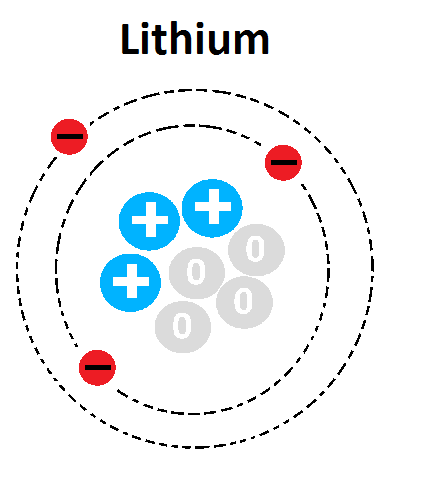
What is the mass number of this atom?
a)
1
b)
3
c)
4
d)
7
100.
What is the atomic number of this atom?
a)
2
b)
4
c)
6
d)
none of the above
101.
What group does this element belong to?
a)
Group 1: Alkali metals
b)
Group 18: Noble Gases
c)
Group 2: Alkaline-Earth Metals
d)
Group 17: Halogens
102.
What's a valence electron?
a)
electrons in the second energy level
b)
electrons in the outermost energy level
c)
the atomic number
d)
electrons in the first level
103.

On the periodic table, Periods are

a)

Horizontal rows

b)

Vertical columns

104.

The innermost energy level has a maximum of how many electrons?

a)

1

b)

2

c)

6

d)

8

105.

What is this element?

a)

Beryllium (atomic #4)

b)

Boron (atomic #5)

c)

Carbon (atomic #6)

d)

Nitrogen (atomic #7)

106.

How many valence electrons?

a)

2

b)

3

c)

4

d)

5

107.

What group does this element belong to?

a)

1

b)

2

c)

17

d)

18

108.

How many valence electrons?

a)

2

b)

4

c)

6

d)

8

109.

Which Bohr model represents Neon?

a)
b)
c)
d)
110.

Name the following

Ca3(PO4)2

a)

calcium phosphate

b)

calcium (III) phosphate

c)

tricalcium diphosphate

d)

calcium phosphide

111.
What is true about the valence electrons?
a)
electrons on the outermost ring
b)
electrons that are involved in bonding
c)
noble gasses have eight of them
d)
all answers are correct
112.

Which type of bond transfers electrons?

a)

ionic

b)

covalent

113.
Which of the following occurs as a monoatomic molecule?
a)
Chalcogens 
b)
Alkali metals
c)
Noble gasses
d)
Alkaline earth metals
114.
How many atoms of oxygen are in the chemical formula of Barium Phosphate?
a)
8
b)
4
c)
24
d)
16
115.
What type of bond shares electrons
a)
metallic
b)
ionic
c)
covalent
116.

How many total electrons does a sulfide ion have with a -2 charge?

a)

18

b)

16

c)

14

d)

10

117.
Give the chemical formula for oxygen tetrabromide
a)
0Br4
b)
O2Br6
c)
0Br2
d)
03Br6
118.
If Oxygen and Potassium bonded what type of bond would form?
a)
Organic
b)
Metallic
c)
Ionic
d)
Covalent
119.
What is commonly the center element in a trigonal planar VSEPR shape due to its 3 valence electrons?
a)
Boron
b)
Bromium
c)
Aluminum
d)
Gallium
120.
Determine the Roman numeral for Mn in the chemical formula below.  

MnS
a)
II
b)
VI
c)
V
d)
III
121.

Which of the following is not a diatomic molecule?

a)

Boron

b)

Hydrogen

c)

Nitrogen

d)

Chlorine

122.

What is the molecular formula of the following molecule?

a)

C4H8O2

b)

C2H4O2

c)

C4H4O2

d)

C1H2O

123.
What is the name of MgCl2
a)
Magnesium Dichloride
b)
Magnesium(II) Chloride
c)
Magnesium Chlorate
d)
Magnesium Chloride
124.
What is the chemical formula of Beryllium Iodide?
a)
BeI4
b)
BeI
c)
BeI2
d)
Be2I4
125.

Which label shows hydrogen bond in between water molecule?

a)

X

b)

Y

c)

Z

126.

CHECK ALL THAT APPLY:

Electronegative atoms that are often involved in Hydrogen Bonds.

a)

Nitrogen

b)

Carbon

c)

Oxygen

d)

Fluorine

e)

Calcium

127.

BaF2

a)

Barium (II) Fluoride

b)

Barium Fluorine

c)

Barium Fluoride

d)

Barium difluoride

128.
Ca+2, O-2
a)
CaO
b)
OCa
c)
Ca-2O+2
d)
Ca2O2
129.
Ca+2, O-2
a)
CaO
b)
OCa
c)
Ca-2O+2
d)
Ca2O2
130.
Ca+2P-3
a)
PCa
b)
P2Ca3
c)
CaP
d)
Ca3P2
131.
The correct chemical formula for magnesium phosphide is
a)
MgP
b)
Mg₂P₃
c)
Mg₃P₂
d)
Mg₃(PO₄)₂
132.
the starting materials in a chemical reaction
a)
Products
b)
Reactants
c)
Starters
d)
Enders
133.
a substance that is formed as the result of a chemical reaction
a)
Product 
b)
Reactant
c)
Starters
d)
Enders
134.
an atom or molecule which has gained or lost one or more of its valence electrons
a)
Covalent Bond
b)
Chemical Formula
c)
Ion
d)
Compound
135.
bond in which one or more electrons from one atom are removed and attached to another atom, resulting in positive and negative ions which attract each other
a)
Covalent Bond
b)
Ionic Bond
c)
Reaction Bond
d)
Null Bond
136.
The first part of a balanced chemical equation is shown:  H2SO4 + 2NaOH → ________.  In order for this equation to be balanced, how many hydrogen (H) atoms must be present in the products?
a)
2
b)
3
c)
4
d)
5
137.
A teacher writes the equation representing the chemical reaction between hydrochloric acid and sodium on the board.HCl + Na → NaCl + H2The teacher states that the equation has not been balanced. Which of these correctly shows the products of this reaction after the equation has been balanced?
a)
Na2Cl + H2
b)
 2NaCl + H2
c)
NaCl + 2H2
d)
 2NaCl + 2H2
138.
The following reaction is an example of a 4NH3(g) + 5O2(g) → 4NO(g) + 6H2O(g)(i) displacement reaction (ii) combination reaction (iii) redox reaction (iv) neutralisation reaction
a)
(i) and (iv)
b)
(ii) and (iii)
c)
(i) and (iii)
d)
(iii) and (iv)
139.
Which of the following statements about the given reaction are correct?3Fe(s) + 4H2O(g) → Fe3O4(s) + 4H2(g)(i) Iron metal is getting oxidised (ii) Water is getting reduced (iii) Water is acting as reducing agent (iv) Water is acting as oxidising agent
a)
(i), (ii) and (iii)
b)
(iii) and (iv)
c)
(i), (ii) and (iv)
d)
(ii) and (iv)
140.
Which among the following is(are) double displacement reaction(s)?(i) Pb + CuCl2 → PbCl2 + Cu (ii) Na2SO4 + BaCl2 → BaSO4 + 2NaCl (iii) C + O2 → CO2 (iv) CH4 + 2O2 → CO2 + 2H2O
a)
(i) and (iv)
b)
(ii) only
c)
(i) and (ii)
d)
(iii) and (iv)
141.
Electrolysis of water is a decomposition reaction. The mole ratio of hydrogen and oxygen gases liberated during electrolysis of water is
a)
(a) 1:1
b)
(b) 2:1
c)
(c) 4:1
d)
(d) 1:2
142.
Which of the following are combination reactions?(i) 2KClO3⎯Heat⎯→ 2KCl + 3O2 (ii) MgO + H2O ⎯→ Mg(OH)2 (iii) 4Al + 3O2 ⎯→ 2Al2 O3 (iv) Zn + FeSO4 → ZnSO4 + Fe
a)
(a) (i) and (iii)
b)
(b) (iii) and (iv)
c)
(c) (ii) and (iv)
d)
(d) (ii) and (iii)
143.
Which of the following reactions is balanced?
a)
2CH4 + O2 -> CO2 + H2O
b)
CH4 + 2O2 -> CO2 + H2O
c)
CH4 + 2O2 -> CO2 + 2H2O
d)
None of the chemical equations are balanced.
144.

Chemical formula of lime water is :

a)

CaO

b)

Ca(OH)2

c)

CaCO3

d)

CO2

145.

Silver article turns black when kept in open for a few days due to formation of

a)

H2S

b)

AgS

c)

AgSO4

d)

Ag2S

146.

The reaction in which two compound exchange their ions to form two new compounds is called

a)

displacement reaction

b)

combination reaction

c)

redox reaction

d)

double displacement reaction

147.

The chemical formula of lead sulphate is :

a)

Pb2SO4

b)

Pb(SO4)2

c)

PbSO4

d)

Pb2(SO4)3

148.

7.The equation

Cu + xHNO3 -> Cu(NO3)2 + yNO2 + 2H2O

The values of x and y are

a)

3 and 5

b)

8 and 6

c)

4 and 2

d)

7 and 1

149.

White silver chloride in sunlight turns to :

a)

Grey

b)

Yellow

c)

Remain white

d)

Red

150.

Heating of ferrous sulphate gives which of the following product?

a)

Ferric oxide

b)

Sulphur dioxide

c)

Sulphur trioxide

d)

All the above

151.

These are all models of the same molecule. What would this molecule look like in a chemical/molecular formula?

a)

CH

b)

C4H

c)

CH4

d)

4CH

152.
What coefficient should be used to make the following equation balanced?
N2+O2--> _NO 
a)
1
b)
2
c)
3
d)
4
153.

Which equation is balanced?

a)

PbO2 + 2H2

b)

SO2 + H20 --> H2SO4

c)

2Na + 2H2O --> 2NaOH + H2

154.
How many HCl molecules do you need to balance this equation? 
Mg +  __HCl --->  MgCl2 + H2
a)
1
b)
2
c)
3
d)
4
155.

What law governs the balancing of chemical equations?

a)

Law of Energy

b)

Law of Conservation of Matter/Mass

c)

Law of Gravity

d)

Law of Matter Movement

156.
What is the total number of atoms present in 5Na3PO4
a)
5
b)
40
c)
55
d)
8
157.

Balance this equation

_Al +_HCl --> _H2 +_AlCl3

a)

2,6,3,2

b)

it's already balanced

c)

4,12,3,4

d)

2,1,4,5

158.

What are the coefficients that would properly balance this equation?

__Ca + __H2O --> __Ca(OH)2 + __H2

a)

2,1 --> 2,1

b)

1,2 --> 1,1

c)

1,2 --> 2,4

d)

1,2 --> 2,1

159.
What is the right ratio of chemicals for the BCE (Balanced Chemical Equation)?__CO + __Fe2O3--> __Fe + __CO2
a)
3,1 --> 2,3
b)
3,2 --> 1,1
c)
3,2 --> 2,4
d)
3,2 --> 2,1
160.

What are the coefficients that would properly balance this equation?

__AgNO3 + __H2S --> __Ag2S+ __HNO3

a)

2,1 --> 1,2

b)

1,2 --> 1,1

c)

1,2 --> 1,2

d)

1,2 --> 2,1

161.

What are the coefficients that would properly balance this equation?

__H2 + __S --> __H2S

a)

1,1 --> 1

b)

2,2 --> 2

c)

1,2 --> 1

d)

1,2 --> 2

162.

What are the coefficients that would properly balance this equation?

__Al + __O2--> __Al2O3

a)

4,1 --> 2

b)

4,3 --> 4

c)

3,4 --> 1

d)

4,3 --> 2

163.
What is the total number of atoms present in 5Na3PO4
a)
5
b)
40
c)
55
d)
8
164.

Determine the coefficients to make the following equation balanced?

__N2 + __O2--> __NO

a)

1, 1, 1

b)

1, 1, 2

c)

2, 2, 2

d)

1, 2, 2

165.

Determine the coefficients to balance the equation.

__Al +__HCl --> __H2 +__AlCl3

a)

2,6,3,2

b)

it's already balanced

c)

4,12,3,4

d)

2,1,4,5

166.

Balance the the following equation.

__Zn+__HCl -->__ZnCl2 +__H2

a)

1,1,2,1

b)

1,1,1,2

c)

1,2,1,1

d)

2,1,1,1

167.
Which number should go in the blank?
Mn + _ HNO3 → Mn(NO3)2 + H2
a)
1
b)
2
c)
3
d)
0
168.
Which number should go in the blank?
Al(NO3)3 + _  NaOH -> Al(OH)3 + 3 NaNO3
a)
1
b)
2
c)
3
d)
0
169.
The numbers needed to balance the equation are:
a)
1, 1, 1, 2
b)
1, 1, 2, 2
c)
1, 1, 1, 1
d)
2, 3, 1, 3
170.
The numbers needed to balance the equation are:
a)
2, 7, 6, 4
b)
2, 1, 3, 2
c)
1, 1, 3, 2
d)
2, 3, 1, 3