
 Worksheets
Chemistry Fall 2021 Semester Review
Total questions: 60
Worksheet time: 41mins
Select all that apply:
When you are going to use a hot plate what should you do?
Check top for any cracks.
Check the cord and make sure there are no melted spots, cuts, or exposed wires.
Check for cracks in the bottom of the piece.
Check for damage to the glass bottom.
Select all that apply:
When you are going to use a piece of glassware what should you do?
Check for chips in the rim
Check for cracks in the rim and walls of the piece
Check for cracks in the bottom of the piece
Make sure it won't electrocute you.
Select all that apply:
If a laboratory fire erupts, immediately
notify your instructor.
run for the fire extinguisher.
throw water on the fire.
open the windows.
After completing an experiment, all chemical wastes should be
left at your lab station for the next class.
disposed of according to your instructor’s directions.
dumped in the sink.
taken home.

A pie graph allows you to easily see?
information about the parts related to the whole.
compare data from different categories
how much data occurs within a range of numbers.
Changes or trends over time.

A line graph chart allows you to easily see?
Changes or trends over time.
how much data occurs within a range of numbers.
compare data from different categories
information about the parts related to the whole.

A bar graph allows you to easily?
information about the parts related to the whole.
compare data from different categories
how much data occurs within a range of numbers.
Changes or trends over time.
The Independent Variable is represented on which Axis?

At what pH do these plants grow the worst?
6.0
6.5
6.8
7.2
Which two groups grew the most?
1 and 2
4 and 5
6 and 7
1 and 4
3 and 2

Read through the story below and answer the following question: What is the dependent variable of this experiment?
Plant A
Plant B
Number of Tomatoes
Music
Read through the story below and answer the following question: What is the independent variable of this experiment?
Plant A
Plant B
Number of Tomatoes
Music
What unit is used in science to represent mass?
Grams
Meters
Liters
Kalvin
What unit is used in science to represent length?
Grams
Meters
Liters
Kalvin
What unit is used in science to represent volume?
Grams
Meters
Liters
Kalvin
What are the four states of matter?
Solid
Liquid
Gas
Plasma
liquefaction
The relationship between the mass m of a material, its volume V, and its density D is
D = mV.
D = V/m.
D = m/V.
D = m + v.
If I have a sample of iron with a volume of 12 mL and the density of iron is 7.874 g/mL what is the mass of my sample?
94.488 g
0.6562 g
7.874 g
12 g
A sample of gold has a mass of 96.5 g and a volume of 5.00 mL. The density of gold is
0.0518 g/mL
19.3 g/mL
101.5 g/mL
483 g/mL
With a density of 19.1 g/mL what would be the volume of a 500 g sample of uranium?
26.18 mL
9550 mL
0.0382 mL
500 mL
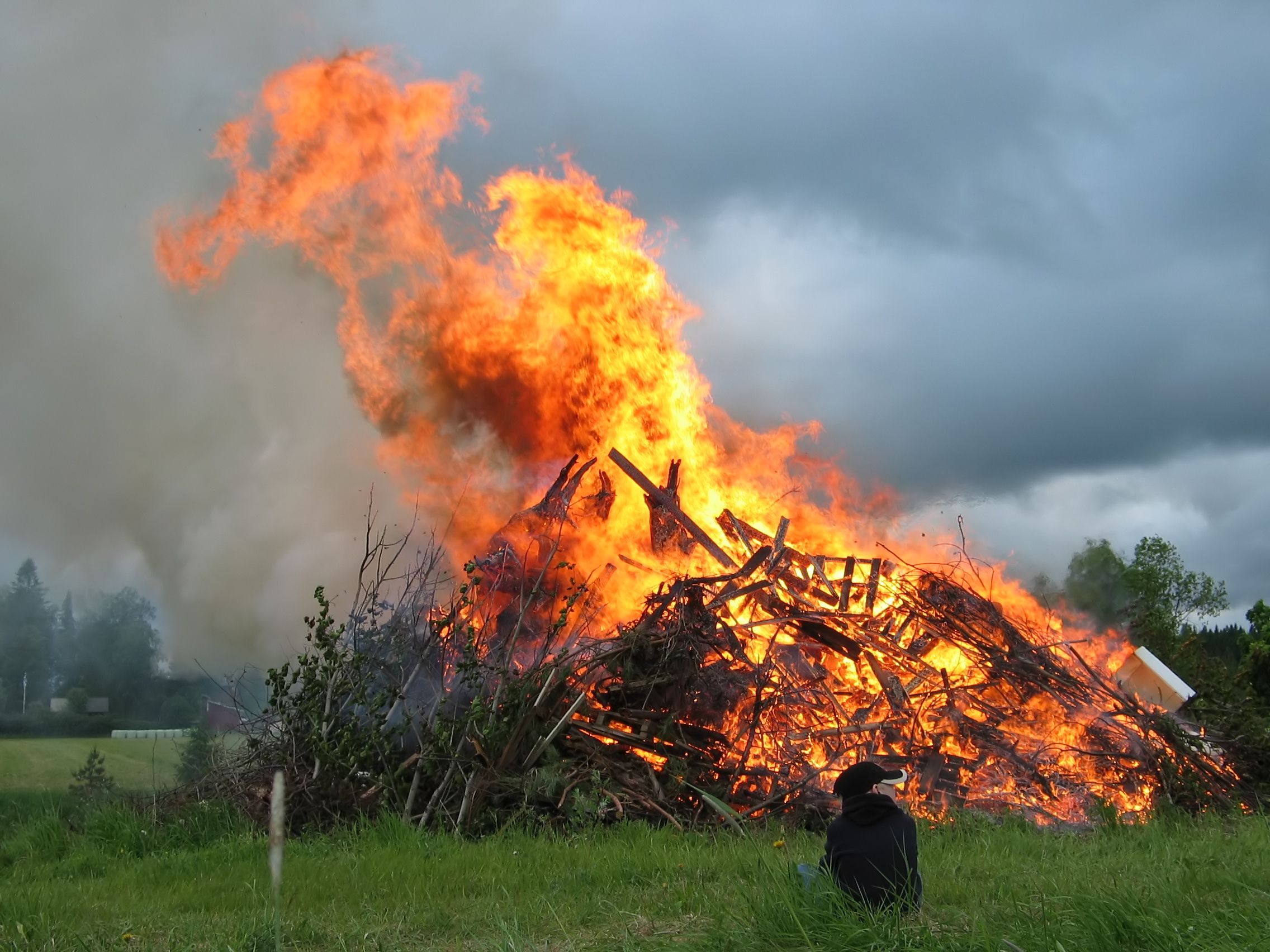
Water boils at 100˚C. What is this an example of?
Physical property
Chemical property
Physical change
Chemical change
Benzene is a compound that is highly flammable. What is this an example of?
Physical property
Chemical property
Physical change
Chemical change
Which best describes each state of matter in terms of volume and shape (check all that apply)
Solids have a definite volume and a definite shape
Liquids have a definite volume but no definite shape
Gases have no definite volume and no definite shape
Liquids have no definite volume and no definite shape
Solids have a definite volume but no definite shape
How would you express 555,000,000,000 in scientific notation?
5.55 x 10¹¹
555 x 109
5.55 x 10⁻¹¹
5.55 x 10⁹
How would you express 10,000 in scientific notation?
1 x 10⁵
1 x 10⁴
1 x 10³
1.0000
Express the following number in standard notation: 8.25e7
82,500,000
0.00000825
0.00082500
8,250,000,000
An atom is electrically neutral because
neutrons balance the protons and electrons.
nuclear forces stabilize the charges.
the numbers of protons and electrons are equal.
the numbers of protons and neutrons are equal.
An element has an atomic number of 53 and 52 neutrons. How would you write the name of this isotope?
Tellurium-105
Iodine-105
Tellurium-53
Iodine 105
A neutral Chlorine atom has an atomic number of 17 and a mass number of 35. How many protons, neutrons, and electrons does chlorine have?
17 of everything
17 Proton and Electrons, 18 Neutrons
18 Protons, 17 Electrons and Neutrons
17 Protons, 18 Electrons and Neutrons

What is the arrow pointing at?
Proton
Neutron
Electron
Gravaton

What is the arrow pointing at?
Proton
Neutron
Electron
Gravaton

What is the arrow pointing at?
Proton
Neutron
Electron
Gravaton
A _____ is a subatomic particle that has no charge and is located in the nucleus of the atom
Proton
Neutron
Electron
Graviton
What is an ion?
A type of chemical compound
An atom with a negative or positive charge
A type of chemical bond
Another name for a covalent bond
A _____ is a subatomic particle that has a positive charge and is located in the nucleus of the atom.
Proton
Neutron
Electron
Graviton
A _____ is a subatomic particle that has a negative charge and orbits around the nucleus of the atom.
Proton
Neutron
Electron
Graviton
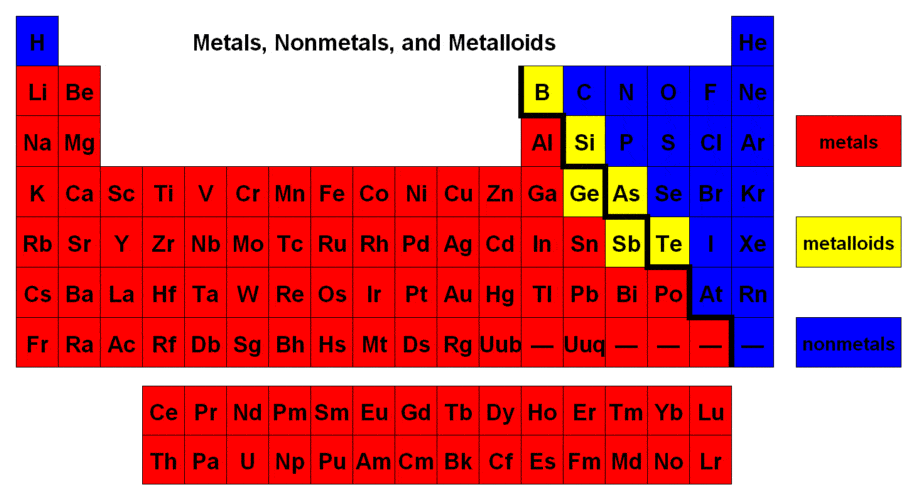
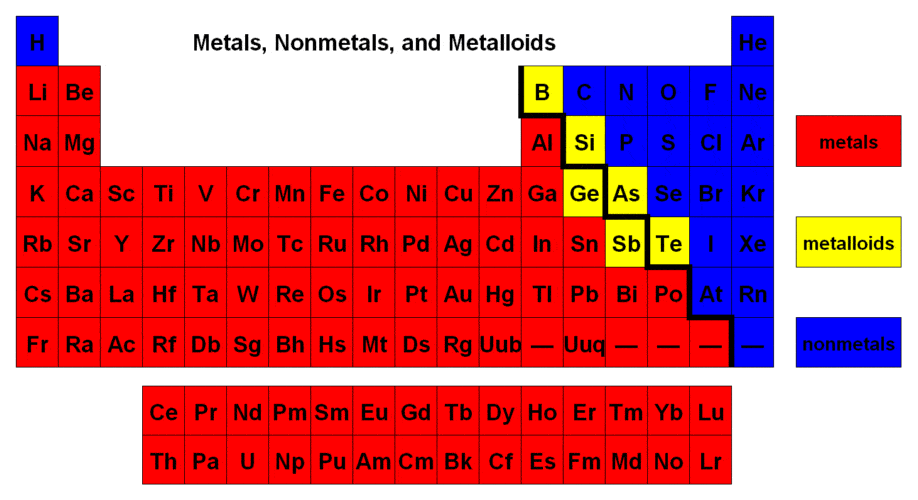
Nonmetals tend to ____ electrons and form _____ ions.
These are called __________.
Gain, negative, anions
Gain, positive, anions
Lose, negative, cations
Lose, positive, cations
Metals tend to ____ electrons and form _____ ions.
These are called __________.
Gain, negative, anions
Gain, positive, anions
Lose, negative, cations
Lose, positive, cations
According to the Octet Rule, atoms of elements react with each other in order to attain ____ electrons in their outermost energy level or shell.
2
4
6
8
10

This atom will
lose 2 electrons
gain 2 electrons
lose 6 electrons
gain 6 electrons
do nothing

What charge will this atom have when it satisfies the octet rule?
-3
+3
-5
+5
0
How many valence electrons does Calcium have?
How many valence electrons does carbon have?
6
4
What is the electronegativity difference between Chlorine and Sodium and what bond type do you predict will occur?
2.1, Ionic
-2.1, Ionic
2.1, Non-Polar Covalent
2.1, Polar Covalent
When will a bond form an ionic bond?
If the difference in electronegativity is 1.7 or greater
If the difference in electronegativity is between 0.5 and 1.6
If the difference in electronegativity is less than 0.5
When will a bond form a nonpolar covalent bond?
If the difference in electronegativity is 1.7 or greater
If the difference in electronegativity is between 0.5 and 1.6
If the difference in electronegativity is less than 0.5
When will a bond form a polar covalent bond?
If the difference in electronegativity is greater than 1.7
If the difference in electronegativity is between 0.5 and 1.6
If the difference in electronegativity is less than 0.5
Which of the following elements GAINS 1 electron in order to attain an octet?
potassium
fluorine
boron
helium
calcium
Which of the following elements LOSES 1 electron in order to attain an octet?
potassium
fluorine
boron
helium
calcium

