wayground logo

Free Printable Worksheets

Font size

S
M
L
XL
Worksheets

EOC Review

Total questions: 170

Worksheet time: 3hrs 32mins
Name
Class
Date
1.
Glucose is a _____.
a)
carbohydrate
b)
lipid
c)
protein 
d)
nucleic acid
2.
Proteins are composed of what smaller building blocks?
a)
amino acids
b)
nucleic acids
c)
fatty acids
d)
nucleotides
3.
Which group of organic molecules serve as long-term energy storage and make the cell membrane is?
a)
proteins
b)
carbohydrates
c)
lipids
d)
nucleic acids
4.
The primary purpose the body uses monosaccharides for is?
a)
Building muscles
b)
Helping the Immune System
c)
Immediate Energy
d)
Generating Heat
5.
Building blocks of polymers.
a)
monomer
b)
polypeptide
c)
monosaccharide
d)
glycerol
6.
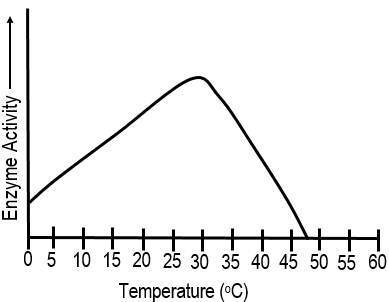
Based on the graph, what temperature does this enzyme work best? 
a)
15 C
b)
40 C
c)
30 C
7.
Which of the following binds to the active site of an enzyme? 
a)
substrate
b)
product
c)
codon
d)
none of the above
8.
What happens when enzymes are heated to a high temperature?
a)
The enzymes die.
b)
The shapes of the enzyme are altered or denatured
c)
The enzymes' amino acid sequence changes.
d)
The enzymes remain the same
9.
Letter C...
a)
active site
b)
enzymes
c)
substrate
d)
products
10.
Enzymes are _________ that __________ chemical reactions.
a)
proteins, slow down
b)
proteins, speed up
c)
lipids, slow down
d)
lipids, speed up
11.

Organelles where photosynthesis occurs, are green due to chlorophyll pigment found in them.

a)

Chloroplasts

b)

Cell Wall

c)

Cell Membrane

d)

Cytoplasm

12.
Where is the genetic material found in the cell? 
a)
Nucleolus
b)
Cytoplasm
c)
Nucleus
d)
Chloroplast
13.
What structure is in plant cells but not animal cells?
a)
Cell Membrane
b)
Mitochondria
c)
Cell Wall
d)
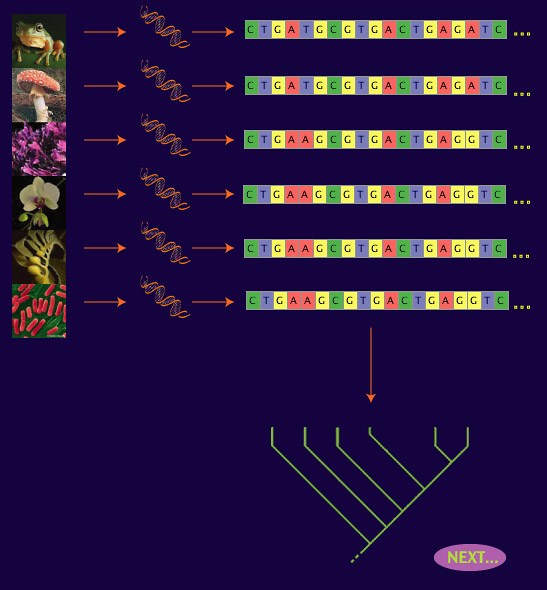
Vacuole
14.
Animal and Plant cells are both this type of cell.
a)
Eukaryote
b)
Prokaryote
15.
Identify letter H.
a)
nucleus
b)
mitochondria
c)
golgi complex
d)
cytoplasm
16.
When the concentration of particles inside of a cell is the same as the concentration of particles outside of the cell. 
a)
active transport
b)
concentration
c)
diffusion
d)
equilibrium
17.
The process where only water is allowed to pass through the cell membrane from a high to low concentration.
a)
meiosis
b)
respiration
c)
diffusion
d)
osmosis
18.
The movement of molecules from an area of high concentration to an area of low concentration.
a)
Osmosis
b)
Respiration
c)
Diffusion
d)
Active Transport
19.
Cells use energy to move materials across a membrane (low to high concentration).
a)
Active transport
b)
Passive transport
c)
Diffusion
d)
Osmosis
20.
Cells transport material across a cell membrane without using energy (high to low concentration)
a)
Passive transport
b)
Concentration
c)
Endocytosis
d)
Active Transport
21.
Particles are removed from a cell (pushed out).
a)
Endocytosis
b)
Exocytosis
c)
Permeable
d)
In high concentration
22.
A cell membrane has pores that allow certain materials to pass through. This is a type of cell membrane.
a)
Permeable
b)
In high concentration
c)
At equilibrium
d)
In low concentration
23.

What is the first source of energy for living things?

a)

food

b)

glucose

c)

the sun

d)

water

24.

What are the inputs (reactants) of photosynthesis?

a)

glucose and oxygen

b)

glucose and carbon dioxide

c)

carbon dioxide and oxygen

d)

carbon dioxide and water

25.

What are the outputs (products) of photosynthesis?

a)

carbon dioxide and water

b)

glucose and oxygen

c)

glucose and carbon dioxide

d)

water and oxygen

26.

What are the inputs (reactants) of cellular respiration?

a)

carbon dioxide and water

b)

glucose and water

c)

carbon dioxide and oxygen

d)

glucose and oxygen

27.

Where does cellular respiration take place?

a)

chloroplast

b)

lungs

c)

mitochondria

d)

nucleus

28.

What are the outputs (products) of cellular respiration?

a)

glucose, oxygen, and energy

b)

carbon dioxide, water, and energy

c)

water, oxygen, and glucose

d)

water and energy

29.

What is an autotroph?

a)

an organism that can makes its own food

b)

an organism that needs to consume food

c)

an organism that has absorbs food by diffusion

d)

all living organisms

30.

What is the purpose of cellular respiration?

a)

to convert sunlight to glucose

b)

to breathe in oxygen and breathe out carbon dioxide

c)

to have cells grow and develop

d)

to convert glucose to usable energy

31.
In RNA, Uracil pairs with ______. 
a)
cytosine
b)
adenine
c)
guanine
d)
thymine
32.
The process to go from DNA to mRNA is _______
a)
translation
b)
transcription
c)
replication
33.
The process to go from mRNA to a protein is called ____
a)
transcription
b)
rRNA
c)
replication
d)
translation
34.
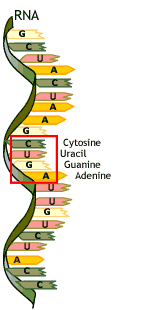
What process is going on in this photo? 
a)
Transcription 
b)
Translation 
c)
Replication 
d)
All the above 
35.
What is the location in the cell for translation?
a)
nucleus
b)
mitochondria
c)
ribosome
d)
chloroplast
36.
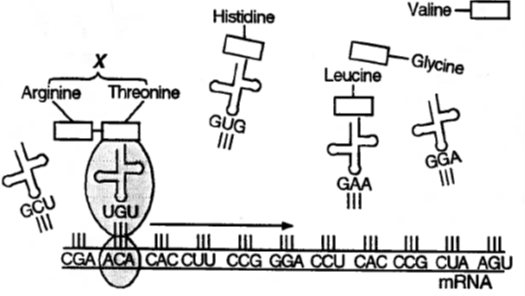
How many amino acids are coded for by this sequence of nucleotides:
ATG GGA ACT CCA
a)
4
b)
2
c)
6
d)
12
37.
What is the three base sequence of mRNA that codes for a single amino acid?
a)
Anticodon
b)
Codon
c)
Protein
38.
Which statement is describing the process of protein synthesis?
a)
DNA is copied into mRNA which is translated into protein
b)
DNA is copied into DNA
c)
DNA is copied into lysosome
39.
DNA sequence ACCTG produces which mRNA strand? 
a)
UGGAC
b)
TGGAC
c)
GTCCA
40.
A new organism is produced from one parent organism.
a)
Sexual Reproduction
b)
Asexual Reproduction
41.
How many chromosomes does a human cell have?
a)
42
b)
46
c)
24
d)
64
42.
How many daughter cells are produced in mitosis?
a)
1
b)
2
c)
4
d)
6
43.

Reproducing asexually will produce offspring ...

a)

genetically different from each other

b)

genetically identical to the parent

44.
What is a disadvantage of asexual reproduction?
a)
New species of organisms cannot come into being.
b)
The offspring does not multiply rapidly.
c)
The offspring does not live for long.
d)
All of these
45.
When a starfish grows a new body off a broken arm, what kind of reproduction is this?
a)
Sexual
b)
Differentiation
c)
Asexual 
d)
Specialization
46.
Which process and type of resulting cells are represented?
a)
mitosis, gametes
b)
mitosis, body cells
c)
meiosis, gametes
d)
meiosis, body cells
47.
The chromosomes that pair up during meiosis, are called __________ chromosomes.  
a)
homozygous 
b)
asexual
c)
homologous
d)
genes
48.
A male shark has 40 chromosomes in each of its sex cells. How many would be present in its body cells?
a)
20
b)
40
c)
80
d)
160
49.
Which letter(s) in the diagram correspond to cells that are haploid? 
a)
A
b)
B
c)
C
d)
A and B
50.
Compared to the number of chromosomes contained in a body cell, how many chromosomes would normally be contained in a gamete?
a)
The same number
b)
One-fourth as many
c)
Twice as many
d)
Half as many
51.
What causes genetic variation in meiosis?
a)
chromosomes lining up
b)
crossing over of chromosomes
c)
separation of chromosomes
d)
chromosomes pulling apart
52.
What is one of the advantages, why is it better to reproduce sexually versus asexually?
a)
survival of the fittest
b)
overproduction
c)
genetic variation
d)
cloning
53.
What do experts say is the most common form of Down Syndrome?
a)
Trisomy 47
b)
Trisomy 46
c)
Trisomy 21
d)
Trisomy 23
54.
Females have ____ and males have _____ chromosomes.
a)
XX, XY
b)
XY, XX
c)
XX, XX
d)
XY, XY
55.
What is this?
a)
Trisomy 13
b)
Monosomy 21
c)
47, XXY
d)
Trisomy 21
56.
Diploid Cells are represented by
a)
2n
b)
n
c)
4n
d)
1/2 n
57.
Diploid Cells are represented by
a)
2n
b)
n
c)
4n
d)
1/2 n
58.
A homozygous dominant dog with brown fur is crossed with a heterozygous dog with brown fur. What are the percentages of the possible genotypes?
a)
100% BB
b)
75% BB and 25%Bb
c)
50 % BB and 50% Bb
d)
50% Bb and 50% bb
59.
What law states that in Tt the person will only show the dominant allele
a)
law of segregation
b)
law of independent assortment
c)
law of dominance
d)
law of punnett squares
60.
Genotype refers to the ...
a)
physical expression of the genes
b)
the possible combination of alleles in a gene
c)
whether an allele is dominant or recessive
d)
how an organism will appear
61.
An offspring will receive how many alleles from each parent to determine a specific trait?
a)
one
b)
two
c)
three
d)
five
62.
Which of the following is a phenotype?
a)
BB
b)
Bb
c)
bb
d)
Blue eyes
63.
having two of the same genes for the trait (sometimes called purebred).
a)
homozygous
b)
hetrozygous
c)
protein
d)
chromosome
64.
having two different genes for a trait (sometimes called hybrid).
a)
protein
b)
homozygous
c)
heterozygous
d)
genotype
65.
An allele whose trait only shows up when no dominant allele is present.
a)
hidden allele
b)
dominant allele
c)
recessive allele
d)
present allele
66.
What type of solution is this cell in?
a)
Isotonic
b)
Hypertonic
c)
Hypotonic
d)
diffused
67.
What type of solution is this cell in?
a)
Isotonic
b)
Hypertonic
c)
Hypotonic
d)
diffused
68.

Which Type of solution is the middle cell placed in?

a)

Hypertonic

b)

Hypotonic

c)

Isotonic

d)

Robotonic

69.

Which molecule is in equilibrium? How can you tell?

a)

Molecule A; equal amounts inside and outside

b)

Molecule B; passive movement into the cell

c)

Molecule C; equal amounts inside and outside

d)

Molecule C; all molecules are inside the cell

70.

The concentration of red molecules outside the cell is higher than the concentration inside the cell. The red molecules cannot penetrate the cell. The cell is inside a ______.

a)

hypotonic solution

b)

hypertonic solution

71.

What happens if a population grows past its carrying capacity?

a)

The population keeps growing

b)

The population starts to die off

c)

The entire species will go extinct

d)

The carrying capacity just increases

72.

Temperature, light, air, water, and soil are all _____ parts of the environment

a)

alive

b)

biotic

c)

abiotic

d)

living

73.

What is an example of a biotic factor?

a)

skunk

b)

rocks

c)

soil

d)

water

74.

What does biodiversity mean?

a)

Only one species in an area.

b)

The different amount of species in an area

c)

All abiotic life

d)

Nitrogen fixation

75.

A population is...

a)

A group of one species in one area

b)

Multiple species that live in one area

c)

All of the living and nonliving things in an area

d)

None of these

76.

The job or role of a plant or an animal in the ecosystem.

a)

carnivore

b)

niche

c)

consumer

d)

habitat

77.

An animal that eats only plants.

a)

scavenger

b)

omnivore

c)

herbivore

d)

carnivore

78.

An animal that eats both plants and animals.

a)

carnivore

b)

omnivore

c)

herbivore

d)

scavenger

79.

An animal that eats only meat.

a)

herbivore

b)

omnivore

c)

carnivore

d)

scavenger

80.

All the green plants that provide the energy for consumers.

a)

consumers

b)

producers

c)

decomposers

d)

herbivores

81.

A diagram that shows the transfer of energy from one organism to another (who is eaten by what).

a)

ecosystem

b)

environment

c)

food chain

d)

food web

82.

A diagram that shows the transfer of energy in an ecosystem by using several food chains.

a)

ecosystem

b)

food web

c)

environment

d)

food chain

83.
The place where an organism lives is its __________.
a)
habitat
b)
ecosystem
c)
organism
d)
population
84.
All of the living AND non-living things in an area that interact with each other are called a/an __________.
a)
community
b)
habitat
c)
population
d)
ecosystem
85.
A group of different species that live together and interact in an environment are called a/an __________.
a)
community
b)
habitat
c)
population
d)
ecosystem
86.
ALL energy flow for an ecosystem begins with ...
a)
plants
b)
the moon
c)
the sun
d)
algae
87.
Which are located at the very BOTTOM of an energy pyramid? 
a)
producers
b)
consumers - Level 1
c)
consumers - Level 2
d)
decomposers
88.
A relationship where both organisms benefit is called __________.
a)
mutualism
b)
commensalism
c)
parasitism
89.
A relationship where one organism benefits and one organism is harmed is called __________.
a)
mutualism
b)
commensalism
c)
parasitism
90.
A relationship where one organism benefits and one organism is unaffected is called __________.
a)
mutualism
b)
commensalism
c)
parasitism
91.

What is binomial nomenclature?

a)

system of 3 names

b)

system of 2 names

c)

the names of the kingdoms

d)

the levels of classification

92.

Who created the 2 name system?

a)

Linnaeus

b)

Edison

c)

Darwin

d)

Einstein

93.

The 3 domains are Eukarya, Archaea, and

a)

Fungi

b)

Plantae

c)

Animalia

d)

Bacteria

94.

What two levels make up a scientific name?

a)

genus and order

b)

genus and species

c)

domain and kingdom

d)

family and genus

95.

What level comes after order?

a)

genus

b)

kingdom

c)

family

d)

species

96.

What level comes before class?

a)

phylum

b)

domain

c)

order

d)

family

97.

The _________ levels that 2 organisms share, the more similar they are to each other.

a)

fewer

b)

more

98.

The 4 eukaryote kingdoms are Animals, Plants, Fungi, and

a)

Bacteria

b)

Archaea

c)

Humans

d)

Protists

99.

All living things are made of

a)

cells

b)

prokaryotes

c)

autotrophs

d)

heterotrophs

100.

Scientists place organisms into domains and kingdoms based on cell type, number of cells, and

a)

if they are able to grow.

b)

if they drink water.

c)

if they have the ability to make food.

d)

if they are able to move.

101.

Where are bacteria found

a)

in very few places

b)

only in the air

c)

all over the place

d)

only in cow intestines

102.

Which of these is a fungus?

a)

bacteria

b)

mushroom

c)

algae

d)

seaweed

103.

What is the study of classification?

a)

taxonomy

b)

biology

c)

botany

d)

microbiology

104.

What is a prokaryote?

a)

an organism that has nuclei in its cells

b)

an autotroph

c)

a heterotroph

d)

an organism without a nucleus in its cells

105.

Which of these is a eukaryote?

a)

bacteria living in your digestive system

b)

archaea

c)

bacteria living in food

d)

mold

106.

What is the correct order of classification?

a)

kingdom, domain, phylum, class, order, family, genus, species

b)

domain, kingdom, phylum, class, order, family, genus, species

c)

domain, phylum, class, order, kingdom, family, genus, species

d)

species, genus, family, phylum, order, class, domain, kingdom

107.

What is the proper way to write a scientific name?

a)

Symbion pandora

b)

Symbion Pandora

c)

symbion Pandora

d)

symbion pandora

108.
You look at two species and see very similar DNA. What does this likely tell you?
a)
These are the same animal.
b)
These animals have a common ancestor.
c)
These animals are not likely related.
d)
These animals are likely becoming one species.
109.
____ is when members of a species that are best suited for their environment survive and reproduce at a higher rate than other members of the species
a)
natural selection
b)
artificial selection
c)
speciation
d)
adaptation
110.
What do the similar embryos of human and chickens tell us?
a)
We both use our bones for the same things, leading to similar structures.
b)
They had a common ancestor.
c)
Humans are descendants of wolves.
d)
It is impossible to tell.
111.
Do organisms "decide" to adapt?
a)
Yes, if they don't adapt they will die
b)
No, they can't adapt.  They either have adaptations or they don't
c)
No, they adapt by random mutations during their lifetime
d)
Yes, they can force mutations in one lifetime
112.
In humans, the pelvis and femur, or thigh bone, are involved in walking. In whales, the pelvis and femur shown are
a)

examples of fossils

b)

acquired traits

c)

examples of natural variations

d)

vestigial structures

113.
An adaptation is
a)
how animals change over time.
b)
a characteristic that helps an organism survive and reproduce
c)
a theory of how organisms change.
d)
the genes in an organism that determine how an organism is going to look.
114.
The differences among a species, like different bird beaks, are called
a)
genes.
b)
variations.
c)
advantages.
d)
theories.
115.
Which two organisms are the most closely related according to their DNA sequence?
Critter A--> ATG CTT AAC CCG TTA
Critter B--> ATC CTT TTC CCG TAA
Critter C--> ATG CTA TAG GCG TAA
a)
Critter A and B
b)
Critter A and C
c)
Critter B and C
d)
They are all equally related
116.
What causes a species to evolve over time?
a)
Extinctions
b)
Inherited genetic variations and mutations
c)
The cycle of the moon
d)
Environmental changes.
117.
Antibiotics are frequently given to humans that have strep throat. Why might this practice be considered a problem?
a)
Antibiotics will have more side effects
b)
The human body can metabolize the antibiotic to quickly, not allowing the antibiotic to reach the bacteria.
c)
A mutation can occur in the bacteria making it resistant to the antibiotic.
d)
Nothing will happen. It takes thousands of years for bacteria to evolve and become antibiotic resistant.
118.
Individuals who are considered fit, have:
a)
Stronger genes
b)
Fewer mutations
c)
More food
d)
More offspring
119.
The ability of an organism to survive and reproduce is known as...
a)
Adaptation
b)
Trait
c)
Fitness
d)
Variation
120.

Which of the following is considered a behavioral adaptation?

a)

Wolves hunting in packs

b)

Long trunks of elephants

c)

Birds wings that allow them to fly

d)

The white underbelly of a shark

121.
Which of the following means "genetic change in a population over time"
a)
natural selection
b)
speciation
c)
evolution
d)
fitness
122.
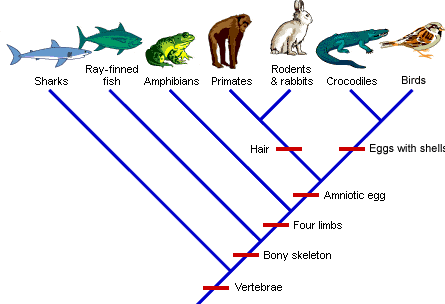
According to this cladogram, sharks are MOST closely related to which organism? 
a)
Amphibians
b)
Ray finned fish
c)
Crocodiles
d)
Birds
123.
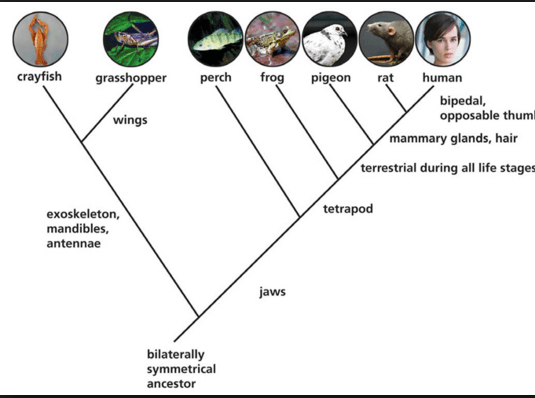
According to the cladogram, which organism is most distantly related to the human?
a)
crayfish
b)
grasshopper
c)
perch
d)
frog
124.

Evolution typically happens.....

a)

in a few weeks

b)

never

c)

over millions of years

d)

in 100 years

125.

A human’s arms, a cat’s front leg, a dolphin’s front flipper, and a bat’s wing

a)

have bones that are alike

b)

used in the same way

c)

share many similarities with insect wings and jellyfish tentacles

d)

have nothing in common

126.

Gradualism means Natural Selection would normally happen over many generations and very ____________

a)

slowly

b)

in space

c)

quickly

d)

beyond time

127.

The peppered moth’s color camouflaged it on the light colored tree bark. It’s color was an example of a(n)

a)

variation

b)

recessive trait

c)

dominant trait

d)

adaptation

128.

Why might it be helpful for a species to have a lot of variations?

a)

They can't be seen by predators

b)

It is helpful in asexual reproduction

c)

If the environment changes, they might be better able to adapt

d)

They don't recognize each other

129.

The Galapagos finch species are an excellent example of

a)

speciation

b)

genetic equilibrium

c)

stabilizing selection

d)

selection on a single trait

130.

Populations will be changed by genetic drift

a)

when change is by chance

b)

when populations are small.

c)

when populations are isolated.

d)

all other answers are correct

131.

What type of selection is pictured?

a)

directional selection

b)

stabilizing selection

c)

disruptive selection

d)

behavioral selection

132.

What type of selection is pictured?

a)

directional selection

b)

stabilizing selection

c)

disruptive selection

d)

behavioral selection

133.

What type of selection is pictured?

a)

directional selection

b)

stabilizing selection

c)

disruptive selection

d)

behavioral selection

134.

Which of the following statements best explains the similarity between the bone structures in the structures in the picture?

a)

All organisms evolve following the same basic pattern.

b)

All animal parts used for motion evolve in the same way.

c)

All animals evolved from a common ancestor.

d)

Organisms that flew evolved into organisms that swim.

135.

What pieces of evidence support the claims of Evolution?

a)

Homologous Structures

b)

Genetics

c)

Fossils

d)

Embryology

e)

Phrenology

136.

Which layer is the youngest or most recent?

a)
1
b)
2
c)
3
d)
4
137.
Study of embryos of various organisms to show a common ancestor because of similarities in development
a)
natural selection
b)
embryology
c)
speciation
d)
evolution
138.

In a cold environment what would be some adaptive traits? Sellect all that apply.

a)

thick blubber

b)

thick fur

c)

thin fur

d)

strong muscles

139.

Analogous structures are

a)

anatomically similar with similar functions

b)

anatomically different with similar functions

c)

anatomically similar with different functions

d)

do not exist in animals

140.

What is natural selection?

a)

when humans decide which organisms can breed

b)

when organisms that are better adapted to survive in their environment survive more and reproduce

c)

survival of the physically strongest organisms

d)

when animals survive predators by camouflaging
141.
Two organisms that are closely related would have
a)
very similar DNA sequence
b)
exactly the same DNA sequences
c)
no proteins in common
d)
completely different DNA sequence
142.
____ made from bacteria is (are) used to help control blood sugar in people with diabetes.
a)
Genes
b)
Insulin
c)
DNA
d)
Cells
143.

Which of the following is used to cut DNA from organisms?

a)

Gel Electrophoresis

b)

Restriction Enzymes

c)

Karyotypes

d)

Haplotypes

144.

A DNA molecule produced by combining DNA from different sources is called?

a)

Mutant DNA

b)

Polyploid DNA

c)

Diploid DNA

d)

Recombinant DNA

145.

A genetically engineered organism that contains a new gene from a different organism is called?

a)

Bacterial

b)

Genetic

c)

Transgenic

d)

Multigenic

146.

Two llamas are produced with the exact same DNA in a science lab. What is this known as?

a)

Stem Cell Therapy

b)

Genetically Modified Organisms

c)

Cloning

d)

Gene Therapy

147.

What is gene therapy?

a)

Inserting copies of a healthy gene directly into cells with a mutated gene

b)

Producing organisms with identical copies of DNA

c)

Crossing two individuals that have similar desirable characteristics or traits

d)

Crossing two individuals that have different characteristics or traits

148.

When genes from one organism are inserted into the genes of another organism that is know as...

a)

Stem Cell Therapy

b)

Genetic Engineering

c)

Cloning

d)

Selective Breeding

149.

If scientists engineer the DNA of tomatoes to make them survive in cold temperatures, what do type of technology do those tomatoes become?

a)

Human Genome Project

b)

Genetically Modified Organisms

c)

Punnett Squares

d)

Gene Therapy

150.

Which type of cell can become any type of cells? (also known as a "blank" cell)

a)

Adult stem cells

b)

Ovum cell

c)

Embryonic stem cells

d)

Heart cell

151.

What are the two types of stem cells?

a)

Adult cells and somatic cells

b)

Embryonic cells and brain cells

c)

Adult cells and embryonic cells

d)

Embryonic cells and teens cells

152.

What would be a positive reason to genetically alter Fraser Fir trees in North Carolina to make them more resistant to rot?

a)

By producing crops that are frost resistant

b)

By making robots to replace large farm machines

c)

The population of fir trees would increase and grow healthier.

d)

By increasing the use of wind farms that produce electricity

153.

In what way is biotechnology useful to law enforcement agencies such as the police or FBI?

a)

It can help identify who was present at the scene of a crime.

b)

It can help undercover officers disguise themselves.

c)

It might help determine who might be the victime of a future crime.

d)

It can help determine who is most likely to become a criminal in the future.

154.

How can agricultural biotechnology have a positive impact on the environment?

a)

By developing crops that are pest resistant requiring fewer pesticides to be used. 

b)

planting crops in shaded areas.

c)

Harvesting crops that have thick stems and leaves.

d)

water crops with a recycled irrigation system.

155.

How can using genetically engineered crops impact North Carolina’s economy?

a)

Improve quality of farm equipment.

b)

Decreased availability of productive land.

c)

Decreased food production and more debt for farmers.

d)

Increased food production and income for the farmers.

156.

Scientists implant a gene into a species of tomato plant that makes them ripen faster and stay firm as they are transported to stores. What is the benefit of this technology?

a)

Increased toxins in the food.

b)

Increase shelf life and availablity.

c)

Decreased size of tomatoes.

d)

Increased seed production

157.

What are some examples of biotechnology being used in agriculture?

a)

Crop irrigation

b)

DNA fingerprinting

c)

Gentically modified crops

d)

Crop rotation

158.

What would be a negative side of genetically modified foods?

a)

Lower cost of production.

b)

Long-term health effects, such as possible allergies to proteins not found in foods before GMO’s.

c)

Ability to produce more food in less time.

d)

Ability to grow more nutritious food in less time.

159.

What would increase the money made by farmers in North Carolina through biotechnology?

a)

Tomatoes that are different in color.

b)

Tomatoes that are smaller.

c)

Tomatoes that taste the same.

d)

Tomatoes that are resistant to disease.

160.

Rice does not provide enough of certain vitamins. How could biotechnology be used to change this?

a)

Using a high nitrogen fertilzer.

b)

Using herbicide to get rid of weeds.

c)

Genetic modification of rice plants that are pest resistant and to produce vitamins they cannot make without biotechnology

d)

Using pesticide to get rid of pests that can harm the crop.

161.

What would be a direct benefit of biotechnology to agriculture in a time of severe drought?

a)

Planting crops in shaded areas.

b)

Genetically modifying crops to be resistant to changes in weather

c)

Harvesting crops to have thick stems and leaves.

162.

Which kitten is most likely the offspring of this cat?

a)

1

b)

2

c)

3

d)

4

163.

Which of the following best describes "restriction enzymes?"

a)

Enzymes that cut DNA

b)

Enzymes that build DNA

c)

Enzymes that dissolve DNA

d)

Enzymes that turn DNA into RNA

164.

Which of the following best describes "gel electrophoresis?"

a)

A tool for separating chunks of DNA

b)

A tool for editing someone's genes

c)

A tool for adding genes from a new species into an organism's DNA

d)

Copying DNA to make an identical organism

165.
Who is the father?
a)
Dad 1
b)
Dad 2
c)
Dad 3 
d)
can not be determined
166.
 This diagram shows the DNA fingerprints of a common ancestor of Deer Species. Which deer species is most related to the common ancestor
a)
2
b)
3
c)
4
167.
Mr. Jones was killed in a car accident.  Afterwards, a former girlfriend filed a paternity suit claiming that Mr. Jones was the father of her child, and thus she was entitled to the man’s estate.  Which sample of DNA would have to be from Mr. Jones if he were the child’s father? 
a)
2
b)
3
c)
4
d)
5
168.
Another name for GMO (Genetically Modified Organsim) is ____________.
a)
Transgenic
b)
Transplanted
c)
Transducted
d)
Plasmid
169.
Why do farmers choose to use GM crops rather than regular crops?
a)
They are safer
b)
They are more productive
c)
They are less expensive
d)
They are less controversial
170.
What is 1 significant issue with many Genetically Modified Organisms?
a)
They are too expensive to be useful
b)
Take a long time to make
c)
May affect other organisms in their environment
d)
Might evolve more quickly