wayground logo

Free Printable Worksheets

Font size

S
M
L
XL
Worksheets

Semester 1 Final Exam Review 2

Total questions: 61

Worksheet time: 57mins

Name
Class
Date
1.
Which of the following is a true statement about work?
a)
It measures how quickly an object accelerates 
b)
It measures how much effort is applied over a certain distance
c)
It measures the change in an object's rate of speed
d)
It measures how much time it takes to move a massive object
2.
What does one newton exerted over a distance of one meter equal?
a)
One watt
b)
One hertz
c)
One volt 
d)
One joule 
3.
A kid applies a force of 70 N to a ball over 1.1 meters. How much work did he do on the ball? 
a)
77 J
b)
7.7 J 
c)
0.7 J 
d)
770 J 
4.
A weightlifter lifts two 300 newton weights 1.5 meters off the ground. How much work has he done?
a)
600 J 
b)
660 J
c)
900 J 
d)
1200 J 
5.
Which of these is a measure of force?
a)
100 newtons
b)
100 meters per second
c)
100 joules
d)
100 watts
6.
You move a 12-newton box up a 6-meter ramp. In order to find out how much power you created, what would you need to know?
a)
The mass of the box
b)
The slope of the ramp 
c)
The direction the box moved
d)
How long the task took
7.
You do 90 joules of work in 30 seconds. How much power have you generated?
a)
30 watts
b)
3 watts
c)
120 watts
d)
270 watts
8.
You move an 8-newton weight five meters in 4 seconds. How much power have you generated?
a)
160 watts
b)
10 watts
c)
6.4 watts
d)
17 watts
9.
Which of the following would produce the most power?
a)
A mass of 10 kilograms lifted 10 meters in 10 seconds 
b)
A mass of 10 kilograms lifted 10 meters in 5 seconds
c)
A mass of 5 kilograms lifted 10 meters in 5 seconds
d)
A mass of 5 kilograms lifted 5 meters in 10 seconds
10.
Work divided by time equals...
a)
energy
b)
power
11.
The unit of work is the ...
a)
joule
b)
force
12.
The unit of power is the...
a)
work
b)
watt
13.
Force multiplied by distance equals...
a)
work
b)
power
14.
Work is done on an object when the object moves in the SAME direction in which the force is applied.
a)
True
b)
False
15.
The FARTHER you move an object, the more work you do.
a)
True
b)
False
16.
The more POWER you use to move an object, the more work you do. 
a)
True
b)
False
17.
If you lift a box from the floor to a height of 1m and then carry the for for 10m, you do work only when you CARRY the box.
a)
True
b)
False
18.
Power is the RATE at which work is done. 
a)
True
b)
False
19.

What is needed to calculate work?

a)

force

b)

distance

c)

time

d)

mass

20.
Power is the RATE at which work is done. 
a)
True
b)
False
21.

What is needed to calculate work?

a)

force

b)

distance

c)

time

d)

mass

22.
GRAVITATIONAL POTENTIAL ENERGY DEPENDS ON
a)
MASS AND VELOCITY
b)
MASS AND WEIGHT
c)
WEIGHT AND HEIGHT
d)
HEIGHT AND DISTANCE
23.
WHICH OF THE FOLLOWING IS NOT AN EXAMPLE OF POTENTIAL ENERGY?
a)
A BALL TRAVELING AT 10 M/S
b)
A COMPRESSED SPRING
c)
WATER BEING STORED AT A WATER DAM
d)
A STRETCHED RUBBER BAND
24.
WHEN AN ARCHER BENDS A BOW, WHAT TYPE OF ENERGY INCREASES IN THE BOW?
a)
GRAVITATIONAL
b)
ELASTIC
c)
KINETIC
d)
THERMAL
25.
WHICH OF THESE DESCRIBES THE LAW OF CONSERVATION OF ENERGY?
a)
NO MACHINE IS 100% EFFICIENT
b)
ENERGY IS NEITHER CREATED OR DESTROYED
c)
THE ENERGY RESOURCES OF EARTH ARE LIMITED
d)
THE ENERGY OF A SYSTEM IS ALWAYS DECREASING
26.
AS A ROLLER COASTER MOVES DOWN A HILL, POTENTIAL ENERGY IS CONVERTED INTO KINETIC ENERGY, THERMAL ENERGY, AND SOUND ENERGY. WHAT IS TRUE ABOUT THE TOTAL ENERGY OF THIS SYSTEM?
a)
ENERGY IS GAINED (CREATED) AS THE ROLLER COASTER MOVES
b)
ENERGY IS LOST (DESTROYED) AS THE ROLLER COASTER MOVES
c)
THE TOTAL ENERGY REMAINS THE SAME AS THE ROLLER COASTER MOVES
d)
THE TOTAL ENERGY CONSTANTLY CHANGES AS THE ROLLER COASTER MOVES
27.
SAM STUDIED KINETIC AND POTENTIAL ENERGY BY OBSERVING APPLES HANGING ON A TREE DURING A FIELD INVESTIGATION. WHAT TYPE OF ENERGY DO THE APPLES HAVE?
a)
KINETIC
b)
MECHANICAL
c)
GRAVITATIONAL
d)
ELASTIC
28.

1. As an object falls, what happens to its gravitational energy?

a)

Increases

b)

Decreases

c)

Stays the same

d)

Need more information.

29.

1. As an object falls, what happens to its kinetic energy?

a)

Increases

b)

Decreases

c)

Stays the same.

d)

Need more information

30.

Select all the factors that influence the amount of elastic energy an object has.

a)

Mass

b)

Stretching

c)

Compression

d)

Elastic Constant

31.

Select the factors that influence how much kinetic energy an object has.

a)

Mass

b)

Speed

c)

Height

d)

Length

32.

Select the factors that influence how much gravitational energy an object has.

a)

Mass

b)

Speed

c)

Height

d)

Length

33.

When a bouncing ball hits the ground and squishes, what is the main type of energy that it has because of the deformation?

a)

Kinetic

b)

Gravitational

c)

Elastic

d)

Chemical

34.

Which type of energy conversion is involved when the ball leaves the ground?

a)

Kinetic to gravitational

b)

Gravitational to kinetic

c)

Elastic to kinetic

d)

Kinetic to elastic

35.

True or False: When a pendulum swings, gravitational energy converts into kinetic.

a)

True

b)

False

36.
Which type of energy increases when you compress a spring?
a)
elastic potential energy
b)
kinetic energy
c)
radiant energy
d)
sound energy
37.

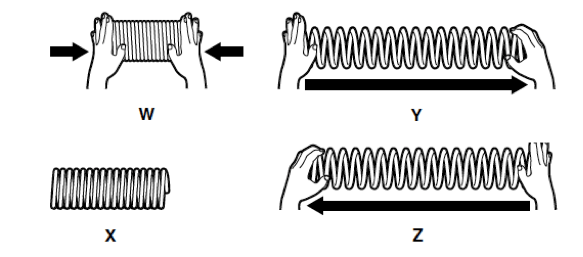
Elastic potential energy is energy stored in an object, such as a spring, due to the object being stretched or compressed. In which position is it most likely that the spring has lost its elastic potential energy?

a)

W

b)

Y

c)

X

d)

Z

38.

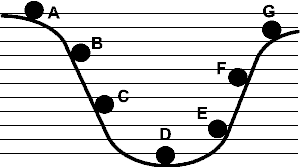
At which point does the ball has the greatest gravitational potential energy (GPE)?

a)

A

b)

G

c)

D

d)

C

e)

G

39.

Which would have the LEAST gravitational potential energy (GPE)?

a)

A ball sitting on the ground

b)

Moon viewed from the Earth

c)

An airplane flying 30,000 feet above the ground

d)

A rock sitting on top of Mt. Everest

40.

How could you increase the gravitational potential energy of an object without changing its mass and gravity?

a)

Make the object larger

b)

Lower the object towards the ground

c)

Raise the object farther off the ground

d)

Allow the object to roll on the ground
41.

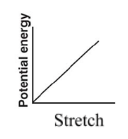
What potential energy is this graph representing?

a)

Electric

b)

Elastic

c)

Magnetic

d)

Gravitational

42.
Calculate the KE of a moving 4 kilogram object traveling at a velocity of 3 m/s.
a)
18 J
b)
36 J
c)
12 J
d)
6 J
43.

How much KE does a moving 6 kilogram object have if it moves with a velocity of 3 m/s?

a)

27 J

b)

18 J

c)

9 J

d)

2 J

44.
As mass increases, KE ...
a)
increases
b)
decreases
c)
stays the same
45.
As the velocity of an object decreases its KE will...
a)
increase
b)
decrease
c)
stay the same
46.
Which has a greater impact on KE?
a)
mass
b)
velocity
47.
Why is it harder to stop a four-person bobsled than a three-person bobsled?
a)
the four-person sled has more KE
b)
the four-person sled has less KE
48.
The Law of Conservation of Energy states that
a)
energy cannot be created nor destroyed, only transformed or transferred
b)
energy can be destroyed but not created
c)
energy can be created but not destroyed
49.
What is the metric unit for work?
a)
meter
b)
newton
c)
joule
d)
miles
50.
If 200 joules of work was done to move an object with a force of 50 newtons, how far was the object moved?
a)
2 meters 
b)
45 meters 
c)
4 meters 
d)
150 meters 
51.

A wave is basically

a)

a disturbance

b)

energy

c)

matter

d)

a phase change

52.

A wave transmits

a)

matter

b)

energy

c)

frequency

d)

plasma

53.

Choose the correct sentence.

a)

A mechanical wave requires a medium, such as air or water, but an electromagnetic wave does not.

b)

All waves require a medium.

54.

An earthquake, sound, and ocean waves are all types of

a)

mechanical waves

b)

electromagnetic waves

55.

Sound waves are

a)

transverse waves

b)

electromagnetic waves

c)

longitudinal waves

d)

latitudinal waves

56.

How many waves are shown in this picture

a)

3

b)

6

c)

2

d)

5

57.

Which of the following waves has the longest wavelength?

a)

radio waves

b)

microwaves

c)

infrared waves

d)

visible waves

e)

They all have the same wavelength

58.

Which of the following waves has the highest frequency?

a)

radio waves

b)

microwaves

c)

infrared waves

d)

visible waves

e)

They all have the same frequency

59.

If a wave had a frequency of 100 Hz and wavelength of 2 meters, what is its wavespeed?

a)

50 m/s

b)

200 m/s

c)

25 m/s

d)

400 m/s

60.

If a wave had a speed of 50 m/s and a frequency of 10 Hz, its wavelength would be

a)

10 m

b)

5 m

c)

500 m

d)

0.2 m

61.

Which sentence correctly describes the relationship between frequency and pitch.

a)

As frequency increases, pitch rises (goes higher)

b)

As frequency increase, pitch is lower.