Wayground logo

Free Printable Worksheets

Font size

S
M
L
XL
Worksheets

Biology Midterm Review

Total questions: 80

Worksheet time: 40mins

Name
Class
Date
1.
When experimenting with the growth of a plant, a scientist uses three (of the same type of) plants, two different fertilizers, equal light, and equal water. What type of variable is the fertilizer?
a)
Dependent
b)
Independent
c)
Control
d)
Compound
2.
What would the INDEPENDENT variable be in an experiment testing which types of paper airplane goes furthest?
a)
the paper used
b)
the type of paper airplane
c)
the distance of each plane's flight
d)
how hard the plane is thrown
3.
Which variable depends on what is done at the beginning of an experiment?
a)
Dependent
b)
Independent
c)
Control
d)
Following
4.
Research question: does the distance a person kicks a soccer ball effect how well they will do on their math test.  What is the dependent variable?
a)
How far they kick the soccer ball
b)
who the person is
c)
how well they do on the math test
d)
Type of soccer ball.
5.

What two words should be in your hypothesis?

a)

I think

b)

If ...then...

c)

It will

d)

No idea

6.

What variable comes after the word IF

a)

independent variable

b)

dependent variable

7.

What variable comes after the word then?

a)

independent variable

b)

dependent variable

8.

Which hypothesis is correctly written?

a)

I think I will do well on my test today, because I ate a good breakfast.

b)

If I eat a good breakfast, then I will do well on my test today.

c)

If I eat a good breakfast, then I will earn a passing grade on my test today.

d)

If I do well on my test today, I get to out to eat for breakfast.

9.

A hypothesis is never wrong.

a)

True

b)

False

10.

An element is determined by the number of ________ in its nucleus (also known as its atomic number).

a)

neutrons

b)

electrons

c)

protons

11.
The smallest particle of any particular type of matter is known by which of the following terms?
a)
Compound
b)
Atom
c)
Chemical
d)
Element
12.

What are the electrons of the "outer shell" of an element called?

a)

VALENCE ELECTRONS

b)

COMPOUND

c)

ELEMENT

13.
Is the density of water ice lower, higher, or the same as liquid water?
a)
Lower
b)
Higher
c)
The same
d)
Um... what is density again
14.

The most important element necessary for life that makes up EVERY macromolecule is:

a)

Hydrogen

b)

Nitrogen

c)

Carbon

d)

Oxygen

15.
Which macromolecule stores energy (long term), insulates us, and makes up the cell membrane?
a)
lipids
b)
proteins
c)
carbohydrates
d)
nucleic acids
16.
Animals, such as bears, that hibernate for long periods of time store most of their long term energy reserves as _______ because
a)
glucose; it is easy to break down.
b)
Lipid/fat; they store twice as much energy per gram
c)
protein; it is a compact source of energy in their bodies.
d)
carbohydrates; they store twice as much energy per gram of glucose.
17.
Which of the following organic compounds is the main source of energy for living things?
a)
carbohydrates
b)
lipids
c)
nucleic acids
d)
proteins
18.
The element _______is found in all of the organic compounds.
a)
Iron
b)
Nitrogen
c)
Carbon
d)
Oxygen
19.
Which of the following macromolecules is used in skin and muscle?
a)
carbohydrates
b)
lipids
c)
proteins
d)
nucleic acids
20.

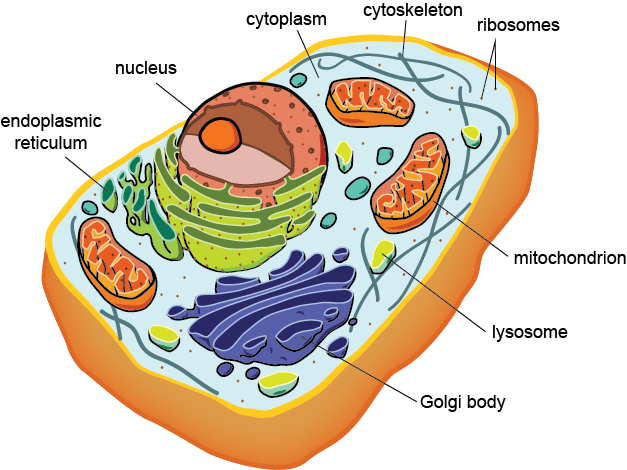
What part of the cell makes enzymes?

a)

lysosomes

b)

ribosomes

c)

chloroplasts

d)

golgi apparatus

21.

Cell membrane transport that occurs without energy is called--

a)

active transport

b)

endocytosis

c)

passive transport

d)

exocytosis

22.
What is the difference between active and passive transport?
a)
Active does not need energy and passive uses ATP (energy)
b)
Active uses ATP (energy) and passive does not need energy
c)
Active stores transport proteins and passive releases 
d)
Active uses hormones and passive does not 
23.
The function of the plasma membrane is....
a)
to regulate what enters and leaves the cell.
b)
fight bacteria and viruses that enter the cell.
c)
provide rigid support and protection to the cell.
d)
make sure each cell can move
24.
Most of the cell membrane is made of...
a)
Lipids
b)
Carbohydrates
c)
Proteins
d)
Nucleic acids
25.
My main goal is to produce a lot of ATP energy. 
a)
Chloroplast
b)
Mitochondria
26.
Contains digestive enzymes to break down worn out parts of the cell.
a)
vacuole
b)
lysosome
c)
ribosome
d)
nucleolus
27.

A whip-like tail that helps cells move is called

a)

cilia

b)

flagella

c)

pseudopodia

d)

feet

28.
Which of the following statements is not part of the cell theory?
a)
Cells are the basic unit of structure and function in all living things.
b)
All cells are produced from other cells.
c)
Only animal cells are composed of cells.
d)
All living things are composed of cells.
29.
Which statement reflects one of the major components of the cell theory?
a)
All living things are multi-cellular.
b)
Organs are the basic unit of structure and function for all living things.
c)
All cells come from previously existing cells.
d)
Every organism has a reproductive system to ensure survival of the species.
30.
Endocytosis is defined as
a)
the movement of large molecules from the inside of the cell to the outisde of the cell using channel proteins. 
b)
the movement of large molecules from the inside of the cell to the outisde of the cell membrane vesciles. 
c)
 the movement of large molecules from the outside of the cell to the inside of the cell using membrane vesciles.
d)
the movement of large molecules from the outside of the cell to the inside of the cell using channel proteins. 
31.
Exocytosis is the movement of
a)
any type of substance from outside the cell to the inside of the cell. 
b)
very large substances from outside the cell to the inside of the cell. 
c)
any type of substance from inside the cell to the outside.
d)
very large substances from inside the cell to the outside.
32.

What is it called when large molecules move across the cell membrane from an area of high concentration to an area of low concentration through a protein channel?

a)

Diffusion

b)

Osmosis

c)

Active Transport

d)

Facilitated Diffusion

33.
The genetic instructions are found in ---- within the DNA
a)
traits
b)
chromosomes
c)
genes
d)
DNA
34.
Prophase
a)
the nuclear membrane breaks apart and the spindle interacts with the chromosomes
b)
chromosomes condense and become visible
c)
chromosomes duplicate and remain attached
d)
chromosomes align in the middle of the spindle
35.

During what phase of Mitosis do the chromosomes line up in the Middle

a)

Metaphase

b)

Prophase

c)

Telophase

d)

Anaphase

36.
Interphase has 3 stages; G1, S, and G2.  What happens during synthesis?
a)
Cells grow and carry out normal functions
b)
Cells copy organelles and prepare for a critical checkpoint
c)
The cell splits into two new daughter cells
d)
The cell makes a copy of its DNA
37.
How does a virus cause a person to develop the common cold?
a)
invades the host cell to reproduce
b)
removes energy from the host cell
c)
produces toxins in the host cell
d)
protects the host cell from bacteria
38.
Any substance that is known to cause cancer is called a
a)
carcinogen
b)
nicolyte
c)
pathogen
d)
retrovirus
39.
Metastasis is
a)
the spread of cancer from one part of the body to another.
b)
the growth of tumors in the lungs
c)
cancer of the blood cells
d)
cancer that is found in connective tissues
40.
In order for a tumor to be cancerous to must ...
a)
Be benign
b)
Be malignant and metastasize
c)
Be malignant and not metastasize
d)
Be benign and spread to parts of the body
41.

Which type of tumor is being described:


Slow growing Not dangerous Does not spread

a)

Malignant

b)

Benign

42.

If there are 20 chromosomes in the nucleus before mitosis how many will there be in each new daughter cell after cytokinesis?

a)

20

b)

10

c)

40

d)

200

43.
Enzymes are...
a)
nucleic acids
b)
proteins
c)
lipids
d)
carbohydrates
44.

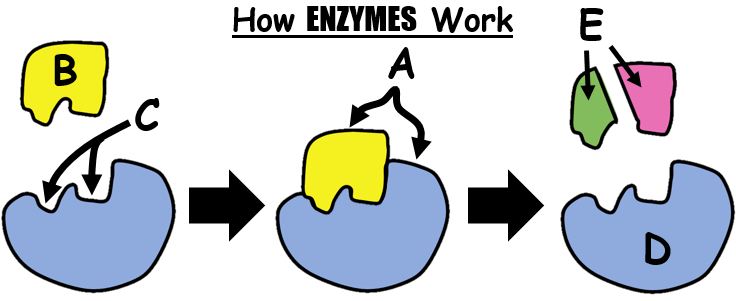
What is happening during letter A?

a)

catalyzed reaction is releasing a product

b)

the enzyme is keeping the bonds the same in the substance

c)

the enzyme is breaking bonds in the substrate

d)

the substrate is beginning to bind the enzyme

45.

Overall, cellular respiration is a reaction that..

a)

absorbs energy/exothermic

b)

absorbs energy/endothermic

c)

releases energy/exothermic

d)

releases energy/endothermic

46.
What is the function of ATP in living things?
a)
provides energy for cells
b)
stores genetic information
c)
provides structure in the nucleus
47.
Where is the energy stored in ATP molecules
a)
In the Ribose Sugar
b)
In the Adenine group
c)
In the Phosphate bonds
d)
In the Bank
48.
Which cellular organelle is responsible for manufacturing ATP?
a)
Ribosome
b)
Nucleus
c)
Mitochondria
d)
Chloroplast
49.
What is the process that copies information from DNA into RNA?
a)
protein synthesis
b)
transcription
c)
translation
d)
DNA Polymerase
50.
The copying of DNA to make two identical strands is called ___
a)
transformation
b)
translation
c)
transcription
d)
replication
51.
The synthesis of a protein from the information carried by  mRNA molecules.
a)
Transformation
b)
Transcription
c)
Translation
d)
Replication
52.
Which organelle is DNA usually found in?
a)
cell membrane
b)
vacuole
c)
chloroplast
d)
nucleus
53.

Place the components in order,from smallest to largest

1. Chromosome

2. DNA nucleotide

3. Codon

4. Gene

a)

1-2-4-3

b)

2-3-4-1

c)

3-4-2-1

d)

4-3-2-1

54.
If a strand reads:
3' A A A T T T C 5'
The matching strand would read...
a)
5' T T T A A A G 3'
b)
3' T T T A A A G 5'
c)
5' A A A T T T C 3'
d)
3' U U U A A A G 5'
55.
What does mRNA do?
a)
provides information from DNA to ribosomes
b)
transfers amino acids to the ribosomes
c)
makes up ribosomes
d)
builds proteins
56.

Chromosomes that have the same sequence of genes and the same structure are ___________.

a)

homologous chromosomes

b)

alleles

c)

phenotypes

d)

genotypes

57.

CROSSING OVER TAKES PLACE DURING

a)

PROPHASE II

b)

PROPHASE I

c)

INTERPHASE

d)

METAPHASE I

58.
The chromosomes that pair up during meiosis, are called __________ chromosomes.  
a)
homozygous 
b)
asexual
c)
homologous
d)
genes
59.
A human being has a somatic cell that has 46 chromosomes.  What is the haploid number found in a gamete?
a)
23
b)
46
c)
69
d)
92
60.
What phase is shown here?
a)
Telophase II
b)
Anaphase II
c)
Metaphase I
d)
Interphase I
61.
Cancer creates abnormal cells by disrupting
a)
the cell cycle
b)
red blood cell formation
c)
DNA replication
d)
ATP synthesis
62.
In order for DNA instructions to move from the nucleus to the ribosomes in the cytoplasm of a cell, an RNA copy of a DNA strand must be made. This process, which takes place in the cell nucleus, is called
a)
translation
b)
mutation
c)
DNA replication
d)
transcription
63.

What type of mutation happens to just one base.

a)

Chromosome mutation

b)

Point mutation

c)

DNA mutation

d)

Deletion mutation

64.

Law of Independent Assortment

a)

every organism has two alleles which separate when gametes are produced

b)

alleles for traits are the same

c)

genes from different traits are inherited independently of one another

d)

the allele combination of an organism

65.

Law of Segregation

a)

every organism has two alleles which separate when gametes are produced

b)

alleles for traits are the same

c)

genes from different traits are inherited independently of one another

d)

the allele combination of an organism

66.

If a dominant allele is present, the trait will always appear in the organism.

a)

Law of Segregation

b)

Law of Dominance

c)

Law of Independent Assortment

67.
This trait always shows up in an organism when the allele is present
a)
dominant allele
b)
codominance
c)
probability
d)
recessive allele
68.

In peas, yellow pod color is dominant to green pod color. A heterozygous parent is crossed with a homozygous recessive plant. What are the chances that the offspring will have green pods?

a)

25%

b)

50%

c)

75%

d)

100%

69.

In peas, yellow pod color is dominant to green pod color. Two heterozygous parents are crossed. What are the chances that the offspring will have green pods?

a)

25%

b)

50%

c)

75%

d)

100%

70.

In a dihybrid cross, how many boxes does the punnet square need to have?

a)

2

b)

4

c)

8

d)

16

71.

Two pea plants are crossed that are heterozygous for both height and flower color. Tall is dominant to short and purple is dominant to white. What is the phenotypic ratio of the children.

a)

9:3:3:1

b)

10:2:2:2

c)

5:4:4:3

d)

6:6:2:2

72.

Male patterned baldness is a recessive sex linked trait. How can a woman have it?

a)

A woman can have it if she has two alleles for it.

b)

A woman can have it if her father had it.

c)

A woman can have it if she has one allele for it.

d)

A woman can't have male patterned baldness.

73.
This is when a trait is controlled by more than one gene.
a)
Multiple alleles
b)
Polygenetic inheritance
c)
Codominance
d)
Incomplete Dominance 
74.

Inheritance Patterns: What answer choice best describes the inheritance pattern where a trait like skin color results from the interaction of many genes?

a)

incomplete dominance

b)

codominance

c)

polygenetic inheritance

d)

non-nuclear inheritance

75.
What does a filled in square represent?
a)
Not affected Female
b)
Not affected Male
c)
Affected Male
d)
Affected Female
76.
What does an open circle represent?
a)
Not Affected Male
b)
Not Affected Female
c)
Affected Male
d)
Affected Female
77.
What does a filled in square represent?
a)
Not affected Female
b)
Not affected Male
c)
Affected Male
d)
Affected Female
78.
Males are more likely to suffer from a sex-linked disease or disorder because
a)
males are the weaker sex
b)
males have less DNA
c)
males have 1 X chromosome, so the disorder is more likely to be expressed
79.
Which disease or disorder is the result of having an extra chromosome?
a)
Cystic Fibrosis
b)
Down Syndrome
c)
Colorblindness
d)
Sickle-cell Disease
80.

Down syndrome is the result of an extra chromosome 21 in a gamete. What caused this to happen?

a)

nondisjunction

b)

telomeres

c)

environment

d)

chromosome inactivation