wayground logo

Free Printable Worksheets

Font size

S
M
L
XL
Worksheets

FCHS Earth Science Final 12-2022

Total questions: 90

Worksheet time: 1hrs 24mins

Name
Class
Date
1.

What should be step 3?:

1. Determine the Problem

2. Do Some Research

3.

4. Conduct the Experiment

a)

Form a hypothesis

b)

Analyze Results

c)

Determine a Conclusion

d)

Formulate a theory

2.

What should be step 6?

1. Determine the Problem

2. Do Some Research

3.

4. Conduct the Experiment

5. Analyze Results

6.

a)

Change your hypothesis

b)

Record the data

c)

Form a conclusion

d)

Give up

3.

Mars has a rock. The rock has a mass of 14g and a volume of 2cm3. What is the density of the rock?

a)

7 mL

b)

7 g/cm3

c)

28 g/cm3

d)

1/7 g/cm3

4.
The green jade sample has a volume of
a)
Cannot be determined
b)
10.5 mL
c)
50.0 mL
d)
60.5 mL
5.
The invisible line at 0 degrees latitude is called the ________. 
a)
International Date Line
b)
Prime Meridian
c)
Equator
d)
Arctic Circle
6.
The invisible line at 0 degrees longitude is called the _________.
a)
International Date Line
b)
Prime Meridian
c)
Equator
d)
Antarctic Circle
7.
Which city is located at 38 degrees north and 120 degrees west?
a)
San Fransisco 
b)
New York
c)
New Orleans
d)
London
8.
Which city is located at 38 degrees north and 120 degrees west?
a)
San Fransisco 
b)
New York
c)
New Orleans
d)
London
9.

What is the contour interval of this map?

a)

10

b)

20

c)

30

d)

40

10.

Which side is steeper?

a)

The left side of the hill

b)

The right side of the hill

11.

Match the topographic map to its profile picture.

a)
b)
c)
d)
12.
In which direction is Mill River flowing?
a)
Southeast
b)
Southwest
c)
Northeast
d)
Northwest
13.

If a mineral can SCRATCH another one, it is -

a)

harder than the mineral

b)

weaker than the mineral

c)

the same mineral

14.

Calcite can scratch -

a)

Apatite

b)

Fluorite

c)

Talc

15.
What is the LEAST useful way to identify a mineral?
a)
luster
b)
streak
c)
color
d)
density
16.
When sediments are pressed together tightly, this is called ____________.
a)
Compaction
b)
Cementation
c)
Weathering
d)
Erosion
17.
The process by which metamorphic rocks are formed...
a)
heat and pressure
b)
erosion and deposition
c)
melting and cooling
18.
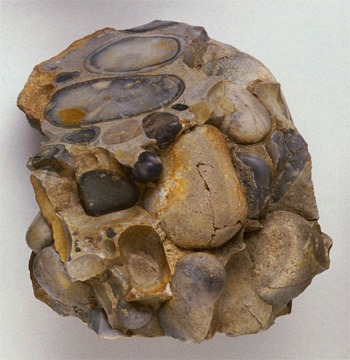
This rock was formed by smaller pieces of rock that settled at the bottom of a lake millions of years ago. What type of rock is this?
a)
Sedimentary
b)
Igneous
c)
Metamorphic
19.
This is how a mineral reflects light.
a)
Cleavage
b)
Density
c)
Hardness
d)
Luster
20.
A mineral breaks into pieces like are shown in the picture. How would you describe its breakage?
a)
cleavage
b)
fracture
c)
glassy
d)
waxy
21.

This mineral is the hardest known substance to man; is used in cutting jewelry, and as a cutting instrument.


According to the table, which mineral is this?

a)

Diamond.

b)

Quartz.

c)

Pyrite.

d)

Talc.

22.

Which rock is formed form the cooling of volcanic ash on Earth's surface?

a)

intrusive igneous

b)

foliated metamorphic

c)

extrusive igneous

d)

organic sedimentary

23.

According to the diagram, what process is shown by letter B?

a)

compaction & cementation

b)

weather & erosion

c)

heat & pressure

d)

melting

24.
__________ volcanoes are formed from fast flowing, lava which flows easily over the surface, forming larger volcanoes with gentle sides.
a)
Cone
b)
Composite
c)
Angel
d)
Shield
25.

Lava that is very thin and runny probably

a)

has low silica content

b)

is high in silica

26.
A subduction zone is...
a)
plates pull apart.
b)
the continental plate slides under the oceanic plate.
c)
where the oceanic plate slides under the continental plate.
d)
plates slap each other a high five.
27.
A break in the rock of the crust where rock surfaces slip past each other; usually occur along plate boundaries:
a)
focus
b)
epicenter
c)
fold
d)
fault
28.

Identify Item #4

a)

Seismic waves

b)

Fault

c)

Focus

d)

Epicenter

29.

Identify Item #2

a)

Seismic waves

b)

Fault

c)

Hypocenter (Focus)

d)

Epicenter

30.
What is represented by the picture? 
a)
Sea-floor spreading
b)
Pangea
c)
How the continents are arranged today
d)
Volcanoes
31.
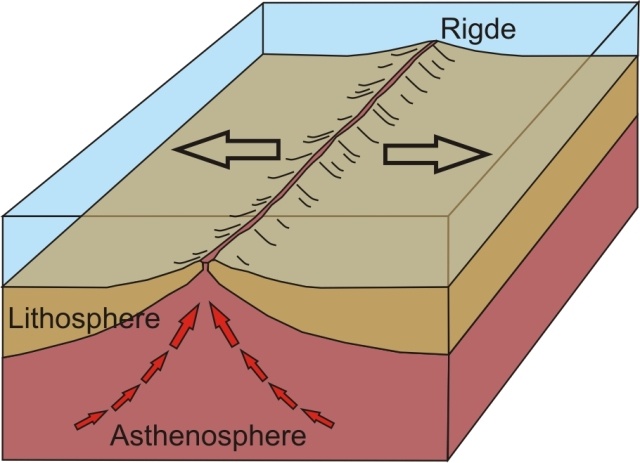
What kind of plate boundary is shown here?
a)
divergent
b)
convergent
c)
transform
d)
subducting
32.
How do plants weather rocks?
a)
during photosynthesis
b)
when roots grow into cracks of rocks and expand the rock
c)
when the plant moves water from the roots to the leaves
33.
These rocks were broken apart from the continuous freeze/thaw of water in the cracks of the rocks. This is an example of:
a)
ice wedging
b)
dumptruck
c)
permeability
d)
acid rain
34.

What is it called when weathered rock is carried away?

a)

weathering

b)

erosion

c)

deposition

d)

breaking

35.

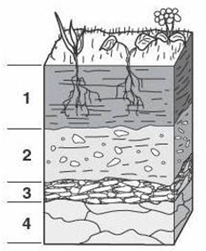
In which layer of the soil profile contains the MOST humus?

a)

Layer 1

b)

Layer 2

c)

Layer 3

d)

Layer 4

36.

Water tends to flow very rapidly through sand since it has

a)

low permeability

b)

high permeability

c)

high porosity but low permeability

d)

cohesion of sand particles

37.
Which is the most recent era of time- the one that we are currently in?
a)
Mesozoic 
b)
Paleozoic 
c)
Cenozoic 
d)
Precambrian 
38.

How are you feeling so far about your test?

a)
b)
c)
d)
39.

Which organism lived further back in time based on its position in the rocks?

a)

Fern

b)

Trilobite

c)

Ammonite

d)

Gastropod

40.
Seawater is typically denser than freshwater due to seawater’s —
a)
Greater depth
b)
Lower freezing point
c)
Smaller mass
d)
Higher salinity
41.
Letter D is pointing to the...
a)
continental slope
b)
continental shelf
c)
trench
d)
mid-ocean ridge
42.
Letter A is pointing to the _______________________.
a)
Continental shelf
b)
Mid-ocean ridge
c)
Continental slope
d)
Trench
43.

Winds blow from

a)

high pressure to low pressure

b)

low pressure to high pressure

c)

high altitudes to low altitudes

d)

low altitudes to high altitudes

44.
Which air mass has wet, warm air?
a)
Continental Tropical
b)
Continental Polar
c)
Marine Tropical
d)
Marine Polar
45.
Is the picture representing a land breeze or sea breeze?
a)
Land breeze
b)
Sea breeze
46.
Is the California current a warm or cold current?
a)
warm current
b)
cold current
47.
  1. Which of the following is a true statement about hurricanes?
a)

They only affect the tropical areas

b)

They cannot be measured on any scientific scale

c)

Their winds are always above 74 miles per hour

d)

They usually last less than 1 hour

48.

When Earth spins on its axis it is called

a)

resolution

b)

revolution

c)

umbra

d)

rotation

e)

geostationary orbit

49.

When a supergiant dies, the brilliant explosion is called

a)

a penumbra

b)

a nebula

c)

a globular cluster

d)

a supernova

50.

A light year is

a)

The distance from the sun to Earth

b)

The distance of the orbit of Earth's moon

c)

The distance from the sun to the exoplanets

d)

The distance that light travels in one year.

51.
The earth is located between which 2 planets?
a)
Jupiter & Saturn
b)
Mercury & Venus
c)
Venus & Mars
d)
Saturn and Uranus
52.
Blue stars are the _____________.
a)
hottest
b)
coolest
c)
smallest
53.

All stars begin their life as a

a)

Main Sequence

b)

Nebula

c)

Protostar

d)

Black Dwarf

54.

What is the name of the space mission dedicated to putting the first man on the moon?

a)

Space-Ex

b)

Andromeda

c)

Apollo

d)

Alexandria

55.

A prediction that can only be supported or not supported by scientific experimentation.

a)

hypothesis

b)

theory

c)

law

56.

Explains something we see in the natural world that has been verified through repeated experiments or testing.

a)

hypothesis

b)

law

c)

theory

57.

Which of these can be represented mathematically and provide no explanation why a phenomenon occurs?

a)

theory

b)

law

58.

Michael loves lettuce & lima beans. He believes that fertilizer will make the plant grow faster, so he treated one plant with fertilizer and the other plant did not receive fertilizer. They both received the same amounts of water & sunlight? What is the control group?

a)

plant receiving fertilizer

b)

plant not receiving fertilizer

c)

lima beans

d)

both plants

59.

Does the type of fertilizer affect a plant's growth? What type of variable is the fertilizer?

a)

Dependent

b)

Independent

c)

Control

d)

Compound

60.

Does the type of shoe worn during a 30 meter dash affect the speed of the runner? Is the speed of the runner independent or dependent?

a)

independent

b)

dependent

61.

What units do we use to measure mass?

a)

meters and kilometers

b)

grams and kilograms

c)

liters and milliliters

d)

ounces and pounds

62.

What is 180° longitude?

a)

the Equator

b)

the Prime Meridian

c)

the International Date Line

d)

the North and South Pole

63.

One degree of latitude is broken into

a)

30 minutes

b)

30 seconds

c)

60 minutes

d)

60 seconds

64.

What is the mineral of the picture that is often referred to as "Fool's Gold"?

a)

Topaz

b)

Turquoise

c)

Corundum

d)

Pyrite

65.

What type of property test is a mineralogist conducting when she rubs a mineral over a mirror, tile, or hard surface?

a)

Streak Test

b)

Luster Test

c)

Appearance Test

d)

Cracking Test

66.

What mineral is used for common table salt?

a)

quartz

b)

sulfur

c)

halite

d)

calcite

67.

What mineral is used for pencils?

a)

Graphite

b)

Titanium

c)

Magnetite

d)

Quartz

68.
In which direction is Mill River flowing?
a)
Southeast
b)
Southwest
c)
Northeast
d)
Northwest
69.

This "Gneiss" metamorphic rock is ________ because it has bands of minerals.

a)

ribboned

b)

stripiated

c)

foliated

d)

non-foliated

70.
a)
normal fault
b)
reverse fault
c)
strike-slip fault
71.

This landform is a -

a)

Canyon formed by water.

b)

V shaped valley formed by water.

c)

U shaped valley formed by ice.

d)

U shaped valley formed by water.

72.
Which type of eclipse is shown in the diagram?
a)
solar eclipse
b)
lunar eclipse
73.

Formed by cooling & solidification of magma inside the Earth.

a)

Sedimentary

b)

Metamorphic

c)

Extrusive Igneous

d)

Intrusive Igneous

74.

Which type of seismic wave travels the fastest and pushes and pulls the ground?

a)

S-Wave

b)

Body Wave

c)

P-Wave

d)

Surface Wave

75.

Which point correctly shows the epicenter of the earthquake that affected cities 1, 2, & 3?

a)

A

b)

B

c)

C

d)

D

76.
What is the point on Earth's surface directly above the focus of an earthquake?
a)
earthquake
b)
epicenter
c)
fault
d)
focus
77.

When plates are moving towards each other, this is called:

a)

Transform

b)

Convergent

c)

Divergent

d)

Volcanic

78.

When plates are moving away from each other.

a)

Convergent

b)

Volcanic

c)

Divergent

d)

Transform

79.
The circular arrows inside the Earth's Mantle represent what type of motion, that drives ALL plate movement?  
a)
Convergent Boundary
b)
Ocean Currents
c)
Convection Currents
d)
Transform Boundary
80.
Who is the person credited with developing the theory of continental drift?
a)
Harry Hess
b)
Galileo
c)
Alfred Wegener
d)
Newton
81.
This is a picture of a
a)
creep 
b)
slump
c)
mudflow
d)
landslide
82.
The slowest type of mass movement is called a _____________________.
a)
slump
b)
creep
c)
landslide
d)
mudflow
83.
This is a picture of a
a)
slump
b)
creep
c)
mudflow
d)
landslide
84.

Which law states that older rock layers are buried deaper in the Earth?

a)

superposition

b)

commensalism

c)

natural selection

d)

evolution

e)

competitive exclusion

85.

Scientists test a mummified corpse and find that it has 50% of its C14 left. How long ago did the mummy die?

a)

17,190

b)

11,460

c)

22,920

d)

5,730

86.

Which of these is in the correct order from OLDEST to YOUNGEST?

a)

C, D, B, E, A

b)

A, B, C, D, E

c)

C, B, A, D, E

d)

C, B, E, A, D

87.

Place the divisions of Geologic Time Scale from largest to smallest.

a)

Eon

b)

Era

c)

Period

d)

Epoch

1)
2)
3)
4)
88.
What symbol is this?
a)
warm front
b)
cold front
c)
stationary front
d)
occluded front
89.
In which layer of the atmosphere does weather occur?
a)
Mesosphere
b)
Thermosphere
c)
Stratosphere
d)
Troposphere
90.
Which layer of the atmosphere contains the ozone layer, which protects us from the sun's harmful rays?
a)
troposphere
b)
mesosphere
c)
stratosphere
d)
thermosphere