wayground logo

Free Printable Worksheets

NEW

Font size

S
M
L
XL
Worksheets

Benchmark Review_2nd 9 weeks

Total questions: 38

Worksheet time: 47mins

Name
Class
Date
1.
What is the main function of the respiratory system?
a)
to provide oxygen and remove carbon dioxide from the body
b)
to bring oxygen to the body
c)
to break down food and absorb nutrients
d)
to remove oxygen from the body and deliver carbon dioxide
2.
What is responsible for delivering oxygen and removing carbon dioxide from the body?
a)
cell nucleus
b)
excretory system
c)
nervous tissue
d)
respiratory system
3.
The __________ system directs the body to inner and outer changes.
a)
digestive
b)
circulatory
c)
nervous
d)
skeletal
4.
___________ are the building blocks of life.
a)
cells
b)
legos
c)
blocks
d)
blood
5.
In multicellular organisms, tissues are comprised of _______.
a)
organs
b)
systems
c)
cells
d)
blood
6.
Which of the following body systems work together for support, protection, and movement?
a)
respiratory and cardiovascular
b)
skeletal and muscular
c)
skeletal and integumentary
d)
digestive and respiratory
7.
Which of the following shows the levels of organization of an organism from LEAST to MOST complex.
a)
cells-tissues-systems-organs
b)
organs-cells-systems-tissues
c)
systems-organs-tissues-cells
d)
cells-tissues-organs-systems
8.

Which two body systems are primarily responsible for gas exchange between the body and the environment?

a)

skeletal and muscular

b)

circulatory and respiratory

c)

circulatory and digestive

d)

respiratory and excretory

9.

How does the circulatory system depend on the respiratory system in order to function?

a)

The respiratory system removes bacteria from the circulatory system.

b)

The respiratory system produces circulatory system cells.

c)

The respiratory system delivers oxygen to the circulatory system.

d)

The respiratory system provides protection to the circulatory system.

10.

How does the circulatory system depend on the skeletal system?

a)

The skeletal system removes carbon dioxide from the circulatory system.

b)

The skeletal system produces blood cells in the bone marrow.

c)

The skeletal system is responsible for voluntary movement.

d)

The skeletal system helps to digest food for the circulatory system.

11.

How do the circulatory and excretory systems work together?

a)

The circulatory system brings nutrients and oxygen so our cells can produce energy.

b)

The circulatory system brings blood to the kidneys to filter and remove waste.

c)

The circulatory system bring white blood cells around the body to fight infection and disease.

d)

The circulatory system helps the excretory system digest food.

12.

How do the skeletal and circulatory systems work together?

a)

The skeletal system produces red blood cells for the circulatory system.

b)

The skeletal system works with the circulatory system to help break down and digest food.

c)

The skeletal system provides structure for the muscles.

d)

The skeletal system protects the lungs and brain.

13.

Which two systems work together to remove wastes?

a)

digestive and excretory

b)

respiratory and skeletal

c)

skeletal and circulatory

d)

digestive and respiratory

14.

Which two systems work together to break down and transport molecules?

a)

muscular and respiratory

b)

circulatory and skeletal

c)

digestive and circulatory

d)

endocrine and digestive

15.
What is diffusion?
a)
when molecules move from a low concentration to a high concentration 
b)
when molecules move from a high concentration to a low concentration.
c)
no movement 
d)
molecules move everywhere
16.
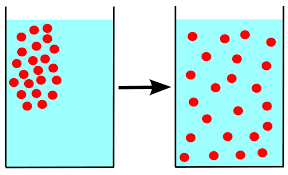
The picture below is an example of _________________.
a)
osmosis
b)
isotonic
c)
diffusion
d)
active transport
17.
What is photosynthesis?
a)
The process in which humans eat their food
b)
When a photographer takes a photo.
c)
To get your pictures from the photo lab.
d)
The process in which plants make their food.
18.
Which organelle from the plant cell is primarily responsible for converting sunlight to energy?
a)
Mitochonria
b)
Nucleus
c)
Vacuole
d)
Chloroplast
19.
Which organisms perform Photosynthesis?
a)
Only Autotrophs
b)
Only Heterotrophs
c)
Autotrophs and Heterotrophs
20.
Cellular respiration takes place in the
a)
nucleus
b)
cytoplasm
c)
ribosomes
d)
mitochondria
21.
This process releases chemical energy from sugars and other carbon-based molecules to make ATP when oxygen is present.
a)
Photosynthesis
b)
Osmosis
c)
Cellular respiration
d)
Diffusion
22.
What are the products of cellular respiration?
a)
Glucose and oxygen
b)
Carbon dioxide, water, and Energy
c)
Lactic acid
d)
Carbon monoxide
23.
In which way are photosynthesis and cellular respiration different?
a)
Cellular respiration stores ATP, while photosynthesis releases ATP.
b)
Cellular respiration produces oxygen, while photosynthesis uses oxygen.
c)
Photosynthesis releases energy, while cellular respiration stores energy.
d)
Photosynthesis used carbon dioxide, while cellular respiration produces carbon dioxide.
24.
If there is a higher concentration of O2 in the lungs than in the blood stream. . .
a)
O2 will diffuse from the lung to the blood stream.
b)
O2 will diffuse from the blood stream to the lungs.
c)
 CO2 diffuse from the blood stream to the lungs
d)
Water will move by osmosis from the bloodstream to the lungs
25.
Water moving from areas of high concentration to low concentration.
a)
Photosynthesis
b)
Osmosis
c)
Cellular Respiration
26.
Process in which substances or particles move through the cell membrane, protein channel, or protein doorway from high concentration to low concentration without the use of energy 
a)
Diffusion
b)
Active Transport
c)
Osmosis
d)
Passive Transport
27.
a)
Endocytosis
b)
Active Transport
c)
Mitochondria
d)
Exocytosis
28.
a)
Endocytosis
b)
Exocytosis
c)
Diffusion
d)
Osmosis
29.
a)
Passive Transport
b)
Osmosis 
c)
Active Transport
d)
Diffusion
30.
If a red blood cell is placed into a hypertonic solution, what effect would it have on a cell?
a)
There would be no effect on the cell
b)
The cell would shrink
c)
The cell would swell
d)
The cell would burst
31.

This is the powerhouse of a cell

a)

Cytoplasm

b)

Rough ER

c)

Ribosome

d)

Mitochondria

32.
This organelle is used to store the materials needed by the cell
a)
Nucleus
b)
Vacuole
c)
Golgi Apparatus
d)
Chloroplasts
33.
The DNA of a cell can be found here
a)
Nucleus
b)
Cytoplasm
c)
Rough ER
d)
Mitochondria
34.
Animal cells DO NOT have ...
a)
mitochondria
b)
lysosomes
c)
vacuoles
d)
chloroplasts
35.
Tiny cell structures that carry out specific functions within the cell...
a)
membranes
b)
nucleus
c)
organelles
d)
animalicules
36.
The two kinds of cells are prokaryotes and eukaryotes. How are they different?
a)
Prokaryotes have a nucleus.
b)
Eukaryotes have a nucleus.
c)
Prokaryotes are plant cells.
d)
All bacteria are eukaryotes.
37.
You are made up of...
a)
eukaryotic cells
b)
prokaryotic cells
c)
plant cells
d)
bacterial cells
38.
This organelle controls what comes in or out of the cell (selectively permeability).
a)
nucleus
b)
cell wall
c)
cell membrane
d)
vacuole