wayground logo

Free Printable Worksheets

NEW

Font size

S
M
L
XL
Worksheets

Fall Semester Exam

Total questions: 45

Worksheet time: 30mins

Name
Class
Date
1.
Functions in energy production, known as the energy factory of the cell
a)
mitochondria
b)
chloroplast
c)
vacuole
d)
cytoplasm
2.
I am located in the nucleus – I’m the genetic material of a cell
a)
cytoplasm
b)
membrane
c)
chromosomes/DNA
d)
vacuole
3.
The major function of ribosomes is to
a)
Make fats
b)
Synthesize protein
c)
Digest protein
d)
Make sugars
4.
Which of the following is an enzyme filled organelle that breaks down waste in the cell?
a)
lysosomes
b)
chloroplast
c)
mitochondria 
d)
Golgi apparatus 
5.
Which tissue is this?
a)
Simple Squamous
b)
Stratified Squamous
c)
Simple cuboidal
d)
Pseudostratified columnar
6.
Which type of epithelial tissue would allow oxygen to quickly pass through it?
a)
Simple Squamous
b)
Simple Cuboidal
c)
Simple Columnar
d)
Transitional
7.
Which type of muscle tissue would line the intestines?
a)
Smooth
b)
Cardiac
c)
Skeletal
d)
Transitional
8.
What type of Connective tissue is found at the ends of bones to reduce friction?
a)
Cartilage
b)
Dense connective tissue
c)
Adipose Tissue
d)
Loose connective tissue
9.
Salivary glands are 
a)
Endocrine Glands
b)
Exocrine Glands
10.
Nails are made out of what?
a)
All of the Above 
b)
Terminal 
c)
 Vellus 
d)
Keratin 
11.
Which layer of the skin contains lots of adipose tissue and connects the skin to muscle?
a)
Dermis
b)
Epidermis
c)
Keratin
d)
Subcutaneous
12.
Melanin:
a)
Helps protect skin from UV radiation
b)
Is found in almost every human being
c)
Is responsible for skin color
d)
All of the above
13.
Which layer of skin is "A" referring to?
a)
Epidermis
b)
Dermis
c)
Hypodermis
d)
Melanin
14.

Connective tissue, nerve cells, muscle fibers, sweat glands, oil glands, and hair follicles are located in ...

a)

epidermis

b)

dermis

c)

subcutaneous layer

15.

Hair follicles usually have _____ associated with them that lubricate the skin and hair

a)

acne

b)

sebaceous glands

c)

sweat glands

d)

nerves and vessels

16.

Articular cartilage is found in what part of the long bone?

a)

inside of the medullary cavity

b)

on the outer surface of the diaphysis

c)

the outer surface of the epiphyses

d)

in the spaces of the spongy bone

17.

What lines the medullary cavity and spaces of the spongy bone?

a)

Periosteum

b)

Epiphysis

c)

Intramembranous

d)

Endosteum

18.

Bone cells are known as

a)

Lacunae

b)

Osteocytes

c)

Collagen

d)

Osteon

19.

Osteogensis is known as

a)

Bone growth

b)

Bone development

c)

Bone-forming cells

20.

Which vitamin is necessary for proper absorption?

a)

Vitamin A

b)

Vitamin C

c)

Vitamin K

d)

Vitamin D

21.

The skull bones, hyoid bone and vertebral column bones are found in which skeleton

a)

Axial Skeleton

b)

Appendicular Skeleton

22.

What is the scientific name of the 'jaw bone'?

a)

Maxilla

b)

Mandible

23.

The scientific name of the collar bone is the ____________.

a)

Scapula

b)

Clavicle

24.

The forearm bone closest to the thumb is the __________.

a)

Ulna

b)

Radius

25.

The patella is commonly known as your knee cap.

a)

True

b)

False

26.

An example of a saddle joint can be found in the thumb.

a)

True

b)

False

27.

Which of the following are functions of the bones?

a)

Support and Protection

b)

Attachment to the muscles

c)

Stores inorganic salts

d)

All of the above

28.
What are the 3 types of muscles?
a)
Cardiac, smooth and skeletal
b)
Cardiac, skeletal, prime
c)
Flexion, extension, smooth
d)
Skeletal, smooth, stringy
29.

Actin is the ...

a)

Thick Filament within a Muscle Fibre

b)

Thin Filament within a Muscle Fibre

c)

Protein that covers myosin-binding sites

d)

Molecule that causes muscle contraction

30.

Myosin is the ...

a)

Thin Filament of a muscle fibre

b)

Segment of a muscle fibre

c)

A molecule that changes shape when bound with Calcium Ions

d)

Thick Filament of a muscle fibre

31.

Myofibril is an arrangement of ___________ within a muscle fibre.

a)

Bands

b)

Sacromeres

c)

Proteins

d)

Crossbridges

32.

What starts a muscle contraction?

a)

Release of Calcium Ions

b)

Attachment of Myosin-Heads

c)

An Action Potential

d)

Release of ADP

33.
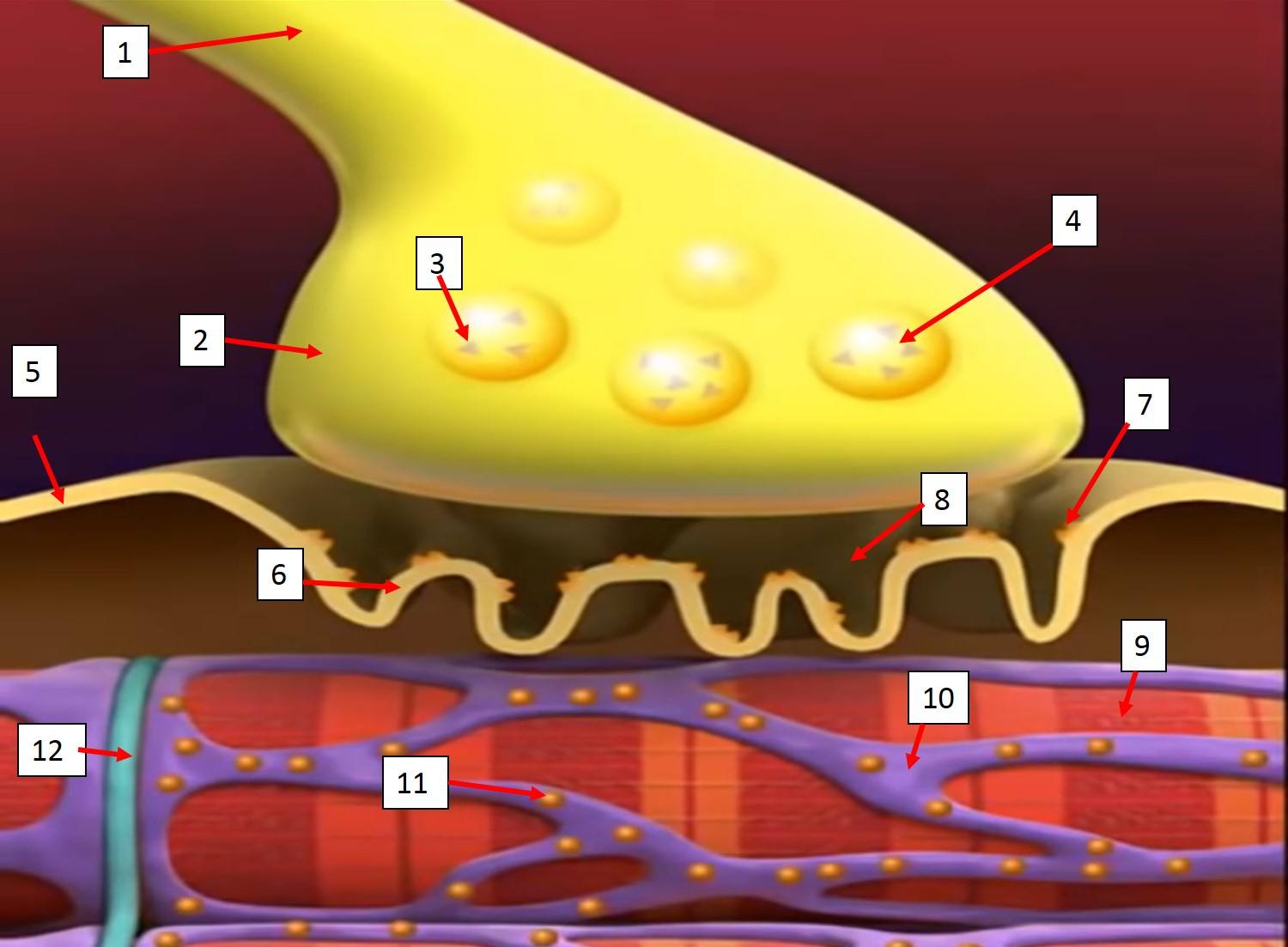
Region where a motor neuron comes in close contact with a muscle cell.
a)
neurotransmitter
b)
muscular dystrophy
c)
muscle tension
d)
neuromuscular junction
34.
The neurotransmitter stored in the axon terminal identified as #3
a)
Acetylcholine
b)
Protein Channel
c)
Calcium Ion (Ca2+)
d)
Syanptic Cleft
35.
The organelle that stores ACh in the axon is identified as #4
a)
Motor Neuron
b)
Axon Terminal of Motor Neuron
c)
Sarcolemma
d)
 Vesicle
36.
The plasma membrane of a skeletal muscle cell is called the:
a)
sarcomere
b)
myofilament
c)
sarcolemma
d)
sarcoplasm
37.
Skeletal Muscle contraction is initiated when the ________ sends a message to the muscle cell.  
a)
Muscle cell
b)
Neuron
c)
Gland
d)
None of the above
38.

The brain has 3 major sections that send and receive signals to control all the activities that keep a person functioning efficiently. Which major section controls breathing and heart beat?

a)

cerebellum

b)

cerebrum

c)

brain stem

d)

cortex

39.
Which are the main divisions of the nervous system?
a)
afferent and efferent
b)
peripheral and central
c)
somatic and autonomic
d)
sympathetic and parasympathetic
40.
What is the central nervous system made up of?
a)
brain and spinal cord
b)
cranial and spinal nerves
c)
sensory and motor systems
d)
sympathetic and parasympathetic systems
41.
What part of the brain is responsible for thought and planning?
a)
frontal
b)
parietal
c)
temporal
d)
occipital
42.
What part is responsible for visual processing?
a)
frontal
b)
parietal
c)
temporal
d)
occipital
43.
Which neurons carry messages from the brain to the body?
a)
sensory neuron
b)
motor neuron
c)
interneuron
d)
afferent
44.
Which system controls involuntary responses?
a)
somatic
b)
autonomic
c)
sympathetic
d)
parasympthetic
45.
What is number 1?
a)
dendrite 
b)
axon
c)
cell body
d)
myelin sheath