Wayground logo

Free Printable Worksheets

Font size

S
M
L
XL
Worksheets

Spheres of the Earth Review

Total questions: 72

Worksheet time: 1hrs 5mins

Name
Class
Date
1.

Theory that Earth's crust is divided into plates & the plates move around on the mantle

a)

Seafloor spreading

b)

Plate tectonics

c)

Continental drift

d)

Earthquakes

2.

Shaking of the ground caused by sudden movement of large blocks of rocks along a fault

a)

Earthquake

b)

Volcano

c)

Tsunami

d)

Surface waves

3.

Fastest seismic waves, first to reach a location after an earthquake, also called P waves

a)

Secondary waves

b)

Seismic waves

c)

Primary waves

d)

Surface waves

4.

The point on Earth's surface directly above the focus of an earthquake

a)

Juan de fuca plate

b)

Focus

c)

Seismic wave

d)

Epicenter

5.

The 2nd seismic waves to arrive at any particular location after an earthquake, also called S waves

a)

Surface waves

b)

Primary waves

c)

Secondary waves

d)

Tidal waves

6.

It is the energy radiated in all directions from the focus due to earthquake.

a)

seismic waves

b)

epicenter

c)

body waves

d)

surface waves

7.

This is known as the sudden shaking of the ground and known as the sources of seismic waves.

a)

earthquake

b)

tsunami

c)

flood

d)

typhoon

8.

This is considered as the fastest kind of seismic waves.

a)

Love waves

b)

Body waves

c)

Primary waves

d)

Secondary waves

9.
Which letter represents the movement created by the P Wave?  
a)
A
b)
B
c)
C
10.
Which seismogram represents a city that is far from the epicenter of an earthquake?  
a)
New York, NY
b)
Nome, Alaska
c)
Guadalajara, Mexico
11.

What is the tool that records earthquakes?

a)

A. Seismograph

b)

B. Seismologists

c)

C. Seismic wave

d)

D. Seismogram

12.
How do geologists locate the epicenter of an earthquake?
a)
They measure the difference between seismic waves on three or more seismographs. The epicenter is where the circles intercept.
b)
They measure the difference between seismic waves on the first seismograph to receive the wave.
c)
They measure the largest surface wave to hit the surface.
d)
They add the total damage of the p wave, s wave and surface wave.
13.

Based on the figure, the difference in arrival times between which pair of waves can be used to determine the distance of the recording station to the epicenter?

a)

C and D

b)

B and C

c)

A and D

d)

A and B

14.
What two elements make up water?
a)
Helium and oxygen
b)
Hydrogen and oxygen
c)
helium and carbon
d)
oxygen and carbon
15.
What word describes when water is attracted to other substances?
a)
cohesion
b)
adhesion
c)
capillary action
d)
surface tension
16.
Attractions between the negative Oxygen atom of one water molecule and the positive Hydrogen atom of another water molecule are called
a)
Covalent bonds
b)
Ionic bonds
c)
Polar bonds
d)
Hydrogen bonds
17.
Why does ice float?
a)
As water freezes, it expands and its density decreases.
b)
As water freezes, it takes up more hydrogen from the atmosphere, causing it to have a greater buoyancy.
c)
As water freezes, air becomes trapped between the hydrogen bonds of water molecules.
d)
As water freezes, it takes up more oxygen from the atmosphere, causing it to have a greater buoyancy.
18.
Water is a universal solvent because it...
a)
It can be found anywhere
b)
It freezes when it gets cold
c)
floats when frozen
d)
Dissolves most substances
19.
Which of the following is LEAST likely to dissolve in water?
a)
nonpolar fats and oils
b)
polar sugar molecules
c)
salt made of a positive sodium ion and a negative chloride ion
d)
all of the substances will dissolve easily in water
20.
Large bodies of water, such as lakes and oceans, do not quickly fluctuate in temperature. What is the reason for this phenomenon?
a)
Water is an acid.
b)
Water is a versatile solvent.
c)
Water has a high heat capacity.
d)
 Water acts as a buffer.
21.
The fact that ice floats on liquid water is due to the fact that water's solid is ___________ than it's liquid form
a)
less polar
b)
more polar
c)
less dense
d)
more dense
22.
How much of Earth's water is salt water?
a)
50%
b)
66%
c)
75%
d)
97%
23.
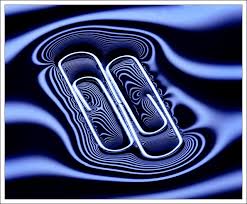
The tightness across the surface of water that enables paper clips to float is ____________.
a)
adhesion
b)
capillary action
c)
surface tension
d)
polarity
24.
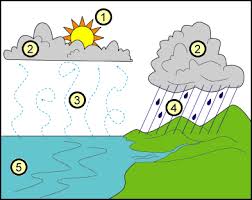
Number 2 in the water cycle diagram is ___________.
a)
The Sun
b)
condensation
c)
precipitation
d)
evaporation
25.
Which statement explains why water molecules stick together?
a)
both sides are negative
b)
one side has a positive charge and the other side has a negative charge
c)
one side has a negative charge adn the other side has a neutral charge
d)
both sides are positive
26.
Large bodies of water, such as lakes and oceans, do not quickly fluctuate in temperature. What is the reason for this phenomenon?
a)
Water is an acid.
b)
Water is a versatile solvent.
c)
Water has a high heat capacity.
d)
 Water acts as a buffer.
27.
Why does ice stay at the top of oceans instead of sinking to the bottom?
a)
 Ice is colder than liquid water.
b)
Ice is less dense than liquid water.
c)
Ice is more dense than liquid water.
d)
Ice is warmer than liquid water.
28.

Water in a cup will help prevent the cup from burning up over a flame due to this property of water

a)

high specific heat

b)

capillary action

c)

surface tension

d)

greatest density at 4 oC

29.

What is the energy source for the water cycle?

a)

sun

b)

wind

c)

rain

d)

oceans

30.
What is A?
a)
Evaporation
b)
Condensation
c)
Precipitation
d)
Runoff
31.
What is B?
a)
Evaporation
b)
Condensation
c)
Precipitation
d)
Runoff
32.
What is      D?
a)
Evaporation
b)
Condensation
c)
Precipitation
d)
Runoff
33.

Precipitation means...

a)

water vapor cooling to form clouds

b)

water running downhill

c)

water falling from the sky

d)

water heating up and rising as gas

34.

Runoff means...

a)

water vapor cooling to form clouds

b)

water running downhill

c)

water falling from the sky

d)

water heating up and rising as gas

35.

Condensation means...

a)

water vapor cooling to form clouds

b)

water running downhill

c)

water falling from the sky

d)

water heating up and rising as gas

36.
What is water that flows in rivers and streams into the oceans and lakes?
a)
evaporating
b)
condensing
c)
precipitating
d)
runoff
37.

Evaporation means...

a)

water vapor cooling to form clouds

b)

water running downhill

c)

water falling from the sky

d)

water heating up and rising as gas

38.

Which best explains why runoff is important?

a)

It returns water to other locations on Earth

b)

It increases the chance of flooding

c)

It makes evaporation occur faster

d)

It increases condensation

39.
The water cycle has
a)
a beginning and an end. 
b)
no beginning an no end. 
c)
only a beginning. 
d)
only an end. 
40.

What is another name or synonym for the water cycle?

a)

Geologic cycle

b)

Hydrologic cycle

c)

Geosphere

d)

Carbon cycle

41.
When humans burn fossil fuels, most of the carbon quickly enters the                       as carbon dioxide.
a)
Water
b)
Atmosphere
c)
Sun
d)
Air
42.
Which one of these does not add CO2 to the atmosphere?
a)
cooking with gas
b)
planting trees
c)
burning wood
d)
riding in a bus
43.
What does not produce carbon dioxide?
a)
Photosynthesis
b)
Burning Fossil Fuels
c)
Animal respiration
d)
Plants decaying
44.
How do living organisms return carbon to the atmosphere in the carbon cycle?
a)
respiration and photosynthesis
b)
 decomposition and respiration
45.
In the carbon cycle, producers take in the gas __
a)
carbon dioxide
b)
oxygen
c)
nitrogen
d)
carbon monoxide
46.
All of the carbon in existence is continually recycled in the carbon cycle
a)
True
b)
False
47.
Which of the following removes carbon from the atmosphere?
a)
Combustion
b)
Respiration
c)
Photosynthesis
d)
Death
48.
Organisms that do not decompose can be buried and become what?
a)
water
b)
nutrients
c)
air
d)
fossil fuels
49.

Which is a true statement?

a)

Humans depend on oxygen, plants depend on carbon dioxide

b)

Plants produce carbon dioxide

c)

Humans depend on carbon dioxide, plants depend on oxygen

d)

Humans don't depend on plants for the air they need

50.
Combustion is another word for __________.
a)
Transportation
b)
Respiration
c)
Fossil Fuels
d)
Burning
51.
Carbon can be found in...
a)
The atmosphere
b)
Soil
c)
Fossil fuels
d)
All of the above
52.
What process occurs when coal (fossil fuel) is used for energy?
a)
Decomposition
b)
Combustion
c)
Pressurization 
d)
Respiration 
53.

If the plant population decreased, the amount of total carbon on the planet would _________.

a)

Stay the same

b)

Increase

c)

Decrease

54.

Which of the following are fossil fuels?

a)

Coal, water, oil

b)

Oxygen, coal, oil

c)

Coal, Oil, Natural Gas

d)

None of the above

55.

The main human activity that releases greenhouse gases is

a)

using public transportation and there by reduce the affects of greenhouse gases.

b)

burning fossil fuels

c)

texting on cellphones

d)

eating meat

56.
Organisms that break down dead plants & animals and release nitrogen back into atmosphere...
a)
bacteria
b)
plants
c)
animals
d)
producers
57.
The process in which Nitrogen circulates and is recycled is called ____________
a)
The nitrogen cycle
b)
The water cycle
c)
The carbon cycle
d)
Nitrogen Fixation 
58.

How many spheres exists?

a)

1

b)

2

c)

3

d)

4

59.

Living things are part of the Geosphere

a)

True

b)

False

60.

The prefix BIo- means?

a)

Before, ahead of time

b)

life, living

c)

house

d)

before, ahead of time

61.

An ecosystem comprising the ENTIRE EARTH and the organisms that inhabit it.

a)

Biosphere

b)

Biome

c)

Abiotic

d)

Ecoregion

62.

All of Earth’s water, ice, and water vapor.

a)

Biosphere

b)

Biota

c)

Geosphere

d)

Hydrosphere

63.
Plants need ________ for photosynthesis
a)
oxygen
b)
soil
c)
carbon dioxide
d)
sugar
64.
What are the products of photosynthesis?
a)
water and carbon dioxide
b)
oxygen and glucose
c)
oxygen and carbon dioxide
d)
oxygen and water
65.
Which gas is removed from the atmosphere during photosynthesis?
a)
hydrogen
b)
oxygen
c)
nitrogen
d)
carbon dioxide
66.
Which of the following go through the process of photosynthesis?
a)
bees
b)
algae
c)
humans
d)
mushrooms
67.
Which statement about photosynthesis is correct?
a)
Plants get the energy they need for photosynthesis from water.
b)
Plants get the energy they need for photosynthesis from soil.
c)
Plants get the energy they need for photosynthesis from sunlight.
d)
Plants do not require energy to perform photosynthesis.
68.
A student is collecting the gas given off from a plant in bright sunlight at a temperature of 27°C. The gas being collected is probably ________.
a)
oxygen
b)
carbon dioxide
c)
ATP
d)
glucose
69.
The main source of energy for all life comes from ____.
a)
the Earth
b)
the moon
c)
the sun
d)
the food we eat/make
70.
Which of the following is not needed for photosynthesis to occur?
a)
sunlight
b)
carbon dioxide
c)
water
d)
oxygen
71.

Which of the following adds carbon dioxide to the atmosphere?

a)

respiration

b)

photosynthesis

c)

transpiration

d)

condensation

72.

Which choice correctly shows the gases that enter and exit plants during photosynthesis?

a)

Enter: Oxygen

Exit: Carbon Dioxide

b)

Enter: Carbon Dioxide

Exit: Oxygen

c)

Enter: Water Vapor

Exit: Glucose

d)

Enter: Light

Exit: Water Vapor