
 Worksheets
Semester Chemistry Final
Total questions: 99
Worksheet time: 3hrs 18mins


the basic structural unit of matter
atom
matter
element
nucleus
a collection of atoms of one type that cannot be broken down into simpler substances by ordinary chemical or physical means
element
subatomic particle
electron
matter
the positively charged subatomic particle contained in the nucleus of an atom
proton
neutron
electron
matter
a subatomic particle, contained in the nucleus of an atom, having the same mass as a proton but no electrical charge
proton
neutron
electron
matter
a negatively charged subatomic particle that orbits the nucleus of an atom
proton
neutron
electron
matter
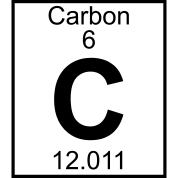
a unique number for each element that equals the number of protons in an atom of that element
element name
element symbol
atomic number
atomic mass
the mass of an atom, calculated by adding the number of protons and neutrons in the nucleus of the atom
element name
element symbol
atomic number
atomic mass
Valence electrons are found
outermost energy level
innermost energy level
some where in the electron cloud
An atom with 1 valence electron 'needs' a full shell, so it can either gain 7 electrons or lose 1. Which is more likely to occur?
nothing
gain 7
lose 1
How many valence electrons does Boron have?
1
2
3
4
Group numbers on the periodic table help us determine
number of valence electrons
state of the element (solid, liquid, gas)
In the molecule of water (H2O) - the two by the H is called the
How many total atoms do you have in the compound 2MgCl2?
2 atoms
4 atoms
6 atoms
8 atoms
How many Ca (Calcium) atoms are found in Ca(OH)2?
5 atoms
3 atoms
2 atoms
1 atom
How many total atoms do you have in the chemical formula 2Mg(ClO3)2?
2 atoms
7 atoms
9 atoms
18 atoms

Americans drink 5,604,000 gallons of sweet tea each day. How many liters is that? (1 gal = 3.79 L)
21,200,000 L
21,240,000 L
21,207,190.2 L
21,000,000 L
Convert 2.5 grams into milligrams.
25 mg
25,000 mg
250 mg
2500 mg

How many minutes are in a school year, 187 days?
269,280 min.
16, 200 min.
16, 156 min.
269,000 min.
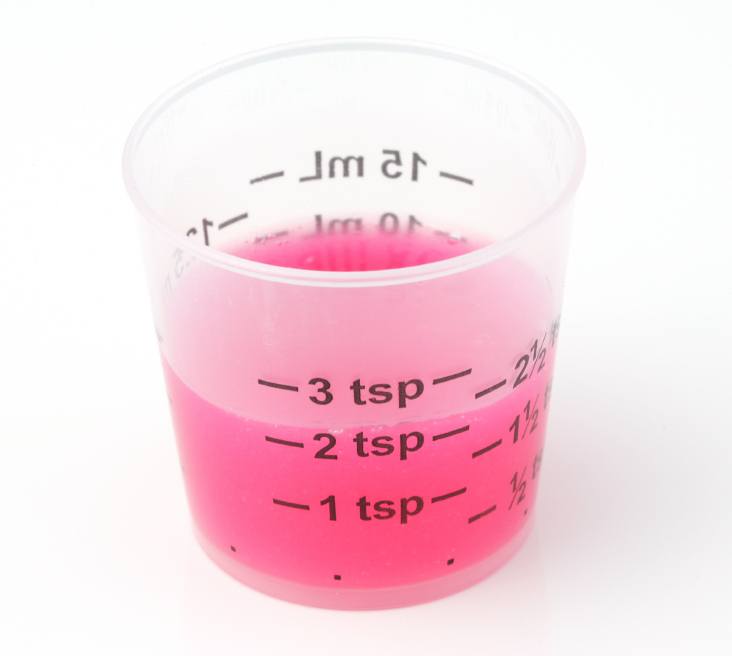
A child weighs 40.0 lb and is to receive 0.10 mg of an antibiotic for each kg of body weight. How many milligrams of the antibiotic shall the child receive? (1 kg = 2.2 lbs)
18.2 mg
182 mg
0.182 mg
1.82 mg
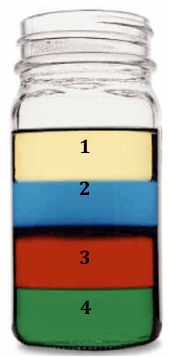

Which box has a higher density?
A
B
They are the same
A piece of copper has a mass of 89g and a volume of 10 cm3 What would be the density of the copper?
0.89 g/cm3
89 g/cm3
8.9 g/cm3
890 g/cm3
An object has a volume of 6 cm3 and a mass of 42 g. What's it's density?
7 g/cm3
48 g/cm3
42 g/cm3
6 g/cm3


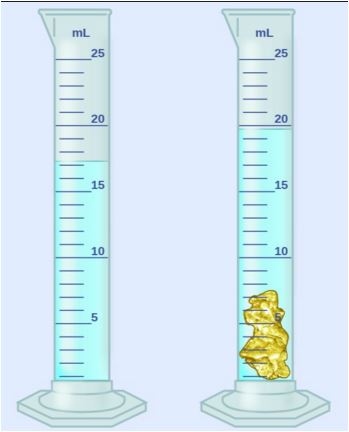
The amount of water displaced is the same as the volume of the object. What is the VOLUME of the object?

The density of a material is 2 g/cm3. The volume is 24 cm3 . What is the mass?


If an object has a density of 6 g/mL and you put it into water, will it sink or float?
Which subatomic particle has the smallest mass?
Protons
Neutrons
Electrons
Nucleus
Which Element has 21 protons?
Carbon
Zinc
Titanium
Scandium
What Element has 26 Electrons?
Cobalt
Iron
Silicon
Oxygen

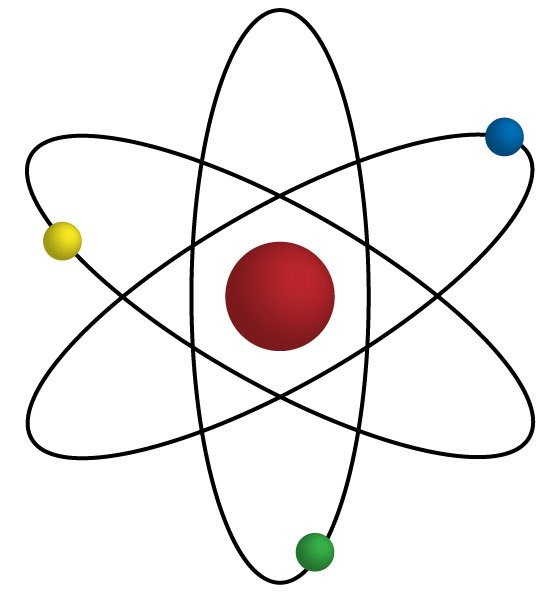
Based on this atomic model, what Element is this?
Boron
Helium
Oxygen
Nitrogen
Based on this atomic model, how many valence electrons does this atom have?
7
1
5
4
Which pair of elements would also be found in the same non-reaction group as Neon?
Florine and Bromine
Argon and Xenon
Zinc and Mercury
Lithium and Beryllium

What is the name for this group of elements?
Alkali
Halogens
Noble Gases
Alkali-Earth
A period on the Periodic Table is best represented by a -
Vertical Line
Diagonal Line
Backwards Line
Horizontal Line
Which Element has properties similar to Arsenic?
Antimony
Selenium
Germanium
Helium
In the formula 5C6H12O6, how many molecules are present?
5
6
24
12
In the formula 5C6H12O6, how many different Elements are present?
5
6
3
12
In the formula 5C6H12O6, how many Carbon atoms are present?
5
6
3
30
In the formula 2C6H12O6, how many Hydrogen atoms are present?
5
24
3
12
Which is the following is a PHYSICAL reaction/change?
A nail turns orange in the air
The statue of liberty turns green in the air
Kool-Aid mixed with water
a precipitate is formed

What are the reactants in this equation?
CH4 and 2O2 and CO2 and 2H2O
CO2 and 2H2O
CH4 and 2O2
The Yield Sign
What are the products in this equation?
CO2 and 2H2O
CH4 and 2O2 and CO2 and 2H2O
CH4 and 2O2
The Yield Sign
Metalloids are found where on the Periodic Table?
On the left
On the right
Along the ZIGZAG stairstep
In Group 18
Which of the following is NOT a pure substance?
Mixture
Element
Compound
Atom
Which of the following is an example of a compound?
carbon
water
salad
einsteinium
Sodium (Na) and Chlorine (Cl) bond to make salt (NaCl). Which of the following is true?
For each atom of sodium there is one atom of chlorine.
For each atom of sodium there are two atoms of chlorine.
There are two atoms of sodium for each atom of chlorine.
We don't know how many Na atoms there are for each Cl atom.
What does the subscript number 2 for hydrogen (H) represent in H2O?
Two molecules of water
Two atoms of hydrogen for each atom of oxygen
Two atoms of oxygen for each atom of hydrogen
All of the above
Which of these is a physical change?
Yarn being knitted into a sweater
A forest fire
Baking soda bubbling in vinegar
Grass capturing energy from sunlight
Where would a newly discovered element most likely be placed in the Periodic Table?
Along the right
Along the left
At the bottom
At the top

Which is pictured here?
Element
Compound
Mixture
Atom
Which of the following is a homogenous mixture? Choose all that apply.
Water
Fruit salad
Lemonade
Milk
Which is the best indication that a chemical reaction has taken place?
Bubbles are released
Color changes
A new substance is formed
The object breaks in half
If a 12-gram ice cube melts inside a sealed plastic bag, how much will the water weigh?
12 grams
Less than 12 grams
More than 12 grams
0 grams

As part of an investigation, students combined substances in a beaker to observe chemical reactions. They performed two procedures. They measured the mass of each substance before and after each reaction. The table shows their observations.
Assuming the students did not make any careless errors, what likely explains these changes in mass?
Procedure 1: One of the products was a gas that escaped into the air. Procedure 2: A gas from the air reacted with one of the other reactants.
Procedure 1: The reactants were liquids with different densities. Procedure 2: The reactants were combined into only one product.
Procedure 1: One of the reactants was converted to thermal energy. Procedure 2: All the products were liquids.
Procedure 1: All the reactants were liquids that evaporated. Procedure 2: A gas was formed as one product, and it escaped into the air.

Four students were asked to complete a table for a science assignment. Each student selected one chemical element from each of four groups in the periodic table and then classified each element as a metal, a nonmetal, or a metalloid. Which table was completed correctly?


Both the esophagus and the small intestine are involved in the digestion of food. The esophagus squeezes food into the stomach by wave-like muscle contractions. Peptidase enzymes in the small intestine break protein molecules into individual amino acids. Which statement best describes changes to food during digestion?
The muscle contractions result in physical changes, while the action of the peptidase results in chemical changes.
The muscle contractions and the action of the peptidase both result only in physical changes.
The muscle contractions result in chemical changes, while the action of the peptidase results in physical changes.
The muscle contractions and the action of the peptidase both result only in chemical changes.

The table lists some compounds found in foods and their formulas.
Based on this information, which of these statements is NOT true?
A molecule of sorbitol contains three more oxygen atoms than a molecule of glutamine does.
A molecule of lactose contains twice as many atoms as a molecule of fructose does.
A molecule of fructose contains four more atoms than a molecule of glutamine does.
A molecule of lactose contains twice as many carbon atoms as a molecule of sorbitol does.
A silver ring reacts with compounds containing sulfur in the air to form silver sulfide, a black substance that makes up the tarnish on the surface of silver objects. To remove the tarnish from the ring, students placed it in a pan lined with aluminum foil and added hot water. Baking soda was added to the hot water and stirred. Students made observations about the process. Which observation of this process provides evidence of a chemical reaction?
Hot water heated the aluminum foil.
The liquid solution changed color.
The pan was lined with aluminum foil.
The hot water cooled.
Which of the following elements exist as a liquids at room temperature?
Mercury and Fluorine
Bromine and Mercury
Bromine and Hydrogen
Neon and Fluorine
Energy is the ability to do
things
work
transform
Kinetic energy is the energy that a __________ object possesses.
stationary
moving
stored
Digestion is an example of
chemical energy
nuclear energy
thermal energy
The energy that comes from space or waves.
heat
electromagnetic
chemical
The energy of motion of a body.
potential
kinetic
mechanical
gravitational
This form of energy is related to the movement or flow of electrons which carry a charge
chemical
electrical
thermal
radiant
The energy of an object’s position.
potential
kinetic
mechanical
gravitational
Energy can change from one form to another.
True
False

