wayground logo

Free Printable Worksheets

NEW

Font size

S
M
L
XL
Worksheets

Life Science-Punnett Squares

Total questions: 52

Worksheet time: 1hrs 16mins

Name
Class
Date
1.
What should students use to identify the percent chance of a trait being passed down from a parent to its offspring?
a)
a graph
b)
a flow chart
c)
a data table
d)
a Punnett square
2.
Which statement best supports why many offspring look similar to their parents?
a)
Offspring inherit characteristics from one parent.
b)
Offspring inherit characteristics from both parents.
c)
Parents choose which characteristics to pass on to their offspring.
d)
Parents choose to change their appearance to match that of their offspring.
3.
When the allele combination is a dominate and a recessive trait together which trait will be seen?
a)
Dominate
b)
Recessive
c)
none
d)
both
4.
Homozygous is when...
a)
the alleles are the same
b)
the alleles are different
c)
the alleles are absent
d)
the alleles are present
5.
B = brown fur  b = white fur
In the punnett square, what is the probability for white fur? 
a)
0%
b)
25%
c)
50%
d)
75%
6.
Aa is
a)
homozygous (purebred)
b)
heterozygous (hybrid)
7.
What is a phenotype?
a)
The expression of a trait; physical appearance.
b)
refers to the genetic makeup of an individual
c)
An organism that has the same genes for a trait (ex. TT or tt)
d)
the passing of traits from parent to offspring
8.
Homozygous or heterozygous?
BB
a)
Homozygous
b)
Heterozygous
9.
Which of the following is a phenotype?
a)
Aa
b)
red hair
c)
heterozygous
d)
DNA
10.
What are the possible combinations of a pea plant with the alleles PP and a male pea plant with the alleles pp.
P= purple
p= white
a)
all Pp
b)
all PP
c)
Pp,PP,Pp,PP
d)
all pp
11.
Dominant or recessive?
Dd
a)
Dominant
b)
recessive
c)
neither
d)
homozygous
12.
Dominant or recessive?
tt
a)
Dominant 
b)
Recessive
13.
T - tall and t = short
In the punnett square below, what belongs in the missing square
a)
tt
b)
Tt
c)
Bb
d)
TT
14.
What you see, or the physical appearance.
a)
Genotype
b)
Phenotype
c)
Homozygous
d)
Heterozygous
15.
What is the probability of heterozygous offspring?
a)
25%
b)
50%
c)
0%
d)
100%
16.
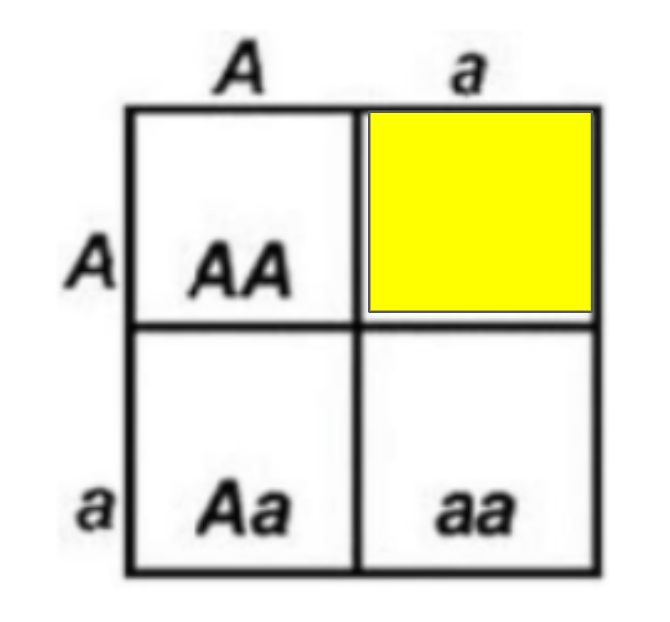
What allele combination should go in the missing box?
a)
AA
b)
Aa
c)
aa
d)
none of these
17.
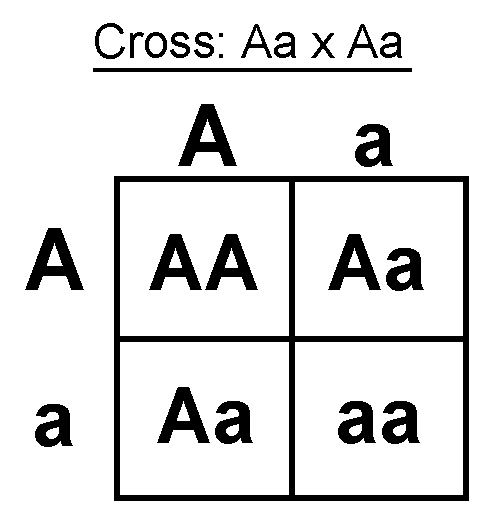
Each one of the boxes on the Punnett Square represents what probability of an offsprings' genotype?
a)
25%
b)
1%
c)
10%
d)
0%
18.
Which choice best represents the genotype of this cross?
a)
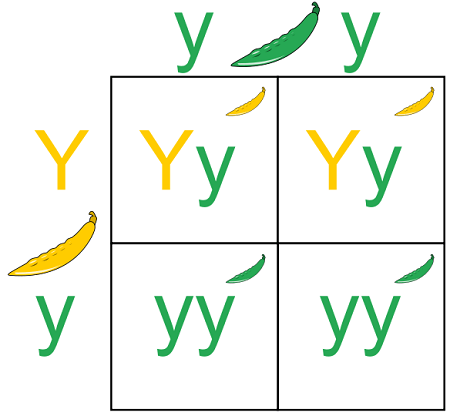
1 Yy: 2 yy: 0 YY
b)
2 Yy: 2 yy: 0 YY
c)
3 Yy: 1 yy: 0 YY
d)
1 Yy: 3 yy: 0 YY
19.
What is the phenotype of the offspring? (A-Brown hair; a-blond hair) 
a)
50 % Brown Hair and 50% Blond Hair 
b)
25 % Brown Hair and 75% Blond Hair 
c)
75 % Brown Hair and 25% Blond Hair 
d)
0% Brown Hair and 100% Blond Hair 
20.
Which of the following genotypes is homozygous dominant?
a)
A
b)
Aa
c)
AA
d)
aa
21.
Which of the following genotypes is heterozygous?
a)
Bb
b)
BB
c)
bb
d)
B
22.
Which of the following is homozygous recessive?
a)
Tt
b)
tt
c)
TT
d)
T
23.
Which of the following genotypes is heterozygous?
a)
Bb
b)
BB
c)
bb
d)
B
24.
Which of the following genotypes is homozygous dominant?
a)
A
b)
Aa
c)
AA
d)
aa
25.
In pea plants, the tall allele is dominant to the short allele. What key would demonstrate this?
a)
Tall = T
Short = S
b)
Tall = T
Short = t
c)
Tall = t
Short = T
d)
Tall = TT
Short = tt
26.

Which of the following is a homozygous recessive genotype?

a)

HH

b)

dd

c)

Aa

27.

Which of the following is a Homozygous Dominant Genotype?

a)

Yy

b)

XX

c)

zz

28.

Why do scientist use Punnett Squares?

a)

A tool scientist use to to see alleles

b)

A tool scientist use to see which alleles are dominant

c)

A tool scientist use to determine possible genotypes for offspring

29.

Which of the following is a heterozygous genotype?

a)

Gg

b)

UU

c)

pp

30.

Fill in the Yellow Box

a)

AA

b)

Aa

c)

aa

31.

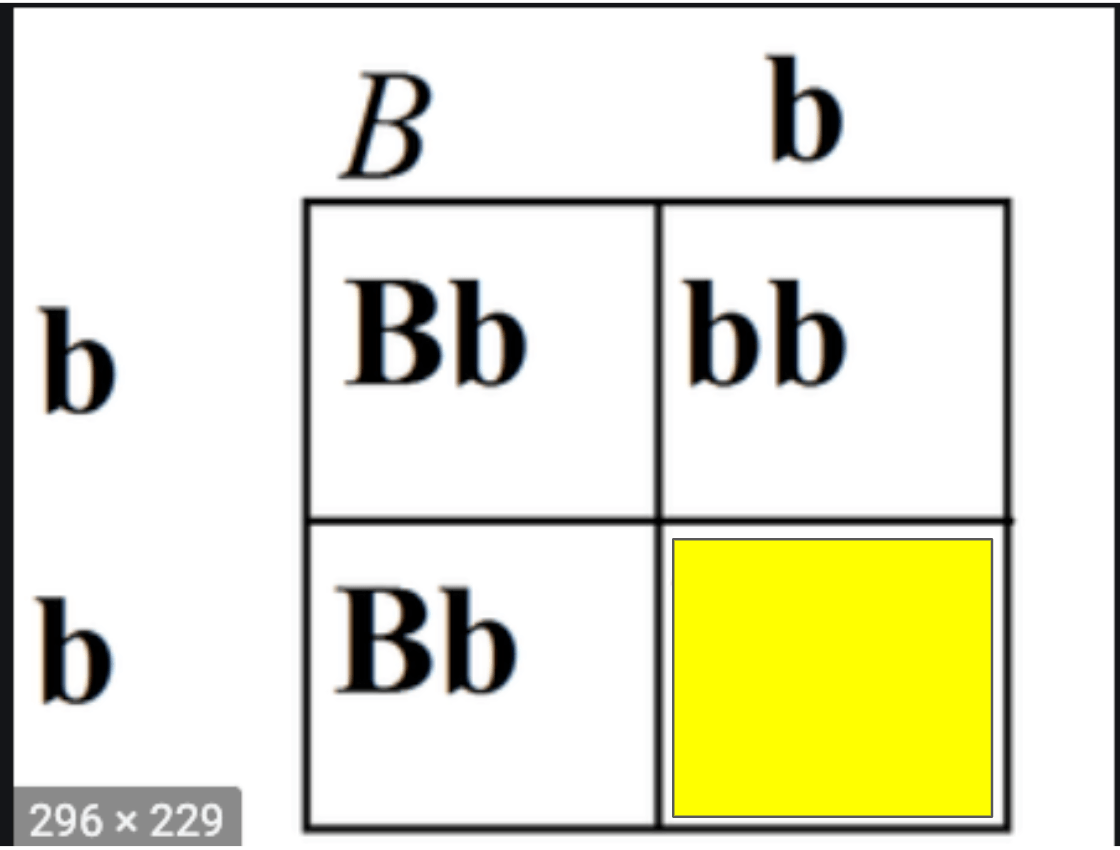
Fill in the Yellow Box

a)

Bb

b)

BB

c)

bb

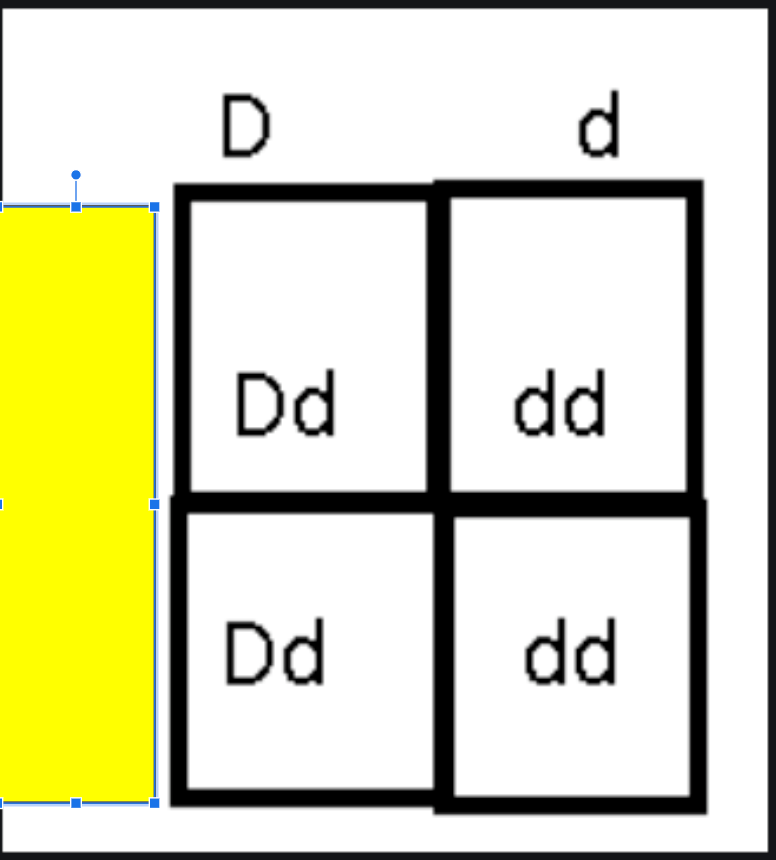
32.

What is the mother's genotype?

a)

DD

b)

Dd

c)

dd

33.

Dominant alleles are represented by a:

a)

capital letter

b)

lowercase letter

34.

AA and Aa will both show up as ___________________ traits.

a)

dominant

b)

recessive

35.

What is the probability that the offspring will have blue eyes?

a)

25%

b)

50%

c)

75%

d)

100%

36.

What is the likelihood that the offspring will have brown eyes (B)?

a)

0%

b)

100%

37.

Which trait is dominant?

a)

pink

b)

white

38.

A tall pine tree (Tt) is crossed with a tall pine tree (Tt). What is the likelihood that an offspring would be tall?

a)

0%

b)

25%

c)

50%

d)

75%

39.

A tall pine tree (Tt) is crossed with a tall pine tree (Tt). What is the likelihood that an offspring could be short?

a)

0%

b)

25%

c)

50%

d)

75%

40.

Round seeds are dominant (R). Wrinkled seeds are recessive (r). What is the likelihood that this offspring is wrinkled (r)?

a)

0%

b)

25%

c)

50%

d)

75%

41.

Round seeds are dominant (R). Wrinkled seeds are recessive (r). What is the likelihood that this offspring is round (R)?

a)

0%

b)

25%

c)

50%

d)

75%

42.

G = green, g = yellow

The genotype for a yellow plant is...

a)

GG

b)

Gg

c)

gg

d)

all of the choices result in yellow

43.

B = brown fur b = white fur

In the punnett square, what is the probability for white fur?

a)

0%

b)

25%

c)

50%

d)

75%

44.

In plants, tall (T) is dominant to short (t). Perform the following cross: Tt x Tt. What is the probability of producing a short plant?

a)

0%

b)

25%

c)

50%

d)

75%

45.

Which of the following alleles is purebred recessive?

a)

Tt

b)

tt

c)

TT

46.

Aa, DD, Ba, and yy are all examples of ---

a)

genotypes

b)

phenotypes

47.

AA and Aa always show up as ---

a)

dominant.

b)

recessive.

48.

A trait controlled by a recessive allele only appears in the organism's phenotype ---

a)

if the organism is a hybrid.

b)

if the organism does not have any dominant alleles.

c)

if the organism is a purebred.

49.
In a flowering plant species, red flower color (R) is dominant over white flower color (r). What is the genotype of any red-flowering plant resulting from this species?
a)
rr
b)
R
c)
RR
d)
RR or Rr
50.
A homozygous dominant brown mouse is crossed with a heterozygous brown mouse (tan is the recessive color). 
a)
100 % tan
b)
100 % brown 
c)
50 % brown and 50% tan 
d)
75 % brown and 25 % tan 
51.

If a heterozygous parent and a homozygous recessive parent mate, what percentage of their offspring will be dominant?

a)

25%

b)

50%

c)

75%

d)

100%

52.
What you see, or the physical appearance.
a)
Genotype
b)
Phenotype
c)
Homozygous
d)
Heterozygous