
 Worksheets
22-23 Macroevolution & Phylogenetic tree review
Total questions: 47
Worksheet time: 36mins
Select ALL lines of evidence below, which support common ancestry and biological evolution.
DNA and amino acid sequences vary among different species, but there are also many overlapping similarities
Vestigial structures
Order of appearance of structures during embryological development
The changes in biodiversity overtime found in the fossil record
Similarity in anatomical structures
The process of evolution primarily results from which factors listed below (Select ALL that apply):
the potential for a species to increase in number
the high heritable genetic variation of individuals within a species due to mutation and sexual reproduction
competition between individuals for an environment's limited resources needed by those individuals to survive and reproduce
the proliferation of those organisms that are better able to survive and reproduce in the environment
the low heritable amount of genetic variation in a population gene pool due lack of random mutations
Natural selection occurs IF in a population only which TWO things are true of that population...
There is variation in the genetic information between organisms in a population
There is very little in the phenotypical variation expressed between individuals within a population
The traits that negatively affect survival are more likely to be reproduced, and thus are more common in the population
There is variation in the expression of that genetic information—that is, trait variation—that leads to differences in performance among individuals
Natural selection leads to ______________, that is, to a population dominated by organisms that are anatomically, behaviorally, and physiologically well suited to survive and reproduce in a specific environment.
artificial selection
mutations
adaptation
extinction
Differing levels of survival and reproduction between individuals within a population is due to...
having an advantageous trait (a "leg up")
always being bigger and stronger than others
the fact that they mutated faster and more frequently
being much faster than the others in their population
If an individual is expressing an advantageous and heritable trait it will lead to what change in the population overtime?
an increase in the overall population size due to the advantageous trait leading to overall higher success between all individuals with and without the trait.
a decrease in the proportion of individuals expressing the advantageous trait overtime in the future generations of the population.
an increase in the proportion of individuals expressing this advantageous trait in future generations and a decrease in the proportion of individuals that do not express the trait.
there is no way to tell because distribution of traits in a population do not predictively change when conditions of the environment change.
Due to how natural selection works slowly overtime to generate adaptation of populations, changes in the physical environment, can cause which of the following?
populations diverge under different conditions causing new distinct species to emerge
the decline–and sometimes the extinction–of some species
increase in the number of individuals of some species
the combining of two distinct species into one hybrid species, reducing biodiversity
If an environment changes too fast or too drastic, leading to members of a species no longer able to survive and reproduce, the opportunity for the species’ evolution is lost and it will _____________.
remain the same species and no longer undergo natural selection
become a convergent species and hybridize with another
diverge into many new species through natural selection
become extinct and the evolution in that lineage will end

Evolution is best defined as:
the process of genetic change overtime
the process which organisms change over time.
the process which organisms that are extinct become revived.
the process which non-living things fossilize.

The solidified remain or imprint of a once living thing are called:
Fossils
Homologous Structures
Vestigial Structures
DNA

What type of evidence is represented in the picture above:
Fossils
Vestigial Structures
DNA
Homologous Structures

What type of evidence is shown in the image above?
Fossil Evidence
Vestigial structures
Homologous Structures
Genetic Evidence

What type of evidence is shown in this picture?
Fossils
Homologous Structures
Vestigial Structures
DNA

What type of evidence are shown in the picture above?
Fossils
Embryology
Homologous Structures
Vestigial Structures

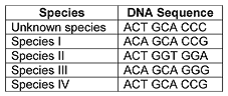


Which scientist is known for his work that he did on the Galapagos Islands to develop his theory of natural selection?
Gregor Mendel
Charles Darwin
Anton Van Leewenhoek
Robert Brown
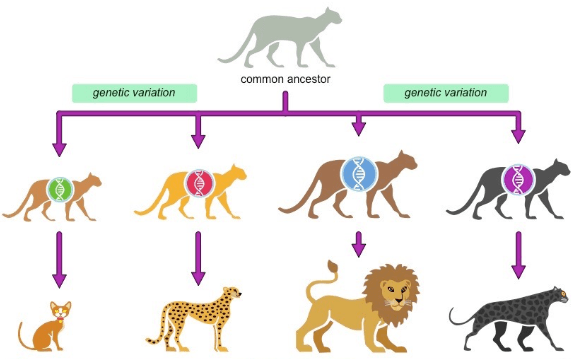
The process by which two populations of the same species become so different that they can no longer interbreed.
natural selection
artificial selection
speciation
fossilization

A species is defined as:
a group of organisms that are extremely different.
a group of organisms that have similar characteristics and always live in the same place.
a group of organisms with similar characteristics and can reproduce to make fertile offspring.
any two organisms to make a hybrid.
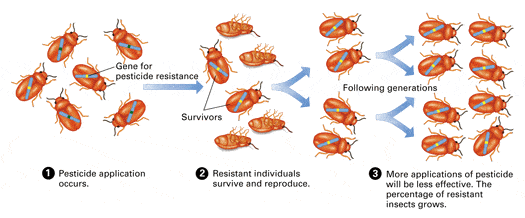
What statement is true regarding why natural selection can be easily seen in insects and bacteria?
Natural selection only occurs in prokaryotic cells
Insects and bacteria can reproduce faster than more complex organisms and pass on selected traits quicker
Insects were the first multi-cellular organism to live on land
Bacteria have directly evolved from insect traits.

Which of the following is true about the picture above?
Camels are highly adapted to cold climates.
There are no benefits to using a camel vs. a horse in the desert.
Camels have directly evolved from whales.
A camels long large intestine, long eyelashes and wide feet allow it to be very adapted to the desert.

Which of the following is true regarding the evidence of evolution
Vestigial structures are not real evidence of evolution.
Homologous structures and fossils are the most dependable forms of evidence.
Comparing DNA is the most definitive and accurate method to show evolutionary relationships.
Embryology and Homologous structures do not support the theory of evolution.


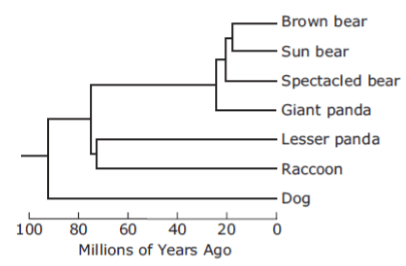
Based on this phylogenetic tree, which statement is true?
Lesser pandas are more genetically similar to giant pandas than they are to raccoons
Brown bears are more genetically similar to giant pandas than they are to sun bears
Lesser pandas are more genetically similar to raccoons than they are to giant pandas
The bear species are all more genetically similar to dogs than they are to giant pandas
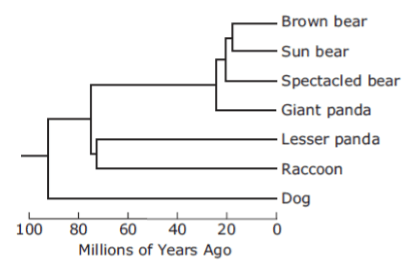
Who is the closest relative to the brown bear?
Giant panda
Dog
Lesser panda
Sun bear
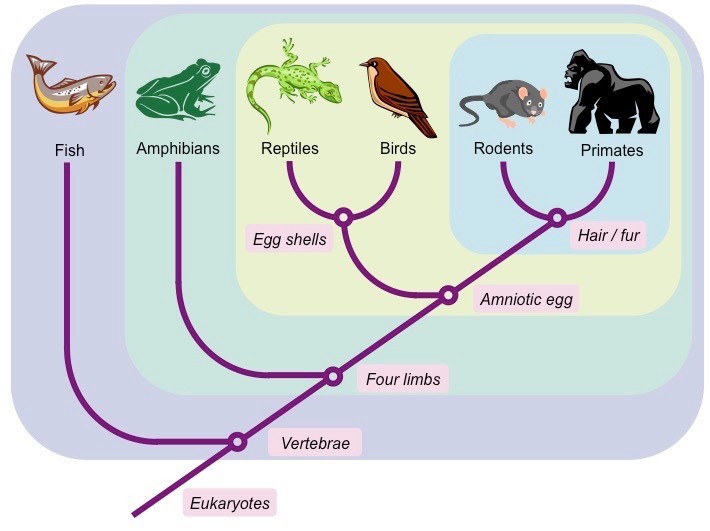
What characteristic distinguishes amphibians from birds and reptiles?
Amniotic egg
Egg shells
Vertebrae
Hair/fur

What is the common ancestor of Letters A, B, C, D, E?
1
2
3
4

Which trait (adaptation) was developed most recently?
tetrapod limbs
feathers
amnion
They developed at the same time

If a sick person takes an antibiotic but it doesn't kill all of the bacteria causing the sickness, what might explain this?
Variations in the bacteria allowed some organisms to be less affected by the antibiotic?
Bacteria cannot be killed by antibiotics
You cannot cure a bacterial infection
Bacteria do not cause sicknesses

Which point is where the sponge and mushroom diverged?
B
C
D
E
Which organism is most closely related to the mouse?
Mushroom
Tomato
Fern
Sponge
Is the mushroom more closely related to the sponge or the tomato?
Tomato
Sponge

Which organism is most likely extinct?
A
B
C
D

Which trait to mice and chimps have that pigeons do not?
Feathers
Fur
Claws or nails
Lungs
Which trait to lizards have that salamanders do not?
Fur
Claws or nails
Lungs
Jaws
Which trait do all organisms share (excluding the hagfish)?
Fur
Claws or nails
Lungs
Jaws

