
 Worksheets
Unit 5- Heredity Review
Total questions: 45
Worksheet time: 2hrs 35mins

An organism is a hybrid genotype (Tt) but is appears tall instead of short.
Law of Dominance
Law of Segregation
Law of Independent Assortment
Which of Mendel's laws states that alleles are separated during meiosis?
Law of Dominance
Law of Segregation
Law of Independent Assortment
If your genotype is Bb, then you can only pass a B or b to your child but you can't pass both.
Law of Dominance
Law of Segregation
Law of Independent Assortment


B = brown fur b = white fur
In the punnett square, what is the probability for white fur?
0%
25%
50%
75%
When one allele is not dominant over the other, resulting in both traits expressed in a heterozygous individual.....
Incomplete Dominance
Codominance
Some flowers are controlled by codominance. Red flowers (RR), blue flowers (BB) and Speckled flowers (RB).
Cross a red flower with a speckled flower. What is the phenotypic ratio?
2 red, 2 speckled
2 red, 2 blue
2 blue, 2 speckled


A roan cow shows codominance in fur color (brown and white). What is the phenotype ratio expected in offspring a female roan and a male roan mate together?
All four would be brown and White
Half would be orange, half would be white
2 Brown: 2 Brown and White: 0 White
1 Brown: 2 Brown and White: 1 White
In Andalusian fowls, black individuals (BB) and white individuals (WW) are homozygous. Heterozygous individuals are grey (BW).
What is the genotype ratio for a cross between a grey fowl and a white fowl?
2 BB: 2 BW: 0 WW
0 BB: 4 BW: 0 WW
0 BB: 2 BW: 2 WW
1 BB: 2 BW: 1 WW
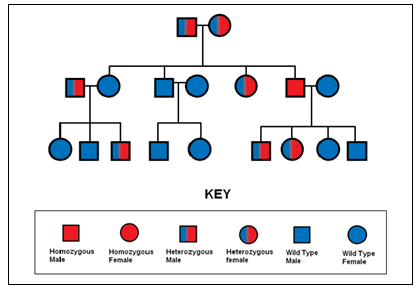


What is the difference between sexual and asexual reproduction?
Asexual produces genetically different offspring. Sexual produces genetically identical.
Sexual produces offspring with fewer chromosomes. Asexual produces more.
Sexual produces genetically different offspring. Asexual produces genetically identical.
Sexual reproduction is quicker than asexual.
The end of mitosis results in ____ to each other.
2 cells that are identical
4 cells that are identical
2 cells that are not identical
4 cells that are not identical
2 haploid cells that are identical
4 diploid cells that are identical
2 diploid cells that are not identical
4 haploid cells that are not identical
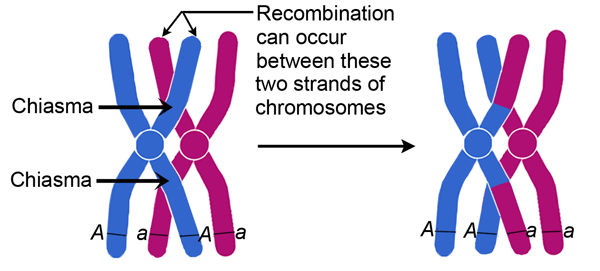
segregation of sister chromatids
condensation and segregation of alleles
mutationin which the DNA content of the gene is altered
crossing - over in which genes are exchanged
In mitosis the (a) daughter cells that are created are (b) . In meiosis the (c) daughter cells that are created are (d)
Which event is an important factor in increasing variety among sexually reproducing organisms?
crossing over
gene linkage
testcross
mitosis
Which is NOT an Asexual reproduction DISADVANTAGE
No genetic variation
Only need one parent
Bad characteristics are passed on
difficult for organisms to adapt

Using the diagram, which type of asexual reproduction is being demonstrated by the bacterial cell?
Binary Fission
Budding
Spore Formation
Regeneration
Takes only one individual to reproduce and takes a longer time to reproduce
Takes only one individual to reproduce and takes a shorter time to reproduce
Which type(s) of cellular division result in new cells that are identical to the parent
Binary Fission
Meiosis
Mitosis
Gamete Formation
The failure of one or more pairs of homologous chromosomes or sister chromatids to separate "normally" during meiosis is called _____________________.
nondisjunction
anaphase I
nondiploidy
karyotype
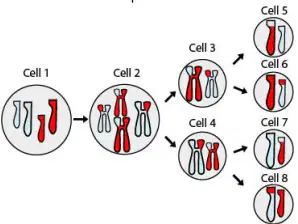
Use the model to describe how genetic continuity is preserved through meiosis.
Cell 7 shows different colored chromosomes than Cell 8. When meiosis is a part of reproduction, none of the offspring will have similar DNA.
Cell 2 shows twice as many chromosomes as Cell 3. When meiosis is a part of reproduction, the offspring inherits twice as much DNA as its parent.
Cell 6 shows different colored chromatids than Cell 1. When meiosis is a part of reproduction, the offspring's DNA will be entirely different from the parent's DNA.
Cell 5 shows half the number of chromatids present in Cell 1. When meiosis is a part of reproduction, half of the offspring's DNA will come from each parent.
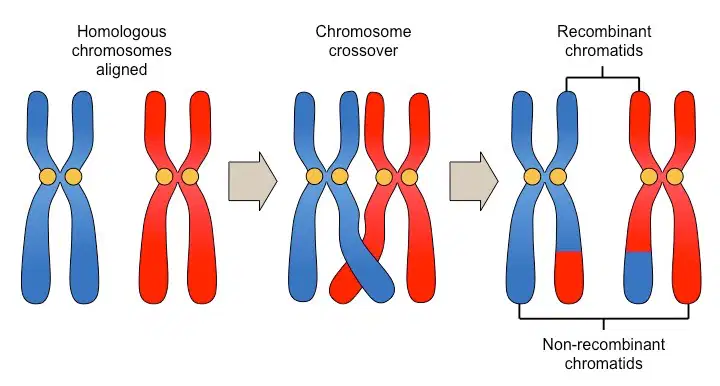
Which claim about crossing over in chromosomes is best supported by the diagram?
Crossing over increases genetic diversity through deletion.
Crossing over decreases genetic diversity through mutation.
Crossing over increases genetic diversity by creating new combinations of genes.
Crossing over decreases genetic diversity by inserting nucleotides into gene sequences.

Failure of homologous chromosomes
to separate during meiosis.
Results in gametes with either one extra or one missing chromosome.
Translocation
Nondisjunction
Replication
Transcription

Match the following
Heterozygous
Rr
Homozygous Dominant
RR
Homozygous Recessive
rr
Homozygous dominant for one trait and heterozygous for another
RRTt
Homozygous recessive for one trait and heterozygous for another
rrTt

How many of the offspring would have a black, rough coat?
**Black and Rough are both dominant traits
9
7
3
1

How many of the offspring would have a black, smooth coat?
**Black is dominant and smooth is a recessive trait
9
7
3
1
Colorblindness is a sex-linked recessive trait. A colorblind woman marries a male with normal color vision. What is the percent chance of them having a color blind son?
0%
25%
50%
75%
The woman who is colorblind marries a man with normal vision. What is the probability that their sons will be colorblind?
0%
25%
50%
100%

