Wayground logo

Free Printable Worksheets

Font size

S
M
L
XL
Worksheets

Quiz #10 (Endocrine, Nervous & Immune Systems)

Total questions: 50

Worksheet time: 1hrs 3mins

Name
Class
Date
1.
A signal molecule that binds to a plasma-membrane protein is a
a)
ligand
b)
second messenger
c)
protein kinase
d)
receptor protein
2.
What determines whether a cell is a target cell for a particular signal molecule?
a)
phosphorylation cascade
b)
cAMP
c)
signal receptors
d)
phosphatase
3.

Which of the following is a chemical message that usually travels through the bloodstream to target cells?

a)

hormone

b)

local regulator

c)

endocrine cell

d)

plasmodesmata

4.

Which of the following is caused by a lack of iodine:

a)

tetany

b)

goiter

c)

diabetes insipidus

d)

Parkinson's disease

5.

Which of the following is the storage form of glucose:

a)

glycogen

b)

glucagon

c)

gluconeogenesis

d)

glycogenolysis

6.

What is the main function of the endocrine system?

a)

It creates chemicals, or hormones, that are sent around the body to maintain homeostasis.

b)

It creates electrical messages that are sent around the body to maintain homeostasis.

c)

It maintains the correct level of oxygen in the body to maintain homeostasis.

d)

It releases waste from the body to maintain homeostasis.

7.

Glucagon is released in response to:

a)

low blood glucose levels

b)

high blood glucose levels

c)

low blood salt levels

d)

low blood calcium levels

8.

Glucagon targets:

a)

the pancreas

b)

all cells of the body

c)

the liver

d)

mostly fat cells

9.

Glucagon triggers:

a)

the liver to break down glucose into glycogen

b)

the bones to uptake calcium, via osteoblasts

c)

the liver to break down glycogen into glucose

d)

the kidney to released glucose into the blood stream

10.

Together, both glucagon and insulin help:

a)

maintain homeostasis

b)

maintain blood glucose levels

c)

keep the body from an energy crisis

d)

All of the above

11.

Which of the following is a disease where sufferers cannot control their blood glucose levels?

a)

Diabetes

b)

Influenza

c)

Cholera

d)

Cystic fibrosis

12.
An organism that has a stable body temperature should be classed as:
a)
Poikilotherm
b)
Homeotherm
c)
Endotherm
d)
Ectotherm
13.
An organism that produces its own body heat should be classed as:
a)
Poikilotherm
b)
Homeotherm
c)
Endotherm
d)
Ectotherm
14.
An organism that relies on the environment for body heat should be classed as:
a)
Poikilotherm
b)
Homeotherm
c)
Endotherm
d)
Ectotherm
15.

Homeostatic cooling mechanisms include

a)

piloerection and panting

b)

panting and vasoconstriction

c)

sweating and piloerection

d)

sweating and vasodilation

16.

temperature regulation center in the brain of a human

a)

hypothalamus

b)

thermoregulation

c)

receptor

d)

negative feedback

17.
Maintaining body temperature is an example of a:
a)
negative feedback loop
b)
positive feedback loop
18.
What is the evaporation of a liquid to cool the body?
a)
Shivering
b)
Sweating
c)
Vasodilation
d)
Vasoconstriction
19.
If the environment gets cold, we will often shiver in order to:
a)
keep body temperature the same as the external temperature
b)
decrease body temperature
c)
increase body temperature
d)
regulate blood pressure
20.

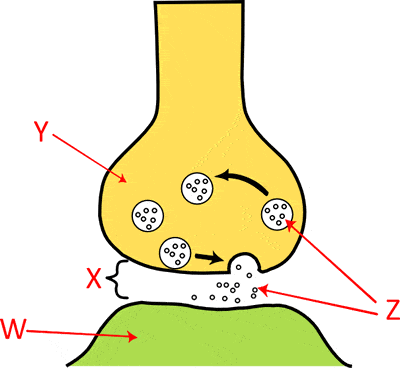
What is W?

a)

Axon Terminal

b)

Neurotransmitters

c)

Dendrite

d)

Synapse

21.

What is Y?

a)

Axon terminal

b)

Neurotransmitters

c)

Dendrite

d)

Synapse

22.

Where are neurotransmitters located within in neuron?

a)

axon terminals

b)

dendrites

c)

Schwann cells

d)

cell body

23.

Calcium ions (Ca2+)are responsible for.....

a)

signaling the release of the neurotransmitter

b)

signaling Na+ to be released into the membrane

c)

signaling the release of K+ out of the membrane

d)

serving as the neurotransmitter

24.

Location at which a neuron can transfer an impulse to another cell with the use of neurotransmitters is called ...

a)

myelin sheath

b)

axon

c)

threshold

d)

synapse

25.
What is the normal resting potential of a neuron cell membrane?
a)
+40mV
b)
-30mV
c)
+55mV
d)
-70mV
26.
Which ions are involved in an action potential?
a)
Na; Cl
b)
Na; K
c)
K; Cl
d)
Na; Ca
27.
At which point on the diagram does depolarisation of the axon occur? 
a)
A
b)
B
c)
C
d)
D
28.
The sodium potassium pump restores the resting potential. By which process does this work? 
a)
Osmosis
b)
Diffusion
c)
Facilitated diffusion
d)
Active transport
29.
When a neuron is not engaged in an impulse.
a)
Resting potential
b)
Action potential
c)
Neural potential
d)
Synaptic potential
30.
A membrane potential becoming less negative is called
a)
hyperpolarization
b)
depolarization
c)
repolarization
d)
polarization
31.
In resting potential, neurons have more _________ on the outside of the cell membrane.
a)
K+
b)
NaCl
c)
Na+
d)
Cl-
32.

What number(s) on the graph represents the THRESHOLD level of stimulus?

a)

1 and 5

b)

2

c)

3

d)

6

33.
When a membrane potential reaches +30mV, ________ channels open, ________ occurs, and ________ channels close.
a)
Sodium, depolarization, potassium
b)
Potassium, depoloarization, sodium
c)
sodium, repolarization, potassium
d)
postassium, repolarization, sodium
34.
Why is -55 mV a significant number?
a)
This is the largest charge achieved during an action potential
b)
This is the threshold required to complete an action potential
c)
This is the resting charge of a neuron
d)
This is the charge when all the sodium is inside the cell
35.
The sodium-potassium pump....
a)
Sends (Na+) into the cell
b)
Sends (K+) into the cell
c)
Exchanges (K+) & (Na+) during depolarization
d)
Exchanges (K+) & (Na+) during hyperpolarization
36.
At what stage are both ions present in large concentrations INSIDE the neuron?
a)
Depolarizarion
b)
Repolarization
c)
Hyperpolarization
d)
Resting Potential
37.
What number on the graph represents the Hyperpolarization phase?
a)
1
b)
2
c)
3
d)
4
38.

When is the potassium channel open?

a)

during rest only

b)

during repolarization only

c)

during depolarization only

d)

all the time

39.

An action potential is __________ in nature, with the inside of the neuron being more ________.

a)

chemical, negative

b)

electrical, negative

c)

chemical, positive

d)

electrical, positive

40.
An organism that enters a life form and causes disease or sickness is a/an:
a)
macrophage
b)
pathogen
c)
vaccine
d)
flu
41.
The organism that is infected by a pathogen/antigen is known as the:
a)
survivor
b)
infectee
c)
source
d)
host
42.
Which of the following is NOT part of the first line of defense?
a)
skin
b)
B cells
c)
sweat
d)
lysozyme
43.
Which type of immunity has memory?
a)
innate
b)
adaptive/acquired
44.
Which line of defense includes the skin, sweat, mucous membranes, and normal microbiota?
a)
First
b)
Second
c)
Third
45.
Cells that ingest pathogens are
a)
plasma cells
b)
phagocytic cells
c)
helper T cells
d)
antibodies
46.
T cells are made in the___________
a)
bone marrow
b)
spleen
c)
thymus
d)
tonsiles
47.
Anything that triggers an immune response is a/n
a)
lymph cell
b)
antigen
c)
antibody
d)
neutrop
48.
B cells mature in the
a)
thymus
b)
intestine
c)
bone marrow
d)
heart
49.
What do B cells produce?
a)
antigens
b)
macrophages
c)
T cells
d)
antibodies
50.
Which of the following is a non-specific response?
a)
Fever
b)
Red, itchy eyes that may be crusted shut
c)
Signs that is related to one antigen