
NEW
Font size
 Worksheets
Unit 3: Matter and Motion Review
Total questions: 68
Worksheet time: 39mins
isotope
How does thermal energy play a role in particle motion and changes of state?
Thermal energy is a term that refers to temperature
Increasing an object's thermal energy increases particle motion and can cause a change of state.
Decreasing an object's thermal energy increases particle motion and can cause a change of state.
Thermal energy is the energy added from a heat source.
What happens to particles during changes of state between solid and liquid.
Particles move so fast they break from their fixed position.
Particles melt and become a liquid.
Particles find a circular orbit around an atom's nucleus.
Particles stop vibrating and change into their liquid form.
What is a main difference between boiling and evaporation?
Boiling requires an outside power source and the evaporation process is internal.
Evaporation takes place at one temperature, boiling takes place at all temperatures.
Boiling takes place at one temperature, evaporation takes place at all temperatures.
Boiling takes can only occur through mechanical methods.
Boiling a liquid...
Has the opposite effect of evaporating a liquid.
Happens at a lower temperature at a lower altitude.
Decreases pressure inside of the liquid.
Increases pressure inside of the liquid.
The reverse of vaporization is...
Condensation
Sublimation
Deposition
Alienation
Condensation occurs when...
Liquid is condensed into a solid.
Water vapor becomes snow at high altitudes.
As a liquid is heated to boiling.
Vapor is cooled on a surface.
An example of sublimation is..
Dry ice turning into CO2
Water Freezing
Dry ice turning into H2O
Lava erupting from a volcano
Pressure effects changes of states because...
Particles confined to a smaller space can move less freely.
Particles are unable to change states under immense pressure.
Particles confined to a smaller space are able to change state with less thermal energy.
Pressure increases the thermal energy of particles.
Water temperature will stop increasing as ice is melting.
True
False
The change of state from a solid to a liquid is called
freezing
melting
boiling
evaporating
The change of state from a liquid to a gas is called
boiling
evaporation
vaporization
sublmiation
The change of state from a solid to a gas is called
freezing
melting
boiling
sublimation
The flat part of a graph showing the temperature of a liquid as it cools over a period of time indicates that
a solid is changing to a liquid
a liquid is changing to a solid
a liquid is changing to a gas
a gas is changing to a liquid
Which property is true of a crystalline solid?
Its particles have a regular, repeated pattern.
Its particles have no pattern.
Its particles are spread out and can flow past each other.
Its particles are so far apart, they can spread in a container.
Herbie notices that a spill on the kitchen floor was gone the next morning. The best description of what happened to the spill is
It evaporated
It sublimated.
It boiled.
It froze.
Iodine gas particles can change directly to a solid when cooled. What is the name of this change of state?
condensation
deposition
freezing
plasma
Particles begin to move faster if they have an increase in
speed
size of particle
thermal energy
thermometer
Herbie makes a graph of the temperature of a solid as he heats it. What shape will the graph have?
A diagonal line that starts low and keeps going up the whole way.
A diagonal line that starts low, has a flat portion, then goes up again.
Gertrude is observing liquids at a birthday party. Some are sweet, some are hot, and some are sticky. If she could look at the particles of the liquids, which statement would be true?
The particles are far apart and moving fast, with no shape.
The particles may touch but they can flow past each other.
The particles are in close contact and cannot move from their places.
The particles have no arrangement.


Segment A-B The bus is _________________.
at rest
returning (to original position)
moving forward
A bicycle rode 210 meters in 3 minutes. What was the speed of the bicycle?
630 m/min
70 m/min
7 m/min
7,000 m/min

Which of the graphs show that a car is stopped?
E
F
G
H
What is a force?
the PUSH or PULL on an object
The MOTION an object creates
The objects HITTING one another
Going REALLY FAST
What is the unit for FORCE?
N (Newtons)
lbs (pounds)
g (grams)
m/s (meters per second)
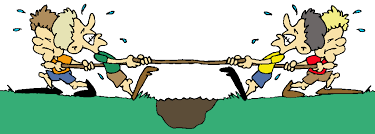
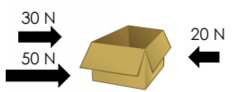
If the net force is 0 the object will ...
CHANGE its motion
STAY the SAME, NOT Move
Match the description to the graph:
"The car is stopped."


Match the description to the graph:
"The car is traveling at a constant speed."
What is the equation to calculate distance?
distance = speed/time
distance = time/speed
distance = speed/distance
distance = speed x time
This is used to MEASURE force:
A balance scale
A digital scale
A spring scale
A mass scale

What is this tool used to measure?
temperature
length
distance
force
Match the description to the graph:
"The car is stopped."
Match the description to the graph:
"The car is traveling at a constant speed."
Match the description to the graph:
"The speed of the car is decreasing."
Match the description to the graph:
"The car is coming back."
Segment A-B The bus is _________________.
at rest
returning (to original position)
moving forward
Segment O-A The bus is _________________.
at rest
returning (to original position)
moving forward

Which runner won the race?
Albert
Bob
Charlie
Which runner stopped for a rest?
Albert
Bob
Charlie
How long did Charlie stop for a rest?
2.5 seconds
2 seconds
3 seconds
5 seconds
What is a force?
the PUSH or PULL on an object
The MOTION an object creates
The objects HITTING one another
Going REALLY FAST
What is the unit for FORCE?
N (Newtons)
lbs (pounds)
g (grams)
m/s (meters per second)
If the net force is 0 the object will ...
CHANGE its motion
STAY the SAME, NOT Move
What is the equation to calculate distance?
distance = speed/time
distance = time/speed
distance = speed/distance
distance = speed x time
________ can be calculated if you know the distance an object traveled and the unit of time. (distance ÷ time)
Speed
Motion
Opportunity
Velocity
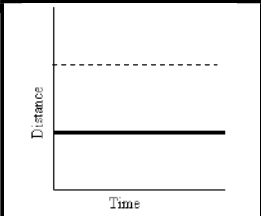
What does the solid line on this graph represent?
Constant speed
Acceleration
At rest
deceleration
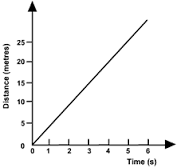
What is the line on this graph showing?
moving away from starting point at a constant speed
moving back towards the starting point at a constant speed
acceleration (getting faster)
deceleration (getting slower)


1st
Law of Motion
2nd
Law of Motion
3rd
Law of Motion
1st
Law of Motion
2nd
Law of Motion
3rd
Law of Motion

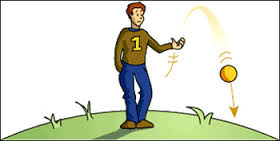

The Law of Inertia
Newtons 1st Law of motion
Newtons 2nd Law of motion
Newtons 3rd Law of motion



