wayground logo

Free Printable Worksheets

Font size

S
M
L
XL
Worksheets

Ecology

Total questions: 79

Worksheet time: 59mins

Name
Class
Date
1.
Study of interactions between organisms and their environment 
a)
niche
b)
community 
c)
ecology
d)
ecosystem
2.
Members of a species in a defined area
a)
Ecosystem
b)
community
c)
biodiversity
d)
population
3.
Non-living factor that affects an ecosystem
a)
biotic factor
b)
abiotic factor
c)
food chain 
d)
biome
4.
What is the original source of almost all energy in most ecosystems?
a)
carbohydrates
b)
sunlight
c)
water
d)
carbon
5.
The nonliving aspects of an ecosystem.
a)
Abiotic factors
b)
Biotic factors
6.
A collection of organisms that belong to different populations but all live in the same area and interact with one another.
a)
Population
b)
Ecosystem
c)
Community
d)
Ecosphere
7.
Organisms that obtains its energy from abiotic sources, such as sunlight or inorganic chemicals
a)
Autotroph
b)
Heterotroph
c)
Omnivore
d)
Carnivore
8.

A bee receives nectar from a flower and carries the pollen to other flowers:

a)

predation

b)

parasitism

c)

mutualism

d)

commensalism

9.

What would be a good example of a primary consumer?

a)

carnivore

b)

detrivore

c)

decomposer

d)

herbivore

10.

Which organisms would be at the top or last trophic level?

a)

plant

b)

herbivore

c)

omnivore

d)

carnivore

11.

The monkey would be a

a)

decomposer

b)

producer

c)

primary consumer

d)

secondary consumer

12.

Mice might grow in population and destroy the community by eating all of the berry bushes if

a)

wolves and snakes were removed from the food web

b)

another predator migrated in to the community

c)

the snake population grew

d)

none of these

13.

These organisms are often not shown in a food chain, but are important for recycling nutrients

a)

producers

b)

decomposers

c)

primary consumers

d)

carnivores

14.

A lion that eats a zebra that eats grass is a

a)

primary consumer

b)

secondary consumer

c)

tertiary consumer

d)

quaternary consumer

15.

90% of the energy that gets lost as you move up a food pyramid or chain gets lost as

a)

pollution to the environment

b)

heat to the environment

c)

energy for decomposers

d)

gets recycled

16.

What percentage of energy is passed on to the next trophic level?

a)

5%

b)

10%

c)

50%

d)

90%

17.

Barnacles are animals that cannot move. In order to get food, they attach to whales and catch any floating plankton in the water. The whale is neither helped nor harmed in the interaction. What type of symbiosis is this?

a)

Mutualism

b)

Commensalism

c)

Parasitism

d)

Neutralism

18.

In the wild, some alligators gets their teeth cleaned by birds. The birds gets their food from the alligators' teeth.

What type of symbiosis is this?

a)

Mutualism

b)

Commensalism

c)

Parasitism

d)

Neutralism

19.

In this photo, what is an abiotic factor?

a)

Deer

b)

Grass

c)

rain

20.

What is this picture describing?

a)

It is describing natural selection.

b)

It is describing direct competition between flamingos and ducks.

c)

It is describing abiotic factors of the tundra.

d)

It is describing the niche of each bird.

21.
All of the living and nonliving things in an area that interact with each other are called a/an ______.
a)
community
b)
habitat
c)
population
d)
ecosystem
22.
An area where an organism finds food, shelter and water in a specific arrangement
a)
niche
b)
biosphere
c)
biome
d)
habitat
23.
The living part of an ecosystem
a)
Biotic
b)
Abiotic
c)
Mother Earth
d)
Flowers
24.
Bacteria which convert nitrogen gas into bio-available forms of nitrogen, such as ammonia and nitrate, are known as _____
a)
De-nitrification bacteria 
b)
Nitrogen fixing bacteria
c)
Oxidizers
d)
Buffers
25.

In the food chain below if the worm contains 6 calories of energy, how much energy is available to the turtle to grow, develop, and reproduce?

a)
0.06
b)
0.6
c)
6
d)
60
26.
Which of the following is another word for a plant?
a)
autotroph
b)
heterotroph
c)
consumer
27.
Which of the following is an organism that eats only meat?
a)
herbivore
b)
carnivore
c)
omnivore
28.
Which is an example of a parasitic relationship?
a)
a bee pollinates a flower
b)
a tapeworm takes nutrients from a dog
c)
an orchid lives in a tree but does not harm the tree
29.
In which type of relationship do both species benefit?
a)
parasitism
b)
mutualism
c)
commensalism
30.
An oxpecker bird eats ticks off of a zebra.  The bird gets food from eating the ticks and the zebra has harmful parasites removed.  Which type of symbiosis is this?
a)
mutualism
b)
parasitism
c)
commensalism
31.

Which of the following statements account for the change in population seen between years 7 and 8?

a)

The birth rate of the pigeons increased.

b)

The emigration rate of the pigeons decreased.

c)

The death rate of the pigeons exceeded the birth rate.

d)

The neighborhood reached its carrying capacity for the pigeon population

32.

Scientists found, that over a period of 200 years, a mountain pond was transformed into a meadow. During that time, several communities of organisms were replaced by different communities. Which of these best explains why new communities were able to replace older communities?

a)

The original species became extinct.

b)

Species in the older community died from old age.

c)

The abiotic characteristics of the habitat changed.

d)

Diseases that killed the older organisms disappeared.

33.

Each step in a food chain is called a trophic level. What percentage of energy available at one trophic level is transferred to organisms at the next level?

a)

about 2 percent

b)

about 10 percent

c)

about 25 percent

d)

about 50 percent

34.
Which best describes what a food chain shows you?
a)
Energy flow through an ecosystem
b)
Food flowing through an ecosystem
c)
Consumers going into other consumers
d)
Who eats who
35.
Which of the following is a herbivore?
a)
cricket
b)
frog
c)
hawk
d)
shrew
36.
An organism that gets energy from breaking down dead organisms, non-living material or waste
a)
producer
b)
consumer
c)
decomposer
d)
autotroph
37.
A secondary consumer 
a)
eats primary consumers
b)
eats producers
c)
eats plants
38.
Another name for a consumer is a
a)
heterotroph
b)
autotroph
c)
producer
d)
plant
39.
Which organism recieves the least amount of energy from the producer?
a)
Owl
b)
Grasshopper
c)
Lilypad
d)
Mouse
40.
Which organism receives the least amount of energy from the producer?
a)
The squirrel
b)
The shrew
c)
The deer
d)
The rabbit
41.
In the food web shown, which is the tertiary consumer?
a)
large lizard
b)
snake
c)
scorpion
d)
desert fox
42.
In a food chain, the first link (where the energy begins) is always:
a)
a primary consumer
b)
a decomposer
c)
a producer
d)
an omnivore
43.

Populations with organisms that are larger in size, have longer lifespan and low reproductive rates. Generally represented by s-shaped growth curves...

a)

k-selected

b)

r-selected

44.

Populations with organisms that are small in size, have shorter lifespan and high reproductive rates... generally exhibit exponential growth with j-shaped growth curves

a)

k-selected

b)

r-selected

45.

Look at this image- What is the carrying capacity of this population?

a)

21

b)

5000

c)

2000

d)

1000

46.

Is this graph showing exponential growth or logistical growth?

a)

Exponential

b)

logistical

47.

What type of growth is represented by this graph?

a)

exponential

b)

logistic

48.
Largest number of individuals of a population that the environment can support...  
a)
carrying capacity
b)
population crash
c)
lag phase
d)
mutualism
49.
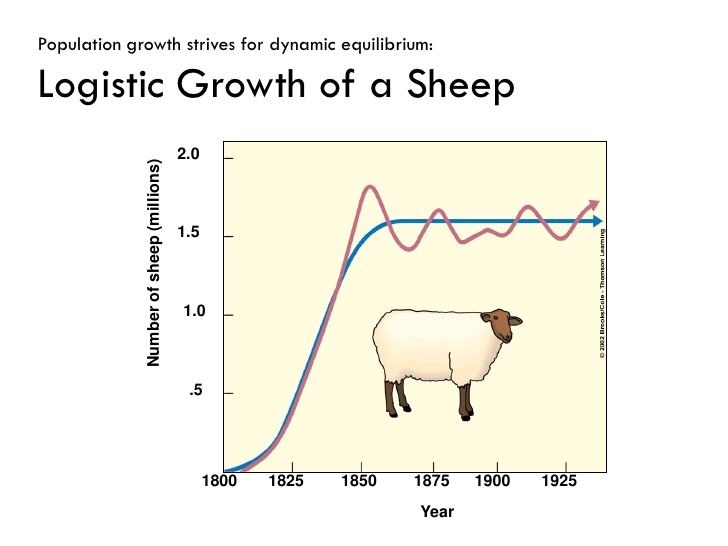
What is the carrying capacity for this sheep population?
a)
1.8 million
b)
1.25 million
c)
1.6 million
d)
1.o million
50.

Why has the human population been able to grow so quickly in such a short period of time?

a)
Doctors have developed easier and safer ways to have babies
b)
People needed more help to work their farms so they had more children
c)
Because people stayed in one place and only moved when crowded out
d)
Because of medical care, clean water and better access to nutritious food
51.

Exponential population growth can be described as

a)

growth when resources are limited

b)

a j-shaped curve

c)

a s-shaped curve

d)

growth that reaches carrying capacity

52.

Factor that causes population growth to decrease.

a)

growth factor

b)

limiting factor

c)

density factor

d)

environmental factor

53.

If a population grows larger than its environmental carrying capacity, then

a)

death rate may rise.

b)

death rate may fall significantly.

c)

birth rate may rise significantly.

d)

immigration rate may increase.

54.

What type of growth is the human population experiencing today?

a)

Exponential growth

b)

Zero population growth

c)

Slight decreases in growth

d)

Slight increases in growth

55.

Exponential Growth occurs when-

a)

populations have plenty of food/space

b)

home to keystone species

c)

have few evasive species in a habitat

d)

have little to no competition or predators

56.
What is it called when plants give off water vapor as a waste product?
a)
condensation
b)
evaporation
c)
sublimation
d)
transpiration
57.

The only organisms that can convert nitrogen in the atmosphere into a form useful to living things are nitrogen-fixing

a)

plants

b)

bacteria

c)

insects

d)

animals

58.
During which stage do clouds form?
a)
condensation
b)
evaporation
c)
precipitation
59.

When liquid water changes to a gas and returns to the atmosphere as part of the WATER CYCLE

a)

precipitation

b)

evaporation

c)

condensation

d)

runoff

60.

When water vapor cools and forms into liquid water as part of the WATER CYCLE

a)

transpiration

b)

percolation

c)

evaporation

d)

condensation

61.

When water falls to the ground as rain, sleet, snow or hail as part of the WATER CYCLE

a)

transpiration

b)

evaporation

c)

precipitation

d)

runoff

62.

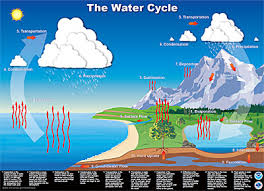
In this diagram,

D = What process in the WATER CYCLE?

a)

percolation

b)

condensation

c)

transpiration

d)

precipitation

63.

TRUE or FALSE: When bacteria eat dead, decomposing material in soil, they change Carbon into Carbon Dioxide.

a)

TRUE

b)

FALSE

64.

TRUE or FALSE: When fossil fuels are burned, very little Carbon Dioxide is released into the atmosphere.

a)

TRUE

b)

FALSE

65.

In the NITROGEN CYCLE, who is responsible for changing the Nitrogen into a "usable" form?

a)

plants

b)

animals

c)

bacteria

d)

this is a trick question ... it is already in a usable form!
66.
When animals perform ___________________ they take oxygen out of the atmosphere and release carbon dioxide 
a)
Nitrogen Cycle 
b)
Photosynthesis
c)
Aerobic Respiration
d)
Anaerobic Respiration
67.
When plants perform __________________ they take carbon dioxide out of the atmosphere and release oxygen. 
a)
Cellular Respiration
b)
Photosynthesis
c)
Nitrogen Cycle 
d)
Aerobic Respiration
68.
After a volcanic eruption, lava covers the land. What is the order that plants grow to repopulate the area?
a)
Lichens → Shrubs → Grasses → Trees
b)
Lichens → tree → shrubs→Grasses
c)
Grasses → Lichens → Shrubs → Trees
d)
Lichens → Grasses → Shrubs → Trees
69.
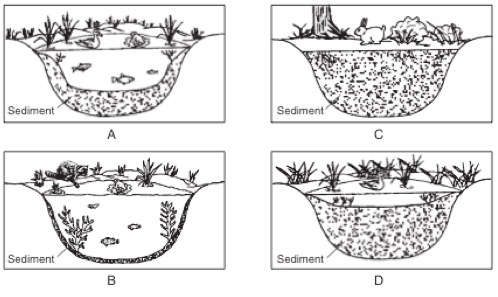
What is the correct order from oldest (happened first) to youngest (happened last) in this pond succession?
a)
A, B, C, D
b)
D, C, B, A
c)
B, A, D, C
d)
C, D, A, B
70.
A pioneer species is...
a)
a large organism
b)
the first organisms to adapt to a new environment 
c)
The best organism 
d)
Abiotic organisms 
71.

The Final stage of ecological succession is...

a)

Mature Tree Growth

b)

Climax Community

c)

Pioneer Community

72.
Replacement of one type of community by another at a single place over time
a)
symbiosis
b)
succession
c)
competition
d)
cooperation
73.
When a population grows past the ecosystem's carrying capacity, what happens to the population?
a)
Continues to grow
b)
The population starts to die off to return to carrying capcity
c)
The population will go extinct due to lack of resources
d)
The population grows then finds a new carrying capacity
74.

When a population has reached carrying capacity

a)

Births & Immigration are equal to Death & emigration

b)

Births & Immigration are less than Death & emigration

c)

Births & Immigration are greater than Death & emigration

d)

Births are exponential

75.
 Which biome is more likely to survive a change in the environment?
a)
High (rich) biodiversity
b)
Low (poor) biodiversity
76.
What does biodiversity mean?
a)
Only one species in an area.
b)
The different amount of species in an area
c)
All abiotic life
d)
Nitrogen fixation
77.

A tick living on a dog

a)

mutualism

b)

commensalism

c)

parasitism

78.

Bees and a flower

a)

mutualism

b)

commensalism

c)

parasitism

79.
Commensalism is where one organism is benefiting and the other organism is _____________________. 
a)
not effected
b)
helped
c)
harmed
d)
hurt