
Font size
 Worksheets
MU Alkanes Alkenes Alcohols Carbonyl Quiz
Total questions: 70
Worksheet time: 1hrs 10mins
Which one is Lucas reagent?
Cold dilute alkaline KMnO4
Con.HCl / anhydrous ZnCl2
FeSO4 / H2O2
Anhydrous AlCl3
Which one gives turbidity immediately with Lucas reagent?
2- propanol
1-propanol
2-methyl 2-propanol
2-methyl 1-propanol

Classify the types of alcohol of the following molecule.
Primary alcohol
Secondary alcohol.
Tertiary alcohol
Aromatic alcohol.
Give the structure corresponding to 3–cyclohexyl–3–pentanol.


State the rule used to convert 2-methylpent-1-ene to 2-methylpent-2-ol.
Zaitsev's rule
Markovnikov's rule
Hund's rule
Aufbau's rule
Propanol is heated with acidified potassium dichromate. The following statements about this reaction is true except for
Green solution is formed.
Orange solution is formed.
Acidic product is formed.
Cr6+ is reduced to Cr3+.
2-butanol heated with acidified KMnO4 solution produced
butanone
butene
butanoic acid
butane
2-methyl-1-propanol heated with acidified K2Cr2O7 solution produced
alkene
carboxylic acid
alcohol
ketone
glacial ethanoic acid heated with 2-propanol in the presence of concentrated H2SO4 produced
ester (2-propyl ethanoate)
salt
carboxylic acid (pentanoic acid)
alcoholic
The functional group exist in alcohol is
Carboalkoxy
Halogen
Hydroxy
carbonyl

The IUPAC name for this compund is
1-butanol
2-butanol
2-methyl-2-propanol
2-propanol
Alcohol W produces a carboxylic acid upon oxidation with hot acidified KMnO4. Alcohol W is probably a ....
tertiary alcohol
secondary alcohol
primary alcohol
haloalkane
alkene + ? --> alcohol
hydrogen
oxygen
water
carbon dioixde
Which of the following statement is NOT true about an alcohol?
Methanol is the simplest alcohol.
Alcohol is more polar than haloalkane.
Ethanol can be prepared by fermentation.
Solubility of alcohol in water increases with number of carbon atoms.
Ethene reacts with acidified potassium manganate (VII) solution to form a product.
What is the name of this reaction ?
halogenation
hydrogenation
hydration
oxidation
What is the condition for hydration of butene ?
phosphoric acid, 60 atm, 300 0C
Nickel or platinum, 180 oC
1000atm, 200 oC
room temperature

Which the CORRECT reagent and condition for A
HBr
Cl2, H2O
H2, Ni
HBr, H2O2

Deduce the structure for B


Deduce the structure for C


Name this compound
propene
2-methylprop-1-ene
2-methylpropene
2, methylpropene

What is the reagent/condition suitable in box for this reaction?
H2 / Ni
HBr
H2O / H+
conc H2SO4 and heated
What is the colour of chemical test alkenes reacted with bromine in dichloromethane?
Purple colour remain unchanged
Purple colour decolourised
Reddish brown remain unchanged
Reddish brown decolourised
Which compound is an alkene?
C2H6
C3H8
C4H8
C5H8
Alkenes are used in making plastics. Where do the alkenes come from?
addition reaction
cracking
crude oil
fractional distillation
Hexane has the formula C6H14. Which substance CANNOT formed by cracking hexane?
H2
C2H4
C4H10
C7H16
How many isomers can butene have?
0
2
3
4
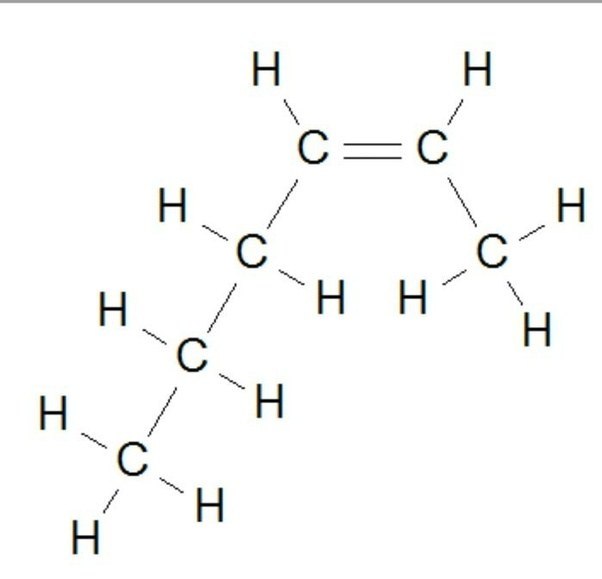
Give the name for the compound shown in the picture:
4-hexane
2-hexane
4-hexene
2-hexene


Diagram represents the structural formula of a carbon compound.
Which of the following alcohol reacts with propanoic acid to produce the above compound?
CH3OH
CH3CH2OH
CH3CH2CH2OH
CH3CH2CH2CH2OH

Diagram shows oxidation process of ethanol.
What can be observed after being heated for 5 minutes?
No colour change
All of the ethanol vapourises and the flask becomes dry
The colour of mixture changes from orange to green
The mixture in the flask separated into two layers. The upper layer is yellow while the lower layer is green

Which group has the following functional group?
hydrocarbon
alchohol
ether
ester
Find out the major product when 2-Butanol is treated with Conc. H2SO4:
1-Butene
2-Butyl Hydrogen Sulphate
2-Butene
None of the above


Tick any steps below that are PROPAGATION steps...
CH3CH3 + Br2 → CH3CH2Br + HBr
CH3CH3 + Br• → CH3CH2• + HBr
CH3CH2• + CH3CH2• → CH3CH2CH2CH3
CH3CH2• + Br• → CH3CH2Br

Tick any steps below that are INITIATION steps...
CH3CH2• + Br• → CH3CH2Br
Br• + Br• → Br2
CH3CH2• + Br2 → CH3CH2Br + Br•
Br2 → 2Br•
Which ONE of the below CANNOT be called
PROPAGATION STEP 1 ...
butane + Cl• → butanyl radical + hydrochloric acid
[CH3CH2]• + Br2 → CH3CH2Br + Br•
CH3CH3 + Br• → [CH3CH2]• + HBr
CH3CH2CH3 + F• → [CH3CHCH3]• + HF


Give the IUPAC name for the following compound
2-methyl-3-butanone
3-methyl-3-butanone
3-methyl-2-butanone
3-methylbutanone
Which is a test for a C=O?
Bromine water
Fehling's solution
Acidified potassium dichromate (VI)
2,4-DNPH (Brady's reagent)
Which of the following tests would give a positive result for propan-1-ol?
The iodoform test (NaOH + I2)
Tollen's reagent (silver mirror test)
PCl5 (phosphorus pentachloride)
2,4-DNPH (Brady's reagent)

What will be formed if butanone is reacted with LiAlH4 in dry ether?
Butanoic acid
Butan-1-ol
Butan-2-ol
Butanal
The following reaction scheme shows how propene can be prepared from propanal in two stages using reagents X and Y. Which of the following are the reagents X and Y?
X Y
CH3CH2CHO → CH3CH2CH2OH → H3CH=CH2
X: LiAlH4 ; Y: KOH, ethanol, reflux
X: NaBH4 ; Y: conc.H2SO4, heat
X: dillute H2SO4 ; Y: conc.ethanol, reflux
X: dillute H2SO4 ; Y: KOH, ethanol, reflux
On heating compound X with acidified KMnO4, compound Y is obtained. Compound Y does not react with Fehling’s solution. X and Y are most likely to be,
Compound X Compound Y
CH3COCH3 CH3COOH
CH3CH(OH)CH3 CH3COCH3
CH3CH2CH2OH CH3COCH3
CH3CH2CH2OH CH3CH2CHO
Which substance would test positively with 2,4-DNPH but negatively with Tollens’ reagent?
Propanal
Propanone
Propanoic acid
1-propanol
Acetone reacts with HCN to form a cyanohydrin. It is an example of
Electrophilic addition
Electrophilic substituition
Nucleophilic addition
Nucleophilic substituition
Which statement about butanone is correct?
The C=O of butanone is polar with O δ–
Butanone can be prepared by reduction of 1-butanol
Butanone forms brick red precipitate with Fehling’s reagent
Butanone form cloudy solution with Lucas test
All the following reagents can be used to differentiate between propanal and a propanone EXCEPT?
Acidified potassium dichromate (VI) solution
Tollen’s reagent, [Ag(NH3)2]+
Fehling’s solution containing complex ions of Cu2+
Brady's Reagent 2,4,DNPH

What is the product of the reduction of the compund in the image
3-methyl butanol
3-methyl-3-butanol
3-methyl butanoic acid
3-methyl butanone
Halogenate 2-pentene with bromine, what is the product?
pentane
2,3-dibromopentane
3,3-dibromopentane
2,2-dibromopentane

What type of reaction is shown
hydration
hydrogenation
dehydration
dehydrogenation
Which compound gives a brick red precipitate when react with Cu2+ ion in basic medium?


What is the reagent for Tollens’ test?
2,4-DNPH
alkaline excess I2
Cu2+, OH-
[Ag(NH3)2]+ , OH-
What is the reagent for Iodoform’s test?
2,4-dinitrophenylhydrazine
excess I2, NaOH
Cu2+, OH-
[Ag(NH3)2]+ , OH-
What is the positive observation for Brady’s test?
brick red precipitate
silver mirror precipitate
light yellow precipitate
yellow or orange precipitate

Determine structure B.


Lucas test is used to ……………………..
Detect methyl carbinol group
Detect carbonyl compound
Detect hydroxyl group
Differentiate the three classes of alcohols
Give the observation when 2-methyl-1-propanol react with concentrated hydrochloric acid and anhydrous zinc chloride.
No cloudy solution formed after 10 minutes
Cloudy solution formed within 5 minutes
Cloudy solution formed after 10 minutes
Cloudy solution formed immediately
Iodoform test is used to …………………………………………
Differentiate the alkene from alkane
Detect the hydroxyl compound
Differentiate the three classes of alcohols
Detect methyl ketone group

Which of the following is not a carbonyl compound?


What is the structural formula when cyclopentanone reacts with KCN, HCl


Which structural formula is of 2,4-DNPH, a reagent to confirm the presence of carbonyl group.
A
B
C
D

Molecular formula of P is
(CH3)2C(OH)CH2CH3
CH3CH(OH)CH(CH3)2
H2C(OH)CH2CH(CH3)2
CH3CH(OH)CH2CH2CH3

