wayground logo

Free Printable Worksheets

NEW

Font size

S
M
L
XL
Worksheets

Semester One Exam Review

Total questions: 70

Worksheet time: 1hrs 10mins

Name
Class
Date
1.
After completing an experiment, all chemical wastes should be
a)
dumped down sink
b)
taken home
c)
thrown in trash
d)
disposed of according to teacher's directions
2.
The proper technique for smelling chemicals is ______________
a)
keeping your nose close to the glassware
b)
wafting
c)
to sniff only a small amount
d)
Trick question; you never are allowed to smell chemicals in class
3.

Be careful picking up glassware in the lab. Hot glassware looks the same as cold glassware.

a)
True
b)
False
4.

In this image, a ping pong ball is floating in water. What is correct?

a)

The ping pong is less dense than the water

b)

The water is less dense than the ping pong

5.
2.5 kilgrams = _____ grams
a)
2500 g
b)
250 g
c)
25,000 g
d)
25 g
6.
The unit cm3 is used to express 
a)
 length.
b)
mass.
c)
volume. 
d)
time.
7.

What is the purpose of this tool?

a)

to measure the temperature of a liquid

b)

used to stir

c)

to measure the volume of a liquid

d)

to measure the mass of a liquid

8.

What are proper units a measurement would have using this tool?

a)

mL

b)

g

c)

oC

d)

cm

9.

Which of the following units is smaller than a centimeter (cm) ?

a)

mm

b)

m

c)

km

10.
Which form of matter does not take the shape of its container?
a)
liquid
b)
gas
c)
solid
d)
air
11.
What term describes a solid changing to a gas?
a)
Deposition
b)
Sublimation
c)
Evaporation
d)
Freezing
12.
Particles (molecules) in a ______________________ have more energy than the other states of matter.
a)
gas
b)
solid
c)
liquid
13.
Molecules are closest together in a 
a)
Solid
b)
Liquid
c)
Gas
14.
a)
It remains the same.
b)
It changes greatly.
c)
It changes minimally.
d)
Unable to tell.
15.

Particles in a ______________________ move quickly and are far apart.

a)

gas

b)

solid

c)

liquid

16.

What is condensation?

a)

gas to solid

b)

gas to liquid

c)

liquid to solid

17.

Which state of matter have the weakest intermolecular forces (attraction between the different particles)?

a)

solid

b)

liquid

c)

gas

18.

Temperature is a measure of a substance's average

a)

kinetic energy

b)

heat

c)

density

d)

electrostatic force

19.
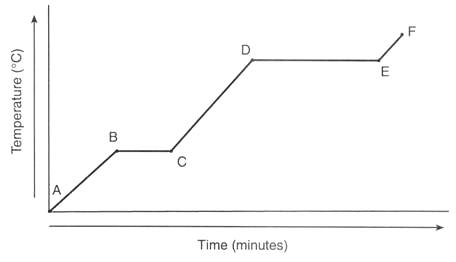
What line segment represents only the solid state?
a)
A-B
b)
B-C
c)
C-D
d)
D-E
20.
Between which points is the substance changing state?
a)
A-B only. 
b)
A-B, C-D, E-F
c)
B-C only. 
d)
B-C, D-E
21.
A substance's heating curve is shown in the graph.  What is its boiling point?
a)
100 C
b)
60 C
c)
80 C
d)
20 C
22.
Contains only one kind of atom.
a)
Element
b)
Compund
c)
Mixture
23.
Examples are milk and gasoline.
a)
elements
b)
mixtures
c)
compounds
24.

Examples are diamonds (C) and Uranium (U)

a)

elements

b)

mixtures

c)

compounds

25.
Is sugar (C12H22O11) an element or a compound?
a)
Element
b)
Compound
26.

diagram "a" is an example of a(n)

a)

element

b)

compound

c)

mixture

27.

diagram "b" is an example of a(n)

a)

element

b)

compound

c)

mixture

28.

diagram "c" is an example of a(n)

a)

element

b)

compound

c)

mixture

29.

What does this illustrate

a)

Elements

b)

Compunds

c)

Mixture of Elements and Compunds

d)

Mixture of Compounds

30.

Which contains only elements?

a)

A

b)

B

c)

C

d)

D

31.

Which process is an example of a physical change?

a)

Ice melting

b)

Milk souring

c)

metal rusting

d)

wood burning

32.

Which type of change does the diagram show?

a)

A physical change

b)

A chemical change

33.

salt dissolving in water

a)

physical change

b)

chemical change

34.

a)

physical change

b)

chemical change

35.
Evidence of a chemical reactions is anything that shows - 
a)
a new substance has formed
b)
a solid dissolved in a liquid
c)
interaction between 2 gases
d)
a change in the state of matter
36.
You know you a chemical reaction has occurred if 
a)
there is a precipitate.
b)
there is a color change.
c)
there is a temperature change.
d)
All of these answers are evidence.
37.
What is atomic number?
a)
Number of protons in an atoms 
b)
Number of neutrons in an atom
c)
Mass of an atom
d)
Charge on an atom
38.
Which subatomic particles are found in the nucleus of an atom?
a)
Protons and Electrons
b)
Protons and Neutrons
c)
Neutrons and Electrons
d)
Protons, Neutrons and Electrons
39.
What electrical charge does a proton have?
a)
+1
b)
0
c)
-1
d)
+2
40.
The total number of protons and neutrons in an atom is called the...
a)
Atomic number
b)
Proton number
c)
Mass number
d)
Weight number
41.

How many protons does an aluminum atom have?

a)

27

b)

14

c)

40

d)

13

42.

How many electrons does a sodium atom have?

a)

23

b)

11

c)

12

d)

34

43.
Complete the missing label on the diagram.
a)
Neutron
b)
Centre
c)
Nucleus
d)
Sub atomic particle
44.
Atoms of the same element must always have the same number of _________
a)
electrons
b)
neutrons
c)
isotopes
d)
protons
45.
Which particle is negatively charged?
a)
proton
b)
atom
c)
neutron
d)
electron
46.

What is the correct number of subatomic particles of a phosphorous atom with a mass of 31?

a)

p# - 15, n# = 15, e# = 15

b)

p# - 15, n# = 16, e# = 15

c)

p# - 15, n# = 15, e# = 16

d)

p# - 16, n# = 15, e# = 15

47.
How many neutrons does the isotope of lithium have?
a)
8
b)
3
c)
4
d)
5
48.
Isotopes are atoms of the same element with different #’s of __________ & therefore different __________.
a)
n0 ;  atomic #’s
b)
p+ ; atomic #’s
c)
e- ; atomic masses
d)
n0 ; atomic masses
49.
An atom is electrically neutral when
a)
protons and neutrons are the same
b)
protons and electrons are the same
c)
neutrons and electrons are the same
d)
neutrons balance the protons and electrons
50.
Ions are: 
a)
atoms with a positive or negative charge
b)
atoms with no charge
c)
atoms with ONLY a positive charge
d)
atoms with ONLY a negative charge
51.
When an atom loses a valence electron, it becomes a(n) _____________ ion.
a)
positive
b)
negative
c)
neutral
d)
polyatomic
52.
What is the charge of an atom that has gained one electron?
a)
-1
b)
-2
c)
+1
d)
+2
53.
anions are _____ ions.
a)
positive
b)
negative
c)
neutral
54.

Chlorine has two naturally occurring isotopes, Cl-35 and Cl-37, The atomic mass of chlorine is 35.45. Which of these two isotopes of chlorine is more abundant?

a)

Cl-35

b)

Cl-37

c)

Cannot be determined from the information provided.

55.
Takes two small nuclei and combines them into a larger nucleus
a)
fission
b)
fusion
56.

Which type of reaction does the diagram illustrate?

a)

Fission

b)

Fusion

c)

Alpha Decay

d)

Beta Decay

57.
In the equation,  146C --> 147N + 0-1B, the _______ decay of radioactive carbon-14 results in the creation of a new nitrogen-14 atom.
a)
Beta
b)
Alpha
c)
Gamma
58.
What type of decay?
a)
alpha
b)
beta
c)
gamma
59.
What atom matches this electron configuration?
1s2s2p3s2
a)
Neon
b)
Magnesium
c)
Aluminum
d)
Potassium
60.
How many valence electrons does Chlorine have?
a)
5
b)
2
c)
7
d)
5
61.
Which element is pictured?
a)
neon
b)
fluorine
c)
magnesium
d)
argon
62.
Electrons occupy orbitals of lowest energy first is part of what electron configuration rule?
a)
Hund’s Rule
b)
Aufbau Principle
c)
Pauli Exclusion Principle
63.
What is the noble gas configuration for phosphorus?
a)
[Ar] 3p5
b)
[He] 3s2 3p5
c)
[Ne] 3s2 3p3
d)
[Na] 3s2 3p5
64.

Each element on the periodic table can be identified by its

a)

classification as a solid, liquid or gas.

b)

location on the table.

c)

ability to react to form compounds.

d)

unique spectral "fingerprint."

65.

What subatomic particle is responsible for the spectral lines seen in emission spectra diagrams?

a)

electrons

b)

protons

c)

neutrons

66.

In order to go from ground state to an excited state, an electron must

a)

emit energy

b)

absorb energy

c)

wiggle

67.

When an electron returns to ground state from an excited state, the atom will

a)

emit energy

b)

absorb energy

c)

rotate

d)

wiggle

68.
Which elements are in the unknown sample?
a)
A and B
b)
B and C
c)
A and D
d)
B and D
69.
You accidentally break some glassware you should
a)
Clean it up immediately
b)
Leave it
c)
Tell the teacher
d)
Tell you lab partner to clean it up
70.

Approved eye protection devices (such as goggles) are worn in the laboratory -

a)

to avoid eye strain

b)

to improve your vision

c)

only if you do not have corrective glasses.

d)

any time chemicals, heat, or glassware are used.