
NEW
Font size
 Worksheets
Quarterly MP#2
Total questions: 35
Worksheet time: 28mins
True or False. The nitrogen in the atmosphere is in the right form for living things to use.
True
False

Organisms that break down dead plants & animals and release nitrogen back into atmosphere.
bacteria
plants
animals
What is Global Warming?
Increasing temperature in Earth's atmosphere
Increasing temperature in a city.
Decreasing temperature in Earth's atmosphere.
Succession that occurs in an area with no soil.
primary succession
secondary succession
Succession that occurs in an area where soil is already present.
primary succession
secondary succession
__________ is an energy resource that WILL NOT run out in the next several hundred years.
Renewable energy
Non-Renewable energy
__________ is an energy resource that WILL run out in the next several hundred years.
Renewable energy
Non-renewable energy
Something is __________ __________ when some molecules can cross the membrane while others cannot.
selectively (or semi) permeable
impermeable
permeable
The process by which molecules move from areas of higher concentration to areas of lower concentration.
diffusion
osmosis
active transport
Osmosis is the diffusion of water.
TRUE
FALSE
Movement of materials through a cell membrane using cellular energy.
passive transport
active transport
How is the carbon cycle similar to the water cycle?
Both involve liquid substances falling to the Earth from the atmosphere?
Neither process works at low temperature.
Both involve the transfer of substances between animals, plants, and the Earth.
Respiration is the process by which animals take in __________ and release __________.
glucose, oxygen

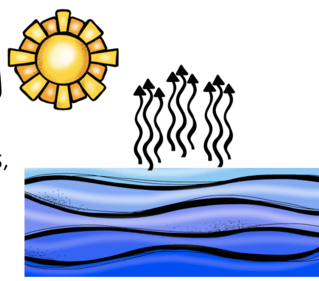
Evaporation happens when the sun __________ water and turns it into vapor.
Nitrogen fixation converts atmospheric nitrogen to a soil form of nitrogen that is usable by plants.
TRUE
FALSE
A correct path that Nitrogen could take would be...
Air--> Bacteria--> Plants--> Animals
Bacteria--> Animals--> Plants--> Air
Plants--> Air--> Animals--> Bacteria

In an ecosystem, plants always play the role of __________ .
producer
consumer
decomposer

A __________ is a community of living organisms interacting with the non-living parts of the environment.
ecosystem
food web
consumer
In a food chain, or food web, all of the energy can be traced back to __________.
plants
decomposers
the sun
All food webs and food chains begin with __________ .
consumers


The __________ is the cell part (organelle) inside cells where cellular respiration happens.
mitochondria
chloroplast
nucleus
The primary purpose of cellular respiration is to produce __________ .
ATP
carbon dioxide
glucose
What two things are needed for cellular respiration to happen in a cell?
glucose & oxygen
water & carbon dioxide
glucose & water

Small openings called __________ are found on the underside of leaves and allow gases to enter or leave the plant cells.

