Wayground logo

Free Printable Worksheets

Font size

S
M
L
XL
Worksheets

Earth Science Final Semester 1

Total questions: 60

Worksheet time: 1hrs 12mins

Name
Class
Date
1.

What is the correct order (starting from the surface) of Earth’s layers?

a)

crust, outer core, inner core, mantle

b)

mantle, outer core, inner core, crust

c)

crust, mantle, outer core, inner core

d)

outer core, inner core, crust, mantle

2.

The process by which the ocean floor sinks beneath a deep-ocean trench and back into the mantle is known as _______

a)

convection.

b)

continental drift.

c)

subduction.

d)

conduction.

3.

Most geologists think that the movement of Earth’s plates is caused by _______

a)

convection.

b)

continental drift.

c)

subduction.

d)

conduction.

4.

The geological theory of _______ states that pieces of Earth’s lithosphere are in constant, slow motion.

a)

subduction

b)

plate tectonics

c)

deep-ocean trenches

d)

sea-floor spreading

5.

A place where two plates slip past each other, moving in opposite directions, is known as a _______

a)

transform boundary

b)

divergent boundary.

c)

convergent boundary.

d)

rift valley.

6.

Scientists think that convection currents flow in Earth’s

a)

continents.

b)

mantle.

c)

lithosphere.

d)

inner core.

7.

The place where two plates come together is known as a _______

a)

transform boundary.

b)

divergent boundary.

c)

convergent boundary.

d)

rift valley.

8.

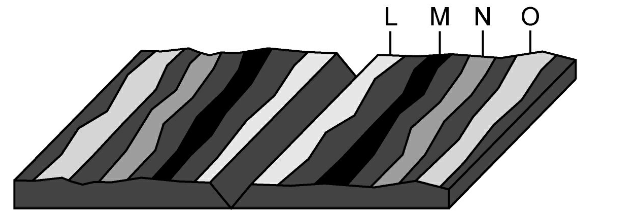
Below is a picture of sea-floor spreading. How are the ocean crusts moving?

a)

Converging

b)

Diverging

c)

Sliding

d)

No movement

9.

The San Andreas Fault in California is known as an active earthquake area. What type of

boundary is it?

a)

Converging

b)

Diverging

c)

Transform

d)

Sea Floor Spreading

10.
Where would the oldest rock be found?
a)
L
b)
M
c)
N
d)
O
11.
How is it possible for new crust to be formed without increasing the surface area of the Earth?
a)
Crust is destroyed at the same time it is created
b)
New crust is underwater where it sinks
c)
New crust breaks more easily than old crust
12.
What are the two types of crust
a)
continental and oceanic
b)
ocean and upper
c)
lower and upper
d)
pizza and subway
13.
The Himalayas in Asia are an example of what type of plate boundary?
a)
divergent
b)
continent-to-continent convergent
c)
ocean-to-continent convergent
d)
transform
14.
What is Pangaea?
a)
the name of a German scientist
b)
the name of the super-continent that existed millions of years ago
c)
another name for continental drift
d)
the name of an ancient fossil
15.
Mountains form from ...
a)
plates sliding past one another
b)
collision of plates
c)
plates moving away from each other
16.
The epicenter of an earthquake is
a)
The point below the surface where rock begins to break and the first motion occurs
b)
The seismic station closest to the earthquake
c)
The place where the greatest damage occurs
d)
The point on the surface directly above the focus
17.
Which travels fastest, always being the first detected by seismic stations?
a)
P waves
b)
S waves
18.
An instrument that detects and measures earthquakes is a 
a)
seismogram
b)
focus seismic map
c)
focus
d)
seismograph 
19.
Most earthquakes happen along the _________________. 
a)
coast
b)
faults
c)
desert
d)
directions
20.
Earthquakes under the water can cause _________________________________.
a)
tornadoes
b)
tsunamis
c)
lightening
d)
hailstorms
21.

Explosive eruptions occur if a volcano's magma is

a)

high in viscosity

b)

Mafic

c)

Low in viscosity

d)

Extremely hot

22.

When a volcano erupts quietly, what kind of mountain forms?

a)

A Shield Volcano

b)

A Cinder Cone Volcano

c)

A Composite Cone Volcano

23.

What provides the force that causes a volcano to become explosive?

a)

Mafic flows

b)

Magma density

c)

Dissolved gases trapped in magma

d)

Extreme heat

24.

The main hazard from a quiet volcanic eruption is _____________

a)

Volcanic gases

b)

Lava Flows

c)

Pyroclastic Flows

d)

Geysers

25.

Volcanoes with steep sides made of layers of ash is called......

a)

Cinder Cone

b)

Shield Volcano

c)

Composite Volcano

26.

Tall, cone-shaped mountains made of both cooled lava layers and layers of ash are called

a)

shield volcanoes

b)

composite volcanoes

c)

lava plateaus

d)

cinder cone volcanoes

27.

What do we call molten hot liquid rock while it is still below the Earth's surface?

a)

Magma

b)

Igneous

c)

Cinder

d)

Lava

28.

What volcanoes are described as having a wide base?

a)

Shield Volcanoes

b)

Cinder Cones

c)

Composite Volcanoes

d)

Calderas

29.

A fluid's thickness and resistance to flow is called....

a)

Viscosity

b)

Consistency

c)

Thickness

d)

Magma

30.

Chunks of magma that are cooled into rocks as they are thrown in the air are

a)

Volcanic bombs

b)

Pyroclastic Flow

c)

Lahars

d)

Blocks

31.

What is the product of Crystallization?

a)

Igneous Rock

b)

Sediments

c)

Sedimentary rock

d)

Magma

e)

Metamorphic rock

32.

What is the product of Deposition and Lithification?

a)

Igneous Rock

b)

Sediments

c)

Sedimentary rock

d)

Magma

e)

Metamorphic rock

33.

What is the product of Metamorphism?

a)

Igneous Rock

b)

Sediments

c)

Sedimentary rock

d)

Magma

e)

Metamorphic rock

34.

breaks the rock down into smaller pieces

a)

melting

b)

deposition

c)

lithification

d)

uplift

e)

weathering and erosion

35.
This rock was formed when magma cooled very slowly inside the Earth. What specific type of rock is it?
a)
Intrusive Igneous Rock
b)
Extrusive Igneous Rock
c)
Foliated Metamorphic Rock
d)
Clastic Sedimentary Rock
36.
This rock formed when lava cooled very quickly on Earth's surface. What specific type of rock is it?
a)
Extrusive Igneous Rock
b)
Intrusive Igneous Rock
c)
Non-Foliated Metamorphic Rock
d)
Biochemical Sedimentary Rock
37.
When you watch a volcano erupt molten rock, you are seeing _____
a)
Lava
b)
Magma
c)
Mineral Crystals
d)
Igneous Rocks
38.
When you are describing the sizes of the mineral grains in a rock, you are detailing the rock's _____
a)
Texture
b)
Composition
c)
Sedimentation
d)
Igneous-ness
39.
What are the 3 major types of rocks?
a)
Igneous, Metamorphic, Sedimentary
b)
Metamorphic, Igneous, Cementation
c)
Brown, Red, Gray
d)
Streak, Hardness, Breakage
40.
Two ways to describe types of igneous rocks are _____
a)
Extrusive and Intrusive
b)
Foliated and Non-Foliated
c)
Clastic and Biochemical
d)
Black and Gray
41.
What process is used to form sedimentary rocks?
a)
Lava cools and hardens to form a rock.
b)
Weathering, Erosion, Deposition, Compaction, Cementation
c)
Extreme heat and pressure from inside the Earth turn rocks into new rocks.
d)
Magma trapped under the Earth's surface cools and solidifies.
42.
What is deposition?
a)
Dropping off sediment
b)
Movement of sediment
c)
Breaking down of sediment 
43.
The process when rocks break into smaller pieces due to exposure to natural elements is called
a)
erosion
b)
weathering
c)
sediments
d)
deposition
44.
The movement of weathered material (sediment) is called?
a)
weathering
b)
erosion
c)
deposition
d)
cementation
45.
Sedimentary rock that is formed from water evaporating and minerals being left behind.
a)
clastic
b)
organic
c)
chemical
46.
Sedimentary rock made from fossils are called...
a)
organic
b)
chemical
c)
stratified
47.
Is the following metamorphic rock foliated or non-foliated?
a)
Foliated
b)
Non-foliated
c)
Neither
48.
How light reflects off of a mineral is called the mineral's 
a)
luster
b)
streak
c)
cleavage
d)
fracture
49.
_____ is if something breaks into smooth flat layers.
a)
fracture
b)
cleavage
c)
streak
50.
__________ is if a mineral breaks apart in a jagged or rough layer.
a)
cleavage
b)
luster
c)
fracture
51.
Which of the following is NOT true of minerals?
a)
They are liquids
b)
They are formed in nature
c)
They are inorganic
d)
They have crystalline structure
52.
Which mineral property is being shown here?
a)
luster
b)
hardness
c)
cleavage
d)
streak
53.
What is the scale that is used to indicate hardness of a mineral?
a)
Red Scale
b)
Moh's scale
c)
Einstein's Scale
d)
Fracture Scale
54.
Inorganic means not of living things. 
a)
True
b)
False 
55.

When plants use their roots to get water from the ground, which 2 spheres are interacting? (choose 2)

a)

Geosphere

b)

Hydrosphere

c)

Atmosphere

d)

Biosphere

56.

When a river deposits sediment, which 2 spheres are interacting? (choose 2)

a)

Geosphere

b)

Hydrosphere

c)

Atmosphere

d)

Biosphere

57.

When ocean water evaporates into the air, which 2 spheres are interacting? (choose 2)

a)

Geosphere

b)

Hydrosphere

c)

Atmosphere

d)

Biosphere

58.

What is the hydrosphere?

a)

all the air and gases on the planet

b)

made up of living things

c)

the non-living soil, rocks, and minerals of the Earth

d)

the rivers, lakes, and oceans of the Earth

59.

What is the geosphere?

a)

all the air and gases on the planet

b)

all the frozen water on the Earth

c)

the non-living soil, rocks, and minerals of the Earth

d)

the rivers, lakes, and oceans of the Earth

60.

What is the atmosphere?

a)

all the air and gases on the planet

b)

made up of living things

c)

the non-living soil, rocks, and minerals of the Earth

d)

the rivers, lakes, and oceans of the Earth