wayground logo

Free Printable Worksheets

NEW

Font size

S
M
L
XL
Worksheets

Biology A Final Exam

Total questions: 55

Worksheet time: 2hrs 50mins

Name
Class
Date
1.
What is the left part of a chemical equation called?
2H2 + O2 --> 2H2O
a)
Reactants
b)
Products 
c)
Yields 
d)
Chemical Equation 
2.
What is the right part of a chemical equation called...
2H2 + O2 --> 2H2O
a)
Reactants
b)
Products 
c)
Yields 
d)
Chemical Equation 
3.
Enzymes are considered to be 
a)
Lipids
b)
Carbohydrate
c)
Protein
d)
Nucleic Acid
4.
What is the purpose  of an enzyme?
a)
give permission for the reaction
b)
raise activation energy
c)
speed up reactions
d)
control how many reactions occur
5.
Where do substrates bind on an enzyme?
a)
voltage-gated channels
b)
surface receptor
c)
calcium channels
d)
active site
6.
How do enzymes increase the speed of chemical reactions?
a)
reducing the number of products   
b)
reducing the activation energy
c)
increasing the temperature of the cell
d)
increasing the concentration of reactants 
7.
What is a substance called if it speeds up a chemical reaction?
a)
reusable
b)
catalyst
c)
specific
d)
fragile
8.
Which of these is NOT true?
a)
Enzymes can denature (change shape) when the temperature gets too high.
b)
Enzymes can only be used once in a chemical reaction. 
c)
Extreme pH can denature enzymes.
d)
Enzymes speed up chemical reactions. 
9.
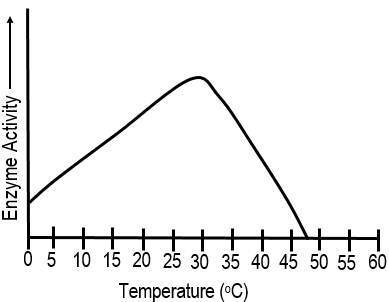
Based on the graph, what temperature does this enzyme work best? 
a)
15 C
b)
40 C
c)
30 C
d)
47 C
10.

What is the correct order of the stages of cellular respiration?

a)

Glycolysis, Krebs Cycle, Electron Transport Chain

b)

Krebs Cycle, Electron Transport Chain, Glycolysis

c)

Electron Transport Chain, Glycolysis, Krebs Cycle

d)

Glycolysis, Electron Transport Chain, Krebs Cycle

11.

Which of the following is not a step in cellular respiration?

a)

Photosynthesis

b)

Glycolysis

c)

Krebs Cycle

d)

Electron Transport Chain

12.

Which of the following is NOT a product of cellular respiration?

a)

Oxygen

b)

Carbon Dioxide

c)

Water

d)

ATP

13.

What is the correct chemical reaction for cellular respiration?

a)

C6H12O6 + 6 O2 ---> 6 CO2 + 6 H2O + 36 ATP

b)

C6H12O6 + 6 O2 ---> 3 CO2 + 5 H2O + 2 ATP

c)

6 O2 6 CO2 ---> C6H12O6 + 6 H2O + 36 ATP

d)

C6H12O6 + 6 O2 + 36 ATP ---> 6 CO2 + 6 H2O

14.

What cell part is involved in cellular respiration?

a)

Nucleus

b)

Mitochondria

c)

Cell Membrane

d)

Chloroplast

15.

How are cellular respiration and photosynthesis almost opposite processes?

a)

The reactants of photosynthesis are the products of cellular respiration and the products of photosynthesis are the reactants of cellular respiration

b)

They both have the same reactants

c)

They both have the same products

d)

They both do the same thing

16.
The main source of energy for all life comes from ____.
a)
the Earth
b)
the moon
c)
the sun
d)
the food we eat/make
17.
Most plants appear green because chlorophyll
a)
absorbs green light.
b)
absorbs violet light.
c)
reflects green light.
d)
does not absorb violet light.
18.
The reactants of photosynthesis are
a)
sugar and water.
b)
sugar and oxygen.
c)
carbon dioxide and water.
d)
carbon dioxide and oxygen.
19.

Which statement is correct?

a)

Heterotrophs are producers and autotrophs are consumers.

b)

Heterotrophs can make their own food; autotrophs cannot.

c)

Autotrophs can make their own food; heterotrophs cannot

d)

Both autotrophs and heterotrophs can make their own food.

20.
What are the products of photosynthesis?
a)
Carbon dioxide and water
b)
Carbon dioxide and oxygen
c)
Glucose and oxygen
d)
Glucose and water
21.
What pigment absorbs sunlight for photosynthesis?
a)
chloroplast
b)
thylakoid
c)
grana
d)
chlorophyll
22.
Which of the following is the correct equation for PHOTOSYNTHESIS?
a)
6CO2 + 6H2O --> 6O+ C6H12O6
b)
6CO+ C6H12O6 + 6H2O --> O
c)
6O2 + 6H2O --> 6CO+ C6H12O6
d)
C6H12O6 + 6O2 ---> 6H2O + 6CO2 
23.

Use the diagram to answer the question. Between which parts of the molecule must the bonds be broken to release energy?

a)
A and B
b)
A and C
c)
B and C
d)
C and D
24.
Where the better adapted organisms survive to pass traits along to offspring.
a)
Evolution
b)
Natural Selection
c)
Extinction
d)
Artifical Selection
25.
What is the advantage of having different shaped beaks?
a)
To look different from other species.
b)
To be able to eat the food readily available in the environment.
c)
To protect itself against predators.
d)
To protect itself against prey.
26.
Why are advantageous traits more likely to be passed onto offspring?
a)
Because they are more likely to survive and reproduce.
b)
Because they come from dominant alleles.
c)
Because they come from recessive alleles.
d)
Because the trait is an acquired phenotype.
27.

What word describes a trait that helps an organism survive in its environment?

a)

natural selection

b)

mutation

c)

camouflage

d)

adaptation

28.
Which organisms are most likely to survive?
a)
the best adapted
b)
the fastest
c)
the strongest
d)
the most domesticated (tamed)
29.

Artificial selection is where ___________ decides which traits should be passed on

a)

nature

b)

a human

c)

the individual

d)

the environment

30.
Which of these is an example of natural selection?
a)
The largest animal in a population will have more opportunities for reproduction.
b)
Several species of organisms work together so that they all succeed.
c)
One species takes all the resources in an environment leaving none for others.
d)
Organism that are best suited to an environment tend to survive and reproduce more often.
31.
Darwin studied which of these species on Galapagos?
a)
Pigeons and tortoises
b)
Tortoises and finches
c)
Finches and Pigeons
d)
Zebras and Mockingbirds
32.
What might account for the fact that all of these limbs share similar structures?
a)
They came from the same source
b)
They are all from one animal
c)
They are very similar organisms
d)
Cooincidence
33.
Define homologous structures.
a)
Structures that appear the same, but have different ancestral origins.
b)
Structures that appear the different, but have the same ancestral origins.
c)
Any two body parts from the same organism
d)
Parts that no longer appear to have a function
34.

how well an organism can survive and reproduce in its environment

a)

fossil

b)

fitness

c)

inherited trait

35.
Humans, birds, whales, and lizards all have similar arm bones. What is the reason for this?
a)
The function of these bones is the same in all animals
b)
They live in similar environments
c)
They have a common ancestor
d)
All organisms resemble humans
36.

An anatomical feature that no longer seams to have a purpose in the current form of an organism

a)

Homologous structure

b)

Analogous structure

c)

Vestigial structure

d)

None of the above

37.

Living things are made up of units called

a)

DNA

b)

Cells

c)

Homeostasis

d)

Seeds

38.

If an organism is made entirely of one cell it is called...

a)

Multicellular

b)

Prokaryotic

c)

Unicellular

d)

Eukaryotic

39.

Reproduction that only involves one parent and all offspring are identical; for example, binary fission of bacteria or amoebas.

a)

Asexual

b)

Sexual

c)

Division

d)

Addition

40.

Reproduction that involves two cells from different parents unite to produce the first cell of a new organism.

a)

Asexual

b)

Sexual

c)

Budding

d)

Division

41.

Living things are based on a universal genetic

code. What molecule is responsible for that code?

a)

RNA

b)

Lipid

c)

Protein

d)

DNA

42.

Maintaining a stable internal

environment is called

a)

homeostasis

b)

equilibrium

c)

balance

d)

evenness

43.
Green plants produce their own food through the process of photosynthesis.
a)
All living things use energy
b)
All living things contain cells
c)
All living things maintain homeostasis
d)
All living things grow
44.
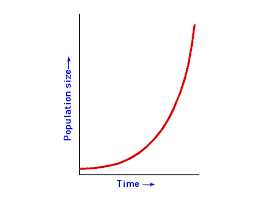
What type of growth is shown in the diagram?
a)
exponential growth
b)
logistic growth 
c)
predator-prey cycle
d)
boom-bust curve
45.
Largest number of individuals of a population that the environment can support...  
a)
carrying capacity
b)
population crash
c)
lag phase
d)
mutualism
46.
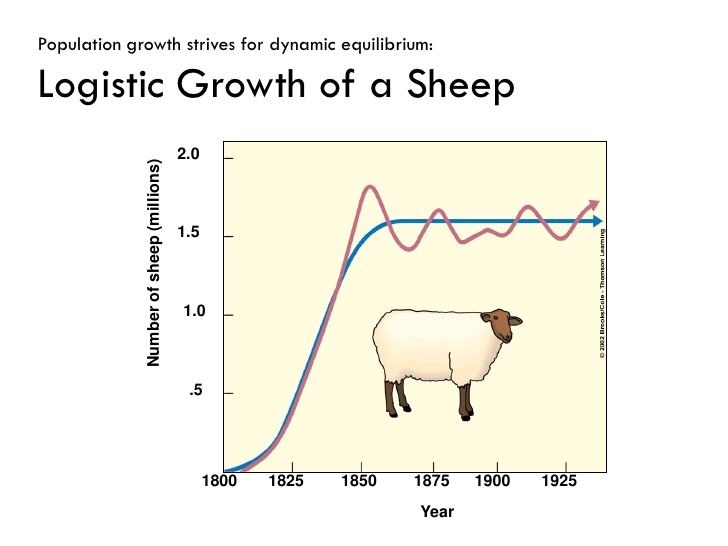
What is the carrying capacity for this sheep population?
a)
1.8 million
b)
1.25 million
c)
1.6 million
d)
1.o million
47.
What is the carrying capacity of this population?
a)
100
b)
200
c)
300
d)
400
48.
When a population grows past the ecosystem's carrying capacity, what happens to the population?
a)
Continues to grow
b)
The population starts to die off to return to carrying capcity
c)
The population will go extinct due to lack of resources
d)
The population grows then finds a new carrying capacity
49.
If the number of births in a population is the same as the number of deaths in a population, what will happen to the growth of the population?
a)
It will increase.
b)
It will decrease.
c)
It will stay the same.
d)
It will fluctuate.
50.
If the number of births is greater than the number of deaths in a population, what will happen to the growth of the population?
a)
It will increase.
b)
It will decrease.
c)
It will stay the same.
d)
It will fluctuate.
51.
When organisms move out of the population, this is known as
a)
emigration
b)
abandonment
c)
immigration
d)
succession
52.
What is happening in a population as it decreases?
a)
more emigration occurs 
b)
more immigration occurs
c)
the birth rate and death rate remain the same
53.
What happened to the wolf population between 1980 and 1982?
a)
it increased rapidly
b)
it decreased rapidly
54.
The wolves and moose on Isle Royale are an example of which type of relationship?
a)
mutualism
b)
predator-prey
c)
parasitism
d)
commensalism
55.

If the wolf population goes extinct on the island, what is likely outcome

a)

Moose will population will remain stable

b)

The moose population will grow and eat all the vegetation

c)

The other species that rely on the vegetation will take over for the wolves

d)

New predators will begin hunting Moose