
 Worksheets
9th class gravitation
Total questions: 40
Worksheet time: 23mins
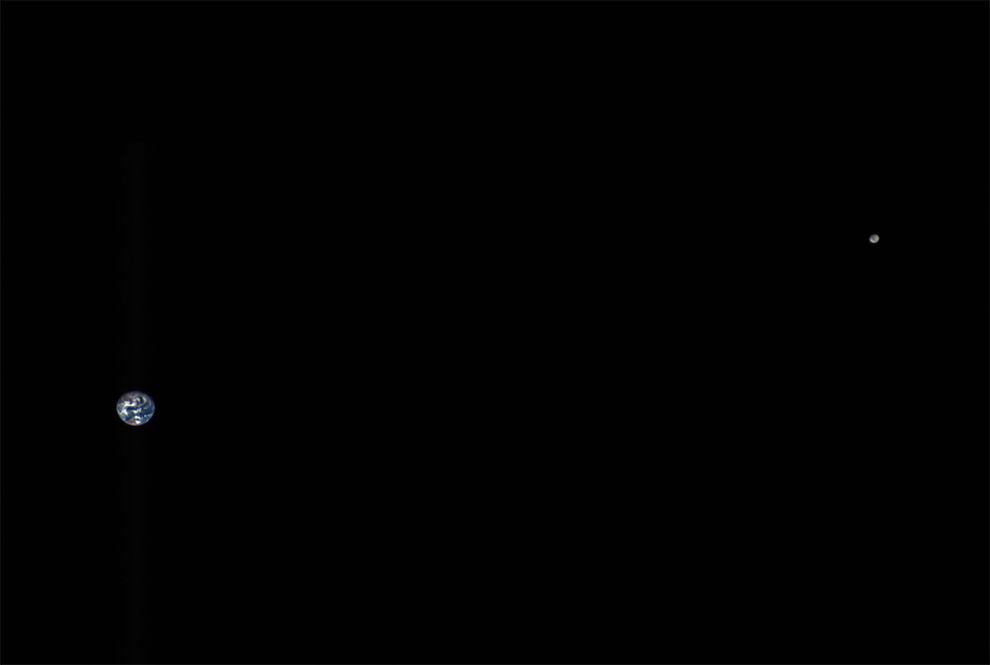
According to Newton's law of gravitation, the Earth and the Moon are gravitationally attracted to each other. The more massive Earth attracts the Moon with...
a stronger force than the Moon attracts the Earth.
a weaker force than the Moon attracts the Earth.
the same force as the Moon attracts the Earth.
a force that is sometimes stronger and other times weaker than the Moon attracts the Earth.

The gravitational force in the previous interaction was 20 N. Determine the gravitational force in the new situation where the second mass is doubled.
10 N
20 N
40 N
80 N

The picture shows the gravitational field in the space surrounding the Earth. What is creating this gravitational field?
The gravitational force.
The mass of the Earth.
The distance of the Earth.
The universal gravitational constant.

Newton said that any two masses will...
combine into a larger mass.
attract each other.
create gravitational fields.
push each other apart.
According to Newton's law of gravitation, the Earth and the Moon are gravitationally attracted to each other. The more massive Earth attracts the Moon with...
a stronger force than the Moon attracts the Earth.
a weaker force than the Moon attracts the Earth.
the same force as the Moon attracts the Earth.
a force that is sometimes stronger and other times weaker than the Moon attracts the Earth.

Which of the following best explains why a person has less weight on top of a mountain?
They are closer to space.
The atmosphere is lighter.
The mountain adds more mass.
The mountain adds more distance.

The picture shows three objects gravitationally interacting with each other. Which object exerts the greatest force on object B?
Object A
Object C
A and C exert an equal force on B
Cannot be determined
A massive object and a less massive object exert a gravitational force on each other. Which of the following picture correctly shows the magnitude and direction of the forces involved in this interaction?


The distance between the two masses in the previous situation is halved. Determine the gravitational force in this new situation.
20 N
40 N
80 N
160 N

An apple is placed in the Earth's gravitational field. Which of the following best explains why the apple falls to the ground?
The field exerts a gravitational force upon the apple.
The Earth exerts a gravitational force upon the apple.
Masses attract each other.
On Earth, all objects fall with acceleration 9.8 m/s².
Which of the following statements is correct with respect to G and g?
G is a fundamental constant, whereas g is a physical quantity and subject to change.
Both G and g can change, but g can only change if you go to a different planet.
G and g are both constant, but g is determined by the mass and radius of the Earth.
The strength of G is determined by g.

The surface gravity on Earth is approximately 10 N/kg. What would the surface gravity be if the Earth contained twice as much mass?
5 N/kg
10 N/kg
20 N/kg
40 N/kg

A newly discovered exoplanet has triple the mass and double the radius as compared to Earth. What is the approximate surface gravity on this exoplanet?
1.5 N/kg
7.5 N/kg
15 N/kg
60 N/kg

The picture shows two exoplanets, b and c. The mass and radius of each planet is given in terms of M and r. What is the surface gravity on planet-c if the surface gravity on planet-b is 4 m/s2?
2 m/s2
4 m/s2
8 m/s2
32 m/s2
The value of acceleration due to gravity
(a) is same on equator and poles
(b) is least on poles
(c) is least on equator
(d) increases from pole to equator
Law of gravitation gives the gravitational force between
(a) the earth and a point mass only
(b) the earth and Sun only
(c) any two bodies having some mass
(d) two charged bodies only
The value of quantity G in the law of gravitation
(a) depends on mass of earth only
(b) depends on radius of earth only
(c) depends on both mass and radius of earth
(a) is independent of mass and radius of the earth
The earth attracts a body of mass 1 kg on its surface with a force of
(a) 9.8 N
(b) 19.6 N
(c) 6.67 x 10⁻¹¹ N
(d) 2 x 6.67 x 10–11 N
The force of attraction between two unit point masses separated by a unit distance is called
(a) gravitational potential
(b) acceleration due to gravity
(c) gravitational field
(d) universal gravitational constant
The weight of an object at the centre of the earth of radius R is
(a) zero
(b) infinite
(c) R times the weight at the surface of the earth
(d) 1/R2 times the weight at surface of the earth
The mass of a body on the surface of earth is 12 kg. If acceleration due to gravity on moon is 1/6 of acceleration due to gravity on earth, then its mass on moon will be
(a) 2kgf
(b) 72kg
(c) 12kg
(d) zero


Which of the following formulas is the correct equation for the law of Universal gravitation?
F=d2GM1M2
F=mg
F=m1m2Gd2
F= F=d2KQ1Q2

A moon is located at 1 unit out from the planet it orbits. If that moon was orbiting at 2 units out from the planet, how much would the gravitational force on the moon be compared to its distance at 1 unit?
41 of the original force
61 of the original force
twice as much
4 times as much
Calculate the force of gravity (F) between two objects whose masses are m1 = 100 kg and m2 = 1000 kg if they are separared by a distance of d = 500 m.
2.67 * 10-11 N
0.4 N
6.67 * 10-11 N
1.3 * 10-8 N
Find the distance between two objects whose masses are m1 = 4,500 kg, and m2 = 8,700 kg; if the gravitational force between them is F = 2.0 x 10⁻⁸ N.
130565.25 m
361.34 m
0.19575 m
0.783 m
The reason why ocean tides happen is
Electrical forces between the sun and the moon
gravitational forces between the Earth and the moon.
Magnetic forces between the Earth and the moon
Motion of the moon around the earth
I man who weighs 1000N on the surface of the earth will weigh how much at twice the distance in the atmosphere.
500 N
250 N
2000 N
4000N
why does a bungee jumper feel weightless on their way down?
Because of Lack of support force as they fall
because they are really weightless
because their mass is negligible as they fall
because they are falling at constant velocity
Is it true that the moon falls?
No, it could have fallen by now.
No, there is no good explanation as to why
Yes, the moon is falling around the earth due to its tangential velocity.
Yes, the moon is falling straight down.
Gravitation is the force of ________________
attraction
repulsion
both
none
What is the value of G?
6.67X 10⁻¹¹
6.80X10¹²
7.97X10⁻¹⁰
NONE
What is the SI unit of G?
Nm2/kg
Nm2/kg2
unitless
none
If a big stone and a small stone when dropped from a height, then both will strike the ground at the same time bcoz :
the value of g does not depend of mass of object
the value of g depends on mass of object
both a and b
none
What is the difference between mass and weight ?( multiple select)
Mass of an object is the quantity of matter contained in it whereas weight of an object is the force with which it is attracted towards the centre of earth
Mass is a vector and weight is scalar
Mass is constant whereas weight is not
SI unit of mass is Kg and SI unit of weight is Newton
What is the mass of an object whose weight is 49 N?
5 kg
6kg
7kg
10kg
which are the following is Newton’s Law of gravitation ?
W=rGMm
F =r2GMm
V =rGM
g=− rGM

What is h?
is the altitude or height of the satellite from the surface of the planet
radius of the planet
radius of the satellite
distance of the two objects from their center
The acceleration due to gravity at pole and equator can be related as:
gp < ge
gp = ge = g
gp < ge = g
gp > ge

