wayground logo

Free Printable Worksheets

NEW

Font size

S
M
L
XL
Worksheets

STEM Final Review

Total questions: 60

Worksheet time: 2hrs 38mins

Name
Class
Date
1.
Research question: does the distance a person kicks a soccer ball effect how well they will do on their math test.  What is the dependent variable?
a)
How far they kick the soccer ball
b)
who the person is
c)
how well they do on the math test
d)
Type of soccer ball.
2.
An experiment is performed on plants to see how different liquids affect plant growth. Each plant in the experiment is given a different liquid; water, apple juice, or milk. Each plant has the same amount of soil, sunlight, and listens to the same music. In this investigation, what is the dependent variable?
a)
Type of plant
b)
Water, apple juice, milk
c)
Plant growth
d)
Color of the plant's leaves
3.
Ms. S set up an experiment to see how the mass of a ball affects the distance it rolls off a ramp. Identify the independent variable.
a)
Distance traveled by the ball
b)
Height of the ramp
c)
Mass of the ball
d)
Who set up the experiment (Ms. S, etc)
4.
This part of the experiment serves as a basis of comparison; the one variable being tested has been omitted. 
a)
experimental group
b)
control group
c)
data
d)
variables
5.
Deductive reasoning means...
a)
Guessing
b)
Ura nok seblu!
c)
Testing and observing patterns to make conjectures
d)
Making general observations of situations and applying them to specific situations.
6.
__________________________ uses specific observations to make generalizations.
a)
Deductive reasoning
b)
Inductive reasoning
7.
Obtuse angles are greater than 90 degrees.  This angle is 110 degrees, so it is obtuse. 
a)
Deductive
b)
Inductive
8.
All observed houses on South Street have roofs that are falling apart.  Sherry lives on South Street.  Her roof is falling apart. 
a)
Deductive
b)
Inductive
9.
A scientific ____________ is a statement that describes what always happens under certain conditions in nature.
a)
law
b)
theory
c)
method
d)
variable
10.
A possible explanation to a problem that has not yet been tested. 
a)
data
b)
theory
c)
hypothesis
d)
fact
11.

Explains something we see in the natural world that has been verified through repeated experiments or testing.

a)

hypothesis

b)

law

c)

theory

12.
T8 - The dependent variable in this experiment is - 
a)
Number of Bacteria
b)
Time of Incubation
c)
Culture Number
d)
Type of Bacteria
13.

What is qualitative data?

a)

a reference line with data points drawn on a graph

b)

any value that can change or be changed in an experiment

c)

numerical data that describes a property of an object

d)

an observation of non-numerical data in an experiment

14.
What is the mode of the scores?
a)
24
b)
14
c)
34
d)
30
15.

What is the mode in the following numbers? [3, 24, 3, 7, 30, 1, 3, 7, 3]

a)

3 and 7 both are modes

b)

1 and 7 both are modes

c)

3 only

d)

7 only

16.
The number of miles that Jenna cycled each week for a 7-week period is shown: 
36, 42, 28, 52, 48, 36, 31 
What is the median number of miles Jenna cycled?
a)
24
b)
36
c)
39
d)
52
17.
Paulo got these markers in three tests: 72, 80 and 82. He had one more test to sit. He wanted an average of 80 for the four tests. What mark must he get in the fourth test?
a)
78
b)
80
c)
84
d)
86
18.
How many significant figures: 216 m
a)
1
b)
2
c)
3
d)
0
19.
How many significant figures: 0.001 g
a)
4
b)
3
c)
2
d)
1
20.
Calculate 923 g ÷ 20312 cm3 and give your answer with the correct number of significant figures.
a)
0.04 g/cm3
b)
0.045 g/cm3
c)
0.0454 g/cm3
d)
0.05 g/cm3
21.
Calculate 7.987 m - 0.54 m and give your answer with the correct number of significant figures.
a)
7.45 m
b)
7.447 m
c)
7.4 m
d)
7.5 m
22.

Which of the following numbers is written in scientific notation?

a)

20.35 x 10⁴

b)

.2035 x 104

c)

2035 4

d)

2.035 x10⁴

23.
How many neutrons does the isotope of lithium have?
a)
8
b)
3
c)
4
d)
5
24.
How many neutrons in C-14?
a)
6
b)
7
c)
14
d)
8
25.
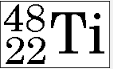
How many protons does this isotope of titanium have?
a)
48
b)
22
c)
26
d)
70
26.
How many neutrons does the isotope below have?     89 36Kr
a)
53
b)
36
c)
89
d)
125
27.

Nickel-59 has how many neutrons?

a)

30

b)

31

c)

32

d)

33

28.
The formula of calcium phosphate is 
a)
CaPO4
b)
Ca2(PO4)3
c)
Ca3PO4
d)
Ca3(PO4)2
29.
What is the formula for manganese(III) oxide?
a)
MgO
b)
Mg2O3
c)
MnO
d)
Mn2O3
30.
ammonium phosphate
a)
(NH4)3PO4
b)
NPO4
c)
NH4PO4
d)
NH4(PO4)3
31.
The chemical formula for tin (IV) oxide is written
a)
Sn2O4
b)
Ti2O4
c)
SnO2
d)
TiO2
32.
Which of the following combinations would need roman numerals in the name?
a)
potassium + fluorine
b)
beryllium + oxygen
c)
boron + iodine
d)
silver + oxygen
33.
What is the correct name for MgI₂?
a)
Manganese IV iodide
b)
Manganese diiodide
c)
Magnesium iodide
d)
Magnesium diiodide
34.
1 meter = _______ cm
a)
1
b)
1,000
c)
100
d)
400
35.
180m = ___dm
a)
8
b)
18,000
c)
1,800
d)
18
36.
___m = 17km
a)
17,000
b)
170
c)
1,700
d)
I will miss Mr. Campbell next year.  :(
37.
A passenger jet has a speed of 900 km/h.
What is its speed in m/s?
(1 km = 1000 m)
a)
250 m/s
b)
324 m/s
c)
1,500 m/s
d)
2,500 m/s
38.

Convert 6 centigrams/day to kilograms/year

a)

2.19 kilograms/year

b)

21.9 kilograms/year

c)

.0219 kilograms/year

d)

219 kilograms/year

39.
a)

Student A

b)

Student B

c)

Student C

d)

Cannot be determined

40.

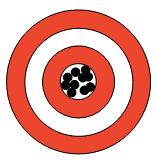
This bullseye demonstrates...

a)

High Accuracy & High Precision

b)

High Accuracy & Low Precision

c)

Low Accuracy & High Precision

d)

Low Accuracy & Low Precision

41.

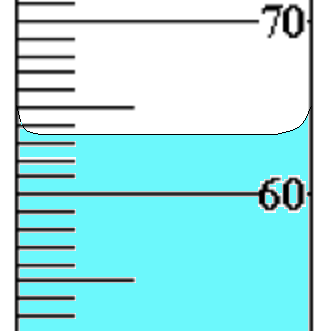
Based on the markings of this graduated cylinder, what is the estimated volume?

a)

63.5 mL

b)

63 mL

c)

63.55 mL

d)

0.063 L

42.
I have two objects with the same volume but different masses.  Which object will be more dense?
a)
The object with less weight.
b)
The object with more weight.
c)
The object with more mass.
d)
The object with less mass.
43.
What is the formula for density?
a)
density = mass x volume
b)
density = mass / volume
c)
density = mass + volume
d)
density = mass - volume
44.
Frank has an eraser. It has a mass of 4g, and a volume of 2cm3. What is its density?
a)
8 g/cm3
b)
2 g/cm3
c)
1/2 g/cm3
d)
24 g/cm3
45.

What is the volume of 150.0 grams of lead if it has a density of 11.3 g/cm3?

a)

13.3 g

b)

13.3 cm3

c)

.075 g

d)

1695 cm3

46.

What percentage of data falls within 1 standard deviation? 

a)

25%

b)

68%

c)

95%

d)

99.7%

47.

If this is the graph of data normally distributed with a mean of 30 and a standard deviation of 5, what label (number) is written at the blue circle?

a)

40

b)

35

c)

45

d)

50

48.

Given a mean of 75 and a standard deviation of 7, what percentage of scores are above 82?

a)

34%

b)

16%

c)

81.5%

d)

2.5%

49.

What is the molar mass of Cl2?

a)

17 g/mol

b)

35.5 g/mo;

c)

71.0 g/mol

d)

89 g/mol

50.

Calculate the molar mass of Ba(C2H3O2)2

a)

255.3 g/mol

b)

237.3 g/mol

c)

228.3 g/mol

d)

196.3 g/mol

51.

The mass of one mole of an element is equal to

a)

its atomic number from the periodic table, but in amus.

b)

its atomic mass from the periodic table, but in amus.

c)

its atomic mass from the periodic table, but in grams.

d)

its atomic number from the periodic table, but in grams.

52.

What is the molar mass of PbSO4?

a)

303.27 g/mol

b)

255.27 g/mol

c)

163.87 g/mol

d)

372.27 g/mol

53.
How many molecules are there in 31.8 moles of water?
a)
5.28 x 10⁻²³ molecules
b)
1.91 x 1025 molecules
c)
5.28x 10⁻²⁵
d)
1.91 x 10²²
54.

Determine the mass of 4.20 moles of C6H12

a)

353 g

b)

0.0499 g

c)

337 g

d)

2.53 x 1024 g

55.
An irregularly shaped stone was lowered into a graduated cylinder holding a volume of water equal to 2 ml. The height of the water rose to 7 ml. If the mass of the stone was 25 g, what was its density?
a)
5 ml
b)
16 g
c)
.20 g/ml3
d)
5 g/cm3
56.
Change from standard form to scientific notation:  0.000398
a)
39.8  x  10-5
b)
3.98  x  10-5
c)
3.98  x  10-4
d)
39.8  x  10-6
57.

Which is the standard form for  6.79  x  104

a)

679,000

b)

6,790

c)

67,900

d)

6,790,000

58.
Ice turns into water then steam.  This is an example of 
a)
plasma
b)
production
c)
physical change
d)
chemical change
59.

Salt dissolved in water is a

a)

physical change

b)

chemical change

60.

Burning wood is a

a)

chemical change

b)

physical change