wayground logo

Free Printable Worksheets

Font size

S
M
L
XL
Worksheets

Weather Review

Total questions: 46

Worksheet time: 3570secs

Name
Class
Date
1.

What type of large scale winds blow constantly, predictably, and over long distances?

a)

land breezes

b)

mountain breezes

c)

global winds

d)

land breezes

2.
Where does the initial source of energy come from that creates winds?
a)
the moon
b)
the sun
c)
the Earth's surface
d)
the rotation of the Earth
3.

Which statement correctly defines wind?

a)

The movement of air from areas of low pressure to areas of high pressure

b)

The movement of air to a colder area in the atmosphere.

c)

The movement of air from areas of high pressure to areas of low pressure.

d)

The movement of air pushed around and bouncing off Earth's surface.

4.

What is the initial source for global winds and convection in the atmosphere?

a)

heat from the Earth's core

b)

the rotation of the Earth

c)

Moon's gravity

d)

unequal heating of the Earth by the sun

5.

The Coriolis effect causes ___________.

a)

the Earth to rotate on its axis

b)

earthquakes

c)

global winds to move in a curved path instead of a straight line

d)

the Earth to revolve around the sun

6.
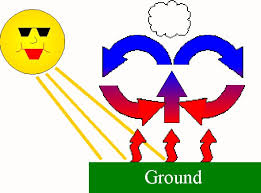
Which diagram shows the formation of a land breeze?
a)
diagram Y
b)
diagram X
c)
neither 
d)
both
7.
Which diagram shows the formation of a sea breeze?
a)
diagram Y
b)
diagram X
c)
neither
d)
both
8.
Which statement correctly describes the properties of cold air?
a)
less dense and less pressure than warm air
b)
more dense and more pressure than warm air
c)
more dense and less pressure than warm air
d)
less dense and more pressure than warm air
9.
What kind of breeze is this and when would it form?
a)
Land breeze - daytime
b)
Land breeze - nighttime
c)
Sea breeze - daytime
d)
Sea breeze - nighttime
10.

In which direction do the westerlies flow?

a)

from east to west

b)

from west to east

c)

from north to south

d)

from south to north

11.
Which global winds are found at the poles? 
a)
Polar Westerlies
b)
Prevailing Easterlies
c)
Polar Easterlies
d)
Trade Winds
12.

The tropical winds running that blow from east to west near the Equator are called the

a)

subtropical westerlies

b)

polar westerlies

c)

trade winds

d)

polar winds

13.
Which global wind belt is found at letter A?
a)
Polar Easterlies 
b)
Prevailing Westerlies 
c)
Tradewinds
d)
Doldrums 
14.
Which global wind belt is found at letter B?
a)
Polar Easterlies
b)
Prevailing Westerlies 
c)
Doldrums
d)
Tradewinds 
15.
Warm air rises and the cool air sinks demonstrates this type of heat transfer. 
a)
conduction
b)
convection
c)
radiation
d)
Insolation 
16.
How do we characterize an air mass that forms over the ocean?
a)
Dry
b)
Wet
c)
Cold
d)
Warm
17.
How do we characterize an air mass that forms over land?
a)
Dry
b)
Wet
c)
Cold
d)
Warm
18.
How do we characterize an air mass that forms over near the equator?
a)
Dry
b)
Wet
c)
Cold
d)
Warm
19.
How do we characterize an air mass that forms near the poles?
a)
Dry
b)
Wet
c)
Warm
d)
Cold
20.
What types of air masses form over oceans?
a)
Maritime
b)
Continental
c)
Polar
d)
Tropical
21.
What's the humidity and temperature of a continental tropical air mass?
a)
Wet and cold
b)
Dry and warm
c)
Wet and warm
d)
Dry and cold
22.
What's the humidity and temperature of a maritime tropical air mass?
a)
Wet and cold
b)
Dry and warm
c)
Wet and warm
d)
Dry and cold
23.
A wet and cold air mass would be a...
a)
Maritime polar
b)
Continental polar
c)
Maritime tropical
d)
Continental tropical
24.
A dry and cold air mass would be...
a)
Maritime polar
b)
Continental polar
c)
Maritime tropical
d)
Continental tropical
25.
A dry and hot air mass would be...
a)
Maritime arctic
b)
Maritime tropical
c)
Continental tropical
d)
Continental polar
26.
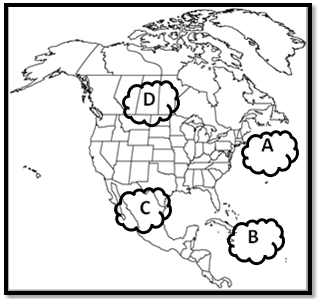
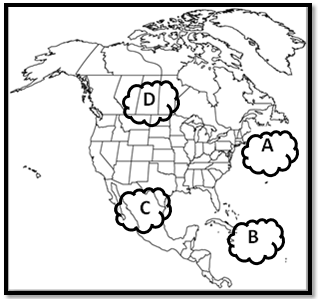
Which type of air would you find at air mass A?
a)
cold, dry
b)
warm, humid
c)
warm, dry
d)
cold, humid
27.
Which type of air would you find at air mass B?
a)
cold, dry
b)
warm, humid
c)
warm, dry
d)
cold, humid
28.
Which type of air would you find at air mass C?
a)
cold, dry
b)
warm, humid
c)
warm, dry
d)
cold, humid
29.
Which type of air would you find at air mass D?
a)
cold, dry
b)
warm, humid
c)
warm, dry
d)
cold, humid
30.
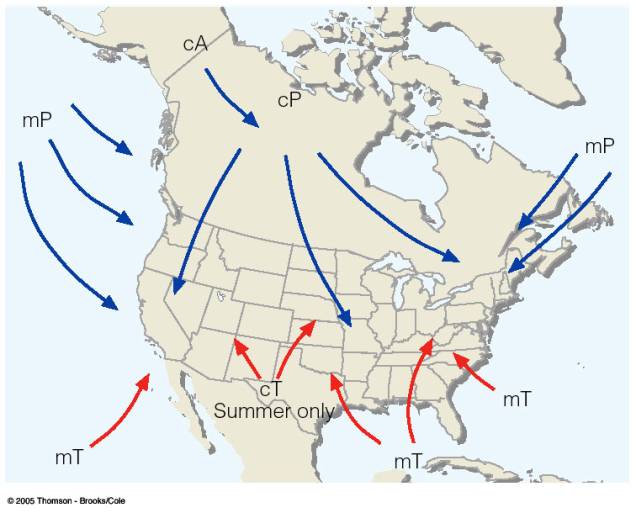
Which abbreviation of an air mass can be identified as dry and hot?
a)
cP
b)
mP
c)
cT
d)
mT
31.
Which abbreviation of an air mass can be identified as cold and moist?
a)
cP
b)
mP
c)
cT
d)
mT
32.

What is a front?

a)

when four air masses meet

b)

when three air masses meet

c)

when two air masses meet

33.

Why do fronts happen?

a)

warm air and cold air mix together

b)

warm air and cold air DON'T mix

c)

warm air and cold air separate

34.

What happens at a front?

a)

the weather stays the same

b)

the weather changes

35.

What is the High Pressure symbol?

a)

C

b)

W

c)

L

d)

H

36.

What two types of weather does High Pressure bring?

a)

humid

b)

dry

c)

rainy

d)

sunny

37.

What is the Low Pressure symbol?

a)

C

b)

W

c)

L

d)

H

38.

What two types of weather does Low Pressure bring?

a)

dry

b)

humid

c)

rainy

d)

sunny

39.

What is the symbol for a Cold Front?

a)
b)
c)
40.

What weather can you expect with a cold front?

a)

storms, then cool good weather

b)

a few days of rain

41.

What is the symbol for a Warm Front?

a)
b)
c)
42.

What weather can you expect with a warm front?

a)

storms, then cool good weather

b)

a few days of rain

43.
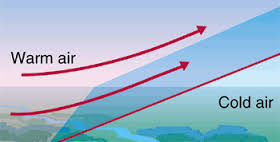
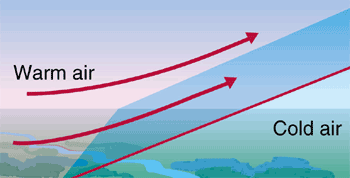
Which type of front is pictured?
a)
Cold front
b)
Warm front
c)
Occluded front
d)
Stationary front
44.

A _____________ weather front occurs when a cold air mass moves forward, pushing the warm air mass up.

a)

Cold

b)

Warm

c)

Stationary

d)

Occluded

45.

Why does warm air rise above cold air?

a)

Warm air is less dense

b)

Warm air is more dense

c)

Cold air is stronger than warm air

46.

What type of weather will you see along a cold front?

a)

Thunderstorms

b)

Sunny skies

c)

Gentle rain

d)

No weather