
 Worksheets
Test 2 Laws of Universal Laws
Total questions: 130
Worksheet time: 2hrs 1mins

How is the gravitational force between to objects related to their mass
They are directly proportional
They are inversely proportional
They do not affect each other
They are equal

Every two objects with mass have a(n) ___ force attracting them together.
gravitation
electrical
spring
friction

The Universal Gravitation Law is true ___.
everywhere
only on earth
only in our solar system
only in the Milky Way Galaxy
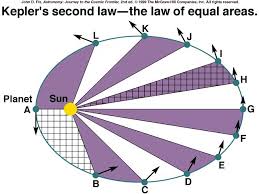


According to the Heliocentric Model of the Universe, _____________ is at the center of our Solar System with the planets revolving around it.
Earth
The Sun
Jupiter
Helios

The diagram below shows a moon revolving around a planet in an elliptical orbit. At which position is the moon traveling fastest?
location 1
location 2
location 3
location 4
A year on Jupiter is 4,344 days long. This tells you how long it takes
Jupiter to orbit the sun.
Jupiter to rotate one time on its axis.
the sun to orbit Jupiter.
Earth to orbit Jupiter.
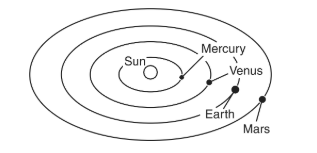
Which planet will take the least amount of time to revolve around the Sun?
Mercury
Venus
Earth
Mars
An orbit with the eccentricity of 0.9 would have more of a(n) __________ shaped orbit.
spherical
elongated
circular
spiral
The value of eccentricity can range from ________ to ________.
0.1 to 0.9
-1 to 0
0 to 100
0 to 1
What effect does increasing the distance between an ellipse’s foci have on the shape of an ellipse?
Increases eccentricity
Decreases eccentricity
no effect
Which statement best describes Kepler’s 3rd Law of Planetary Motion?
The closer a planet is to the sun, the shorter the orbital period is.
Planetary orbits are in the shape of an ellipse
The closer a planet is to its star, the lesser its orbital velocity.
An orbital period is the time (in Earth time) a planet _______________ .
to complete one orbit around the sun
revolves around the solar system
Experiences a season
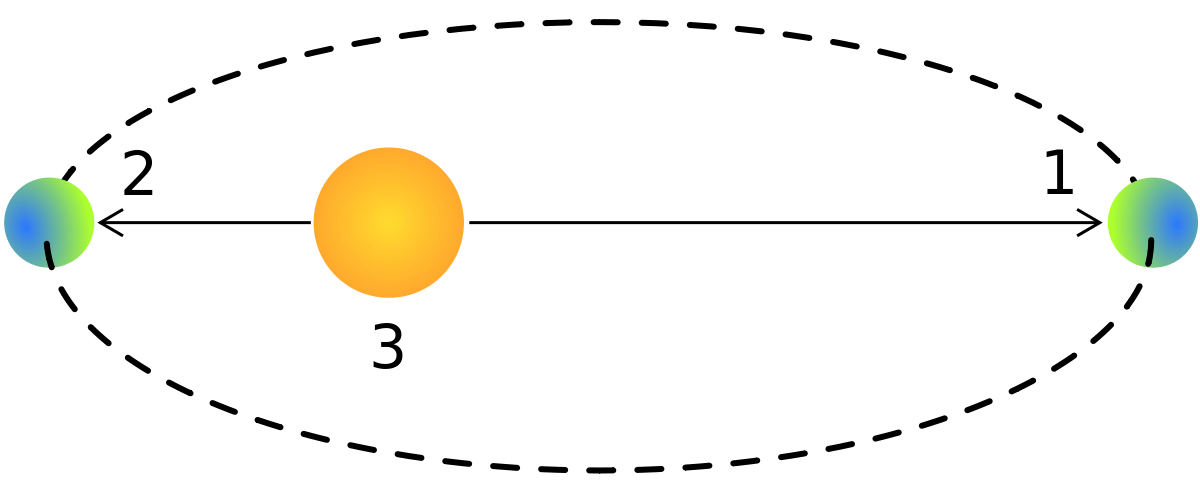
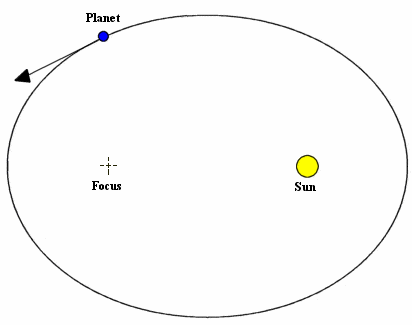
Kepler's Third Law states that p2 = a3, when p is the orbital period (measured in Earth years) and a is the semimajor axis (measured in AU). If an unknown planet's orbital period (p value) is 5 Earth years, what is its semimajor axis (measured in AU)?
5
2.92
125
25
Ptolemy used epicycles to explain the motions of the sun, moon, and planets in his ____ model of the solar system. that had everything orbiting Earth.
heliocentric
geocentric
orrery


What does a wave carry from place to place?
energy
matter
people
The highest point on a transverse wave is the
compression
crest
rest position
trough
The lowest point on a transverse wave is the
compression
crest
rest position
trough
The number of waves that pass somewhere in a second is:
amplitude
frequency
wavelength
A wave that can travel through matter and empty space is a:
electromagnetic wave
longitudinal wavy
transverse wave

#1 refers to the
wavelength
amplitude
crest
trough
#2 refers to the
wavelength
amplitude
crest
trough
#3 refers to the
wavelength
amplitude
crest
trough
#4 refers to the
wavelength
amplitude
crest
trough
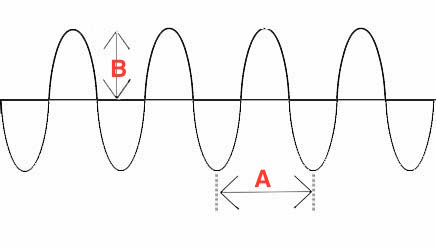
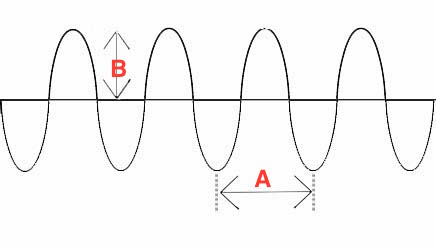
What property of this wave is represented by the letter "A"
amplitude
crest
trough
wavelength

A wavelength is the distance between which 2 points?
B and G
A and C
C and F
A and H
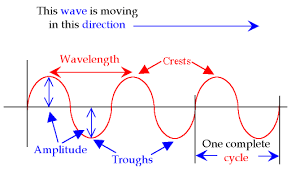
What is another name for wave height?
Frequency
Amplitude
Wavelength
Origin
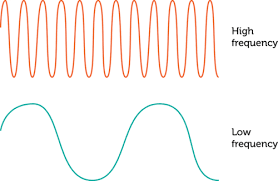
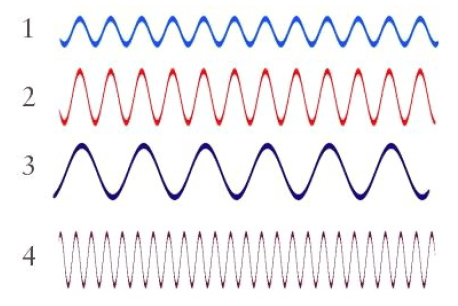
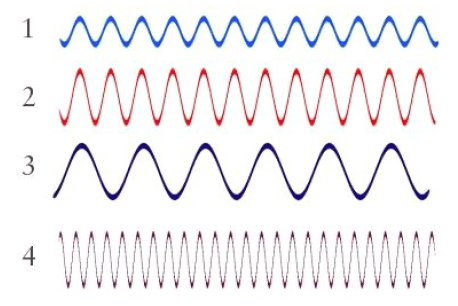
If a wave has a greater frequency, what happens to the wavelength?
increases
decreases
stays the same
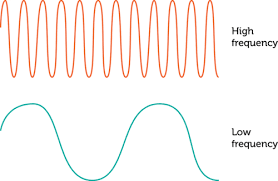
If a wave has a greater frequency, what happens to number of waves per second?
increases
decreases
stays the same
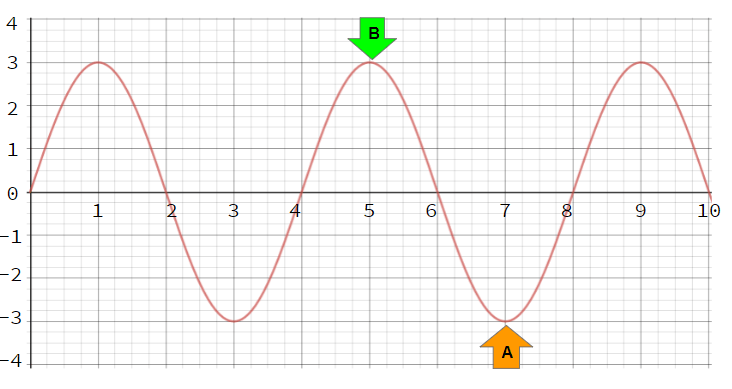
What is the amplitude of this wave?
2
3
6
10
What is the wavelength of this wave?
1
2
3
4
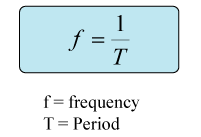
Frequency and period are closely related. Frequency is the inverse of period.
suppose the time from one crest to another (one crest to another is also known as "the period") is 5 seconds; what is the frequency?
Select the 2 that apply.
.2
1/5
.5
1/2
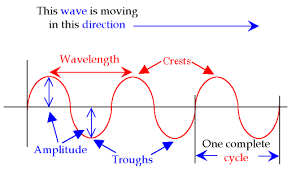
One hertz is equal to:
1 cycle per second
1 amplitude
1 frequency
all the cycles in the wavelength
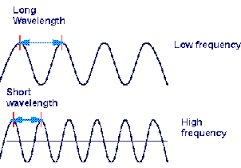
Wavelength and Frequency are related in that...
they are always the same
when one increases, the other decreases (inversely proportional)
there is no correlation
they both vary in an irregular pattern

True or False: Waves A and B have the same amplitude.
True
False
Which property of the wave would change if you changed the amount of energy the wave had?
amplitude
frequency
wavelength
wave speed
What is the visible spectrum?
a. The part of light waves we can see
b. The part of light waves we cannot see
c. the whole electromagnetic spectrum
d. the energy spectrum
What color has the shortest wavelength and highest frequency?
Violet
Orange
Red
Blue
Why do we see grass as green?
Green light is absorbed
Green light is reflected
Review: What is the frequency of a wave?
How fast the wave moves from one point to the next
The time it takes for one wave to happen
The length of a wave
How many waves pass a fixed point in 1 second
V=fλ
If the frequency is 5 Hz and the wavelength is 2 m, then what is the wave's velocity?
10 m/s
5/2 m/s
2/5 m/s
7 m/s
V=fλ f=T1
If the time period of a wave is 2 seconds and the wavelength is 4 m long, then what is the wave's velocity?
2 m/s
8 m/s
1/2 m/s

A wave has a frequency of 8 Hz and a speed of 32m/s meters. By using formula above, what is the wavelength of the wave?
2 meter
3 meter
4 meter
5 meter
A wave with a large wavelength will have a ______ frequency and _____ energy
high, low
high, high
low, high
low, low
What is the speed of light?
3.0x10⁸ ms
3.0x10⁸ m/s
6.626x10⁻³⁴ Js
6.626x10⁻³⁴ J/s
A wave has a frequency of 10 hz and a wavelength of 4 m. What is the velocity of the wave?
24 m/s
40 m/s
2.5 m/s
A wave has a velocity of 10 m/s and a frequency of 20 hz. What is the wave length of the wave?
2 m
0.5 m
10 m
A wave has a frequency of 2.5 hz and a wavelength of 20 m. What is the velocity of the wave?
50 m/s
8 m/s
40 m/s
A wave has a velocity of 4 m/s and a wavelength of 2 m. What is the frequency of the wave?
2 hz
8 hz
18 hz
A wave has a velocity of 25 m/s and a frequency of 12.5 hz. What is the wave length of the wave?
12 m
5 m
2 m
A wave has a velocity of 25 m/s and a wavelength of 5 m. What is the frequency of the wave?
2 hz
5 hz
125 hz

Wavelength= .5m
Frequency= 150 hertz
Wavelength= .5m
Frequency= 150 hertz
Wavelength= __________
Frequency= 600 hertz
A wave has wavelength of 10 m and a speed of 340 m/s. What is the frequency of the wave?
34 m/s
34 hz
3400 m/s
3400 Hz

The color of emitted light with the LONGEST wavelength is
violet
green
red
indigo
The color of emitted light with the SHORTEST wavelength is
violet
green
red
indigo
The color of emitted light with the HIGHEST frequency is
violet
green
red
indigo
The color of emitted light with the LOWEST frequency is
violet
green
red
indigo

The unknown emissions spectra belongs to the element
Hydrogen
Mercury
Neon
Sodium

The unknown emissions spectra belongs to the element
Hydrogen
Mercury
Neon
Sodium
State whether true or false.
Every element has its own unique atomic spectra.
True
False

Each element on the periodic table can be identified by its
classification as a solid, liquid or gas.
location on the table.
ability to react to form compounds.
unique spectral "fingerprint."
Which type of spectra produces, or emits, light of specific frequencies and has bright lines on a dark background?
Absorption spectra
Emission spectra
Continuous spectra
Which type of spectra measures the light that a gas absorbs and produces dark lines?
Absorption spectra
Emission spectra
Continuous spectra
Which three features can appear together in a single spectrum?
Emission lines
Absorption lines
Continuum
Temperature
Aborption and emission spectra result when:
the electrons of the atoms gain or lose energy
the protons of the atoms gain or lose energy
the light is emitted into space
What is a photon?
a picture
a color
a particle of light
True or false: A continuous spectrum with no lines indicates the path of light is free from absorbing gases.
true
false


Which elements are in the mixture?
A only
D only
Z only
A and D
D and Z
A spectrum represents the specific parts of an object's
sound
light
shape


Which of the statements below is true for the emission spectra
The emission is only in the visible region
The peak intensity increases with temperature
The peak intensity decreases with temperature
The peak frequency decreases with temperature
The peak wavelength increases with temperature

Five emission spectra for five identical objects are shown in the figure below. the higest temp is for graph________________ and the object that has peak at lowest energy is _________
A and B
A and F
B and F
C and B
Which of the following give off infrared radiation?
people
light bulbs
stars
teletubbies
a heated / glowing stovetop burner

(Q4) If you pointed an infrared sensor at the sun, would you be able to detect it? (Does the sun produces infrared energy?)
Yes, we also feel the infrared energy as warmth on our skin.
No.

(Q5) If you pointed an ULTRAVIOLET sensor at the sun, would you be able to detect it? (Does the sun produces UVenergy?)
Yes, that is why we get sunburns.
No.
An iron rod is heated. The colors at different temperatures are noted. Which of the following colors shows that the iron rod is at the lowest temperature?
red
orange
white
blue
The radiations emitted by hot bodies are called as
gamma radiations
visible light
blackbody radiations
X- ray
As a radiator, the black body emits the maximum possible thermal radiation
at constant single wavelength
at all wavelength
at maximum wavelength
none of the above



