
 Worksheets
APES exam Units 1 - 3
Total questions: 134
Worksheet time: 2hrs 46mins
What is genetic diversity?
Diversity within a species
# of species and abundance in the community
How many different habitats are in a region
What is habitat diversity?
Diversity within a species
# of species and abundance in the community
How many different habitats are in a region
What is species diversity?
Diversity within a species
# of species and abundance in the community
How many different habitats are in a region

Describe what happens during the bottleneck effect.
A population size is increased because of an environmental event. This increases the genetic variation and can increase biodiversity.
A population size is reduced because of an environmental event. This reduces the genetic variation and can lead to a loss of biodiversity.
A population size is reduced because of an environmental event. This increases the genetic variation and can lead to greater biodiversity.
The number is species in an ecosystem
Species evenness
Species diversity
Species richness
Ecosystem services that give humans products and what they need to survive, like food and lumber are called
Provisioning Services
Regulating Services
Cultural Services
Supporting Services
Ecosystem services that provide humans beauty art and enjoyment are called
Provisioning Services
Regulating Services
Cultural Services
Supporting Services
Ecosystem services that indirectly benefit humans , such as plants cleaning air and bees pollinating plants are called
Provisioning Services
Regulating Services
Cultural Services
Supporting Services
Ecosystem services that that support human life and life on Earth such as producing oxygen and water cycling are called
Provisioning Services
Regulating Services
Cultural Services
Supporting Services
The Theory of Island Biogeography states that
There are more species on islands that are smaller and farther from the mainland.
There are more species on islands that are smaller is
and closer to the mainland.
There are more species on islands that are larger and closer to the mainland.
There are more species on islands that are larger and farther from the mainland.
Organisms, like koalas, that require specific habitats and food are called
specialist
generalist
Organisms, like cockroaches, that can live in many places and eat many things are called
specialist
generalist
The total range of conditions conditions (abiotic factors) that an organism can lived in is called _____________.
Succession
Environmental disturbance
Ecological tolerance
limiting factors
What are adaptations?
Natural or anthropogenic factors that influence an ecosystem.
The biologic and behavioral ways organisms adapt over time to survive.
The change in habitats or communities over time.
This is a slower process that shows how communities and habitats change over time. It starts with bare rock (no soil), such as after a volcanic eruption. Moss or lichens usually inhabit first, breaking down the rock to make soil. Afterward larger and larger plants move in and over time it will become a climax community.
Primary succession
Secondary succession
Keystone species
This is a faster process that shows how communities and habitats change over time. It starts after a fire or flood that destroys the habitat but soil remains. Over time it becomes a climax community as new plants move in.
Primary succession
Secondary succession
Keystone species
Species that many other species depend on are called
Climax Community
Pioneer Species
Indicator species
Keystone species
First members in an area after a fire, etc.
Climax Community
Pioneer Species
Indicator species
Keystone species
Species that serve as early warnings that a community or ecosystem is being degraded. (think of the canary in the coal mine)
Climax Community
Pioneer Species
Indicator species
Keystone species
The greater species richness, the ________ ecosystem resilience.
less
more
the same
Which type of species is more affected by habitat loss?
specialists
generalists
On islands with abundant resources, why are there more specialists than generalists?
Specialists are able to eat many types of foods and live in many habitats.
The specialists are able to outcompete any other species in their niche.
Generalists eat one type of food.
With so few resources, the specialists are able to eat a wide variety of resources.
Which of the following are conditions for which an organism will have a range of tolerance?
temperature
pH
Dissolved Oxygen (DO)
Salinity
All of the above

The diagram to the right is an illustration of
Theory of island Biogeography
Bottleneck Effect
Intermediate Disturbance Hypothesis
Ecological Succession
Ecological Tolerance

The diagram to the right is an illustration of
Theory of island Biogeography
Bottleneck Effect
Intermediate Disturbance Hypothesis
Ecological Succession
Ecological Tolerance

The diagram to the right is an illustration of
Theory of island Biogeography
Bottleneck Effect
Intermediate Disturbance Hypothesis
Ecological Succession
Ecological Tolerance
The greater the genetic diversity, the _______ the optimum range of ecological tolerance is
narrower
wider
same
Which of the following are examples of natural ecosystem disruptions
wildfires
floods
severe storms like hurricanes
earthquakes
All of the above
Tectonic plate movement, earthquakes, and volcanic eruptions
Geologic Processes Affecting Natural Selection
Tectonic Plates Effect on Evolution and Location of Life
Climate Change Effect on Natural Selection
Catastrophes- collision between earth and large asteroids, effect on natural selection
Occur Periodic, Episodic, and Random and Effect
Wildfires, volcanic eruptions, and flooding-- cause wildlife to migrate and perhaps colonize new habitats, creates a change in the gene pool of populations, may result in speciation
Geologic Processes Affecting Natural Selection
Tectonic Plates Effect on Evolution and Location of Life
Climate Change Effect on Natural Selection
Catastrophes- collision between earth and large asteroids, effect on natural selection
Occur Periodic, Episodic, and Random and Effect
Ice Ages followed by warming temperatures
Geologic Processes Affecting Natural Selection
Tectonic Plates Effect on Evolution and Location of Life
Climate Change Effect on Natural Selection
Catastrophes- collision between earth and large asteroids, effect on natural selection
Occur Periodic, Episodic, and Random and Effect
Locations of continents have shifted, species physically move, or adapt, or form new species through natural selection
Geologic Processes Affecting Natural Selection
Tectonic Plates Effect on Evolution and Location of Life
Climate Change Effect on Natural Selection
Catastrophes- collision between earth and large asteroids, effect on natural selection
Occur Periodic, Episodic, and Random and Effect
Tectonic plate movement, earthquakes, and volcanic eruptions
Geologic Processes Affecting Natural Selection
Tectonic Plates Effect on Evolution and Location of Life
Climate Change Effect on Natural Selection
Catastrophes- collision between earth and large asteroids, effect on natural selection
Occur Periodic, Episodic, and Random and Effect
The ability of a species to survive and reproduce under a range of environmental circumstances (generalists are more tolerant compare to specialists)
Ecological Tolerance
Range of Tolerance
natural disturbances/disruptions
anthropogenic disturbances/disruptions
Human-caused disturbances to ecosystems. Often negatively impacts biodiversity. Timber harvesting, pollution, overgrazing, introducing invasive species, and development.
Ecological Tolerance
Range of Tolerance
natural disturbances/disruptions
anthropogenic disturbances/disruptions
All natural events that destroy or damage an ecosystem; fires, hurricanes, tornadoes, droughts, floods
Ecological Tolerance
Range of Tolerance
natural disturbances/disruptions
anthropogenic disturbances/disruptions
Range of chemical and physical conditions that must be maintained for populations of a particular species to stay alive and grow, develop, and function normally
Ecological Tolerance
Range of Tolerance
natural disturbances/disruptions
anthropogenic disturbances/disruptions
Describes an event that occurs or repeats at regular intervals (seasons, night & day)
Periodic
Episodic
Random
Describes an event that happening in parts or segments or that kicks off a flow of related events (earthquakes, eutrophication, overhunting by humans)
Periodic
Episodic
Random
Something that occurs randomly (hurricanes, lightening strikes, etc.)
Periodic
Episodic
Random
Movement of organisms from one habitat to another. Sometimes permanent (when their habitat is destroyed or disturbed) or temporary (for mating, feeding, or seasonal reasons)
Migration
sea level
Geologic Timescale
Movement of organisms from one habitat to another. Sometimes permanent (when their habitat is destroyed or disturbed) or temporary (for mating, feeding, or seasonal reasons)
Migration
sea level
Geologic Timescale
The average level of the ocean's surface at any given time. Has changed significantly over time based on amount of glacial ice and polar ice.
Migration
sea level
Geologic Timescale
Scale used by paleontologists to represent evolutionary time
Migration
sea level
Geologic Timescale
A characteristic that improves an individual's ability to survive and reproduce in a particular environment.
Adaption
Genetic Diversity
Genotype
Phenotype
A measure of the genetic variation among individuals in a population (higher gen. diversity leads to greater rate of evolution)
Adaption
Genetic Diversity
Genotype
Phenotype
An organism's physical appearance, or visible traits.
Adaption
Genetic Diversity
Genotype
Phenotype
An organism's genetic makeup
Adaption
Genetic Diversity
Genotype
Phenotype
A process in which individuals that have certain inherited traits tend to survive and reproduce at higher rates than other individuals because of those traits. Leads to evolution of new traits (microevolution) and new species (macroevolution)
natural selection
Evolution
Speciation
Species
Changes in a species over time driven by natural selection. Can lead to new traits or entirely new species. INDIVIDUALS DO NOT EVOLVE. SPECIES EVOLVE.
natural selection
Evolution
Speciation
Species
The formation of new and distinct species in the course of evolution.
natural selection
Evolution
Speciation
Species
A group of similar organisms that can breed and produce fertile offspring. Different species cannot breed with each other.
natural selection
Evolution
Speciation
Species
Differences in behavior or morphology that prevent organisms from breeding with each other (diff. mating calls in birds or diff. structures in flowers in plants)
natural selection reproductive isolation (sympatric speciation)
Geographic isolation (allopatric speciation)
Two populations are separated physically by geographic barriers such as rivers, mountains, or stretches of water. this prevents them from breeding with each other and leads them to evolve into different species
natural selection reproductive isolation (sympatric speciation)
Geographic isolation (allopatric speciation)
This is the stable, last stage of succession after a disruptions.
Climax Community
Pioneer Species
Indicator species
Keystone species
Type of ecological succession that starts with soil.
Primary Succession
Secondary succession
Type of ecological succession that starts with bare rock.
Primary Succession
Secondary succession
The replacement-level fertility rate is ____ for developed countries and ____ for developing countries.
1.6; 1.9
2.5; 2.0
2.0; 2.5
2.1; 2.5
1.8; 2.1
Which factor below is least likely to affect birth and fertility rates today?
number of people 60 or older
cost of raising and educating children
religious beliefs
educational and employment opportunities for women
average age at marriage
One key demographic statistic is the percentage of people in a region that are under 15 years of age. Why is this statistic important?
Young people buy lots of goods and services
Young people will be the leaders of the future
Young people will feel the effects of global warming.
Young people are reckless and impulsive
Young people are poised to move into their prime reproductive years.
Which of the following pairs of indicators best reflects the availability of health care in a country?
Crude death rate and growth rate
Crude death rate and crude birth rate
Growth rate and life expectancy
Infant mortality rate and life expectancy
Infant mortality rate and crude death rate
Which of the following statements about total fertility rate is correct
TFR is equal to the crude birth rate minus the crude death rate.
TFR is the average number of children each woman must have to replace the current population.
TFR is generally higher in developed countries than in developing countries
TFR is equal to the growth rate of a country
TFR is the average number of children each woman will give birth to during her childbearing years.
Which of the following countries best exemplifies phase 4 of a demographic transition?
Argentina
China
India
Mexico
Japan
Using the rule of 70, a population growing at 10% would double in
7 years
10 years
17 years
15 years
not enough information to tell
Populations whose age structure diagrams are narrower at the bottom than at the top have
high death rates
the same proportion of individuals in each age group
a declining population
a high growth rate
all of the above

Identify the effect on a population represented by the type of growth seen in the graph above.
Increasing
Decreasing
Stays the same
Which two countries had the largest number of people in 2017?
China and the United States
China and Indonesia
India and the United States
India and Indonesia
China and India
In 1798, Thomas Malthus hypothesized the collapse of the human population. What factor led to the increase to the continued increase of the human population?
Use of fossil fuels.
Increased genetic resistance of pest species.
Reliance of renewable resources.
Food production increasing at an exponential rate due to technological advances in agriculture.
Modern health care doubling the birth rate worldwide
During what two stages of demographic transition does most of a country's population increase occur?
Stages 1 and 2.
Stages 2 and 3.
Stages 4 and 5.
Stages 1 and 4.
Stages 1 and 5.
During this stage of the demographc transition, population growth levels off then declines as birth rates equals and then falls below the death rate.
Stage 1
Stage 2
Stage 3
Stage 4

Which correctly describes the term demographic transition?
The transition from low birth rates and death rates to high birth rates and death rates as a country develops.
The transition from high birth rates and death rates to low birth rates and death rates as a country develops.
The transition from high birth rates to low death rates as a country develops.
The transition from low birth rates to high death rates as a country develops.
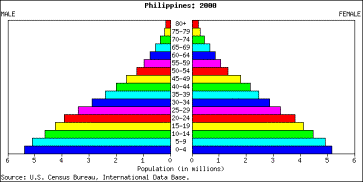

According to this graph, Which stage of the demographic transition has the highest level of population growth?
pre-industrial
transitional
industrial
post-industrial
I. China's larger population.
II. China's growing dependence on fossil fuels to drive their economy.
III. Ivory Coast's dependence on small scale and subsistence agriculture.
IV. Ivory Coast's much smaller GDP.


A rhino is an example of an
R- Selected Species
K - Selected Species
Somewhere in-between

Kangaroos are an example of which type of species?
r - Selected
K - Selected
Somewhere in-between

Frogs are an example of which type of species?
r - Selected
K - Selected
Somewhere in-between

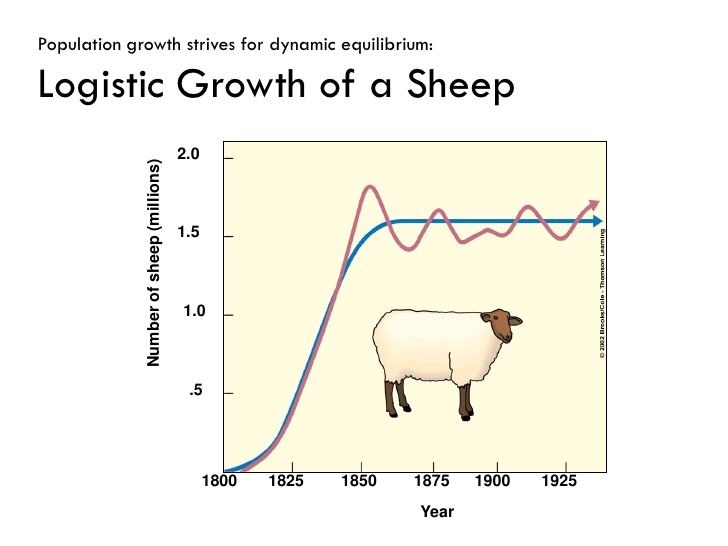

What point on the graph represents the carrying capacity?
A
B
C
D

What is happening at the 'A' on the graph?
the population overshoots above the carrying capacity
the population stops growing
growth begins to slow down due to limited resources
growth is speeding up due to an abundance of resources

Which of the following organisms would you expected to follow the pictured survivorship curve?
Humans
Sea turtles
Mice
These animals are not choosy about what they eat or where they live
Endangered
Specialists
Extinct
Generalists
These animals have specific diet and climate requirements
Extinct
Generalists
Specialists
Endangered

Tracks organisms that tend to live long lives (low death rate and high survivorship rate); toward the end of their life expectancies, however, there is a dramatic increase in the death rate.
Type I
Type II
Type III
Type IV
Describes organisms with a high death rate (or low survivorship rate) immediately following birth. Examples include bacteria, fishes, and invertebrates.
Type I
Type II
Type III
Type IV
These organisms typically live in unstable, unpredictable environments & are able to reproduce rapidly (exponentially). They do not take care of their young & are subject to predation.
K-strategist
r-strategist
m-strategist
s-strategist
These organisms have short life spans, are generally small, quick to mature and waste a lot of energy. Typical examples include salmon, corals, insects and bacteria.
K-strategist
r-strategist
m-strategist
s-strategist
These organisms occupy stable environments, are larger in size and have longer life expectancies. They produce, during their life spans, fewer offspring, but place a greater investment in each.
K-strategist
r-strategist
m-strategist
s-strategist
Human activities such as the ____ release large amounts of Carbon into our atmosphere.
Burning of fossil fuels
burning of wood
use of synthetic fertilizers
use of detergents
Which of the following biogeochemical cycles does not have an atmospheric phase?
Hydrolic Cycle
Nitrogen Cycle
Sulfur Cycle
Carbon Cycle
Phosphorous Cycle
Energy enters a system as sunlight and a producer is able to produce 10 kilograms of tissue. If eaten, the producer would provide about ___ kilograms of energy to a primary consumer that would provide about ____ kilograms of energy for a secondary consumer
100; 10
10; 1
100; 1
1; 0.1
Productivity in an ecosystem has to do with
Efficiency of its primary producers
The number of different species living in the ecosystem
Its longevity
Its rate of producing biomass
Ecologists study....
Living things and their genetic makeup
Genetic Patterns and the chemistry in them
The physical world and its processes
Relationships between organisms and their environment
An ecosystem consists of
A physical environment within which a biological community lives
The species with which a biological community interacts
A biological community and its physical environment
the primary producers within a biological community
The length and complexity of a food web in the Arctic would be ____ when compared to one in the tropical rainforest.
Short and less complex
short and more complex
long and less complex
long and more complex
In the nitrogen cycle, what is one natural way that nitrogen gets into our soil?
Fertilizers
Human Waste through septic tanks
Decomposing animals
Industrial waste
In the _____, there is no wet/dry season. But we do see more lower plants with a thicker epidermis..
Tundra
Boreal
Savanna
Desert
Taiga
There are less nutrient rich soils in the Rain Forest due to the dense tree canopy and water runoff.
True
False
Which biome has the lowest average Temperature, and the lowest Precipitation?
Tundra
Savanna
Rainforest
Taiga
Select the two characteristics that determine which type of biome an ecosystem is.
Climate
Temperature
Elevation
Precipitation
Which of the following is an example of a biotic factor?
Temperature
Light
Atmosphere
Population
Water
In a food pyramid, which organism can be found on the bottom?
Primary Consumers
producers
Secondary Consumers
Herbivores
We see saltier soils due to the evaporation rate in which biome?
Forest
Grasslands
Tundras
Deserts
Human activities such as the ____ release large amounts of Carbon into our atmosphere.
Burning of fossil fuels
burning of wood
use of synthetic fertilizers
use of detergents


Gas that makes up 78% of our atmosphere.
Oxygen
Nitrogen
Hydrogen
Carbon Dioxide

__________ primary productivity = the organic materials that remain after photosynthetic organisms in the ecosystem have used some of these compounds for their cellular energy needs (cellular respiration).
Gross
Total
Net
Secondary
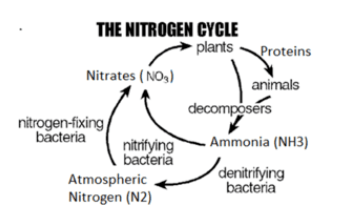
According to this diagram, plants use nitrogen to make _________________________
bacteria
animals
proteins
decomposers
The average efficiency of energy transfer between trophic levels is approximately
1 percent
4 percent
40 percent
50 percent
10 percent

Which of the following organisms is a herbivore?
fox
ladybug
butterfly
snake

What type of consumer is the wolf?
omnivore
decomposer
carnivore
herbivore

What do the arrows in the food chain indicate about the flow of energy in an ecosystem?
Energy is continuously recycled by the organisms in an ecosystem.
Energy flows in one direction in an ecosystem, from producers to consumers.
More of the available energy in an ecosystem is given to large animals than to small animals.
Organisms at the end of the food chain receive more energy than those at the beginning.

How would the removal of earthworms from the food chain affect the other organisms?
The number of bass will increase.
The number of crayfish will decrease.
The crayfish will get their energy directly from the sun.
The number of bass and ospreys (bird) will increase.


The owl receives energy from which organisms?
rabbit and butterfly
mouse and rabbit
grasshopper and butterfly
fox and frog

Which biome covers most of the land mass near Earth's equator?
Desert
Grassland
Tropical rainforest
Temperate forest
A large region characterized by a specific type of climate and certain type of plants.
boreal forest (taiga)
climate
biome
canopy

__________ primary productivity is the total amount of energy that producers convert to chemical energy in organic molecules per unit of time.
Net
Total
Gross
Secondary

