
 Worksheets
DNA and Protein Synthesis
Total questions: 56
Worksheet time: 54mins

What makes up the SIDES of a DNA ladder?
nitrogen bases
sugars & phosphates
genes & chromosomes
RNA

What makes up the rungs (steps) of a DNA ladder?
sugars & phosphates
nitrogen bases
sugars
genes & chromosomes

What SHAPE is DNA?
single strand
straight ladder
double helix (twisted ladder)
DNA has no shape

In DNA. what base always pairs with A?
A
T
C
G
In DNA, what base always pairs with C?
C
T
A
G

If one strand of a DNA molecule has the following order of bases, what will be the correct order of bases on the complementary (matching) strand?
AATTGGCC
AATTGGCC
TTAACCGG
GGCCAATT
GACTGACT

What is DNA made up of?
nucleotides
cytoplasm
RNA
cells

Which is NOT one of the three parts of a nucleotide?
sugar
base
ribosome
phosphate

In what cell part is the DNA located?
ribosome
cytoplasm
mitochondria
nucleus

What is a section of DNA that codes for a specific protein called?
RNA
replication
gene
protein

What is it called when DNA makes a copy of itself?
Translation
Replication
Mitosis
Gene therapy

TRUE or FALSE? During DNA replication, the two new copies of DNA formed are IDENTICAL
True
False

During protein synthesis, DNA sends mRNA out of the nucleus to make what?
identical DNA molecules
genes
proteins
fats

How is RNA different than DNA?
It is 2 stranded
It has the sugar deoxyribose
It has the base U instead of T
It is not different- RNA is identical to DNA

What are proteins made of?
Amino acids
chloroplasts
guanine
carbohydrates

What does DNA stand for?
Deoxyribonucleic acid
Diribose nutride acidosis
Dinitro acid
Deoxynitrogenic acid

Fill in the matching bases that would appear on the top strand of the DNA molecule pictured, in order.
A G T C A T G A
A G T C A T G A
T T T A A A C C
T C A G T A C T
C A T G A G A T

What part of the cell cycle does replication occur?
S phase
Prophase
Metaphase
G1

What is the job of ribosomes?
make proteins
store energy
create covalent bonds
create hydrogen bonds
Which organelle is DNA usually found in?
cell membrane
vacuole
chloroplast
nucleus
Which of the following is NOT a base in RNA?
Adenine
Thymine
Uracil
Cytosine
Where does TRANSCRIPTION occur?
Nucleus
Ribosome
Cytoplasm
Mitochondria
Why must transcription occur where DNA can be found?
because DNA can't leave
because ribosomes are in the nucleus
because DNA polymerase is found there
because helicase unzips the DNA
How many codons equals 1 amino acid?
1
2
3
4
How many nucleotides equal 1 amino acid?
1
2
3
4
TRANSCRIBE this DNA sequence: TACGTTACT
AUGCAAUGA
ATGCAATGA
AUGGATUGA
TACGTTACT
Which of the following are differences in the structure between RNA and DNA
DNA uses deoxyribose sugar, RNA uses sugar ribose
DNA pairs Adenine with Uracil, RNA pairs Adenine with Thymine
DNA is a double helix, RNA is a single helix
DNA pairs Adenine with Thymine, RNA pairs Adenine with Uracil
Which organelle is the location where protein is made?
Ribosome
Nucleus
Cytoplasm
Nucleotide
When these bond together, they form a protein
Amino Acids
Peptide Bonds
Ribose
Nucleotides
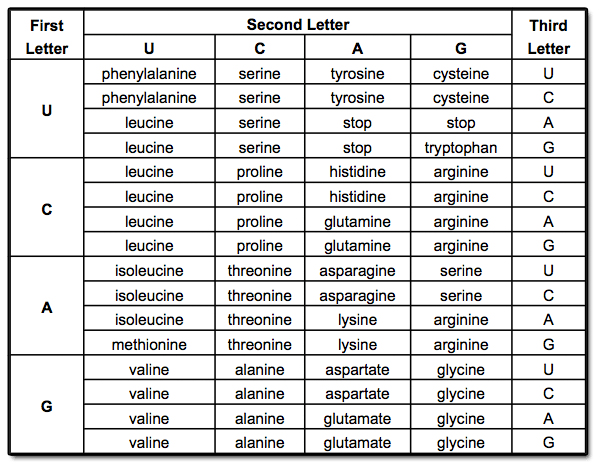
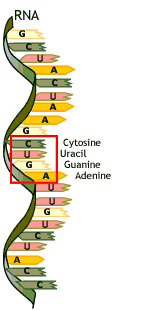
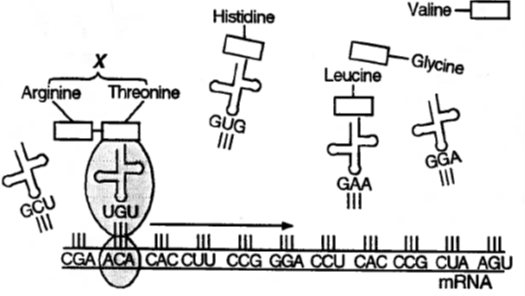
ATG GGA ACT CCA
How many codons: AAU GCG AUG
9
1
3
15
What is the order for Protein Synthesis?
Transcription -> Translation -> Protein
Translation - > Transcription -> Protein
Protein -> Transcription -> Translation
Translation -> Protein -> Transcription
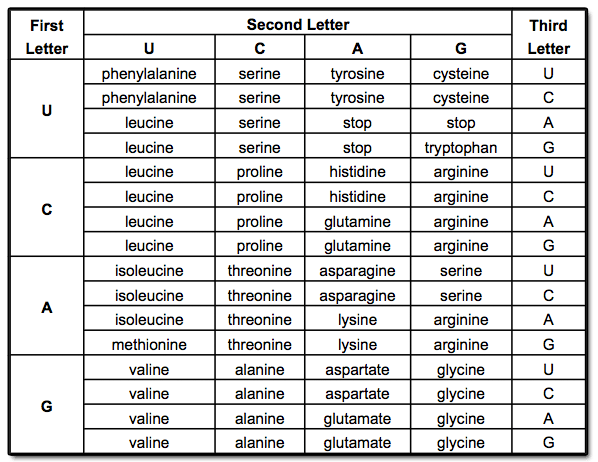


What amino acid would be added to the protein being formed during translation if the mRNA codon reads "AUG?"
Phenylalanine
Tyrosine
Leucine
Methionine
What is the correct amino acid sequence for the mRNA code AUG GCA AAC CGU
Met-Ala-Asn-Ala
Met-Ala (because the third codon codes for STOP)
Ileu-Ala-Asn-Ala
Met-Ala-Asn-Arg
Ileu-Ala-Asn-Ala

