wayground logo

Free Printable Worksheets

Font size

S
M
L
XL
Worksheets

erosion weathering deposition

Total questions: 35

Worksheet time: 26mins
Name
Class
Date
1.
The natural chemical or physical processes that breaks down rock on Earth's surface.
a)
weathering
b)
erosion
c)
deposition
d)
jackhammering
2.
The process by which water, ice, wind or gravity moves weathered rock and soil from one place to another.
a)
weathering
b)
erosion
c)
deposition
d)
dumptruck
3.
This type of weathering occurs when rock is physically broken down into smaller pieces of rock.
a)
mechanical weathering
b)
chemical weathering
c)
erosion weathering
d)
deposition
4.
This type of weathering occurs when rocks weaken then break down due to chemical changes in the composition of the rock.
a)
mechanical weathering
b)
chemical weathering
c)
erosion weathering
d)
deposition
5.
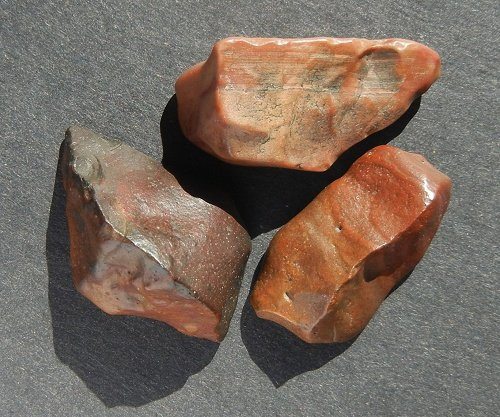
These rocks were made smooth by wind blowing smaller rock particles across their surface.  This is an example of:
a)
ice wedging
b)
chemical weathering
c)
acid rain
d)
abrasion
6.
These rocks were broken apart from the continuous freeze/thaw of water in the cracks of the rocks. This is an example of:
a)
ice wedging
b)
acid rain
c)
permeability
d)
abrasion
7.
How does freezing water cause the weathering of rocks?  The freezing water—
a)
keeps the rocks in place
b)
makes the rocks last longer
c)
expands cracks and breaks rocks
d)
causes rocks to fall in landslides
8.

Which profile best shows the general depositional pattern that occurs when water from a stream enters

the ocean?

a)
b)
c)
d)
9.

Each of the rock particles below has the same density

and volume. Which particle will most likely settle at

the fastest rate in moving water?

a)
b)
c)
d)
10.

Which size particle will remain suspended longest as

a river enters the ocean?

a)

pebble

b)

sand

c)

silt

d)

clay

11.

The diagram shows four identical columns containing the same amount of water. Four different-sized spherical particles, made of the same uniform material, are dropped into the columns and settle to the bottom. Which graph best shows the relative settling times of the four particles?

a)
b)
c)
d)
12.
The process by which the products of weathering are transported.
a)
Weathering
b)
Erosion
13.
Where does wind erosion occur?
a)
Places where there is a lot of vegetation (plants, trees, grass)
b)
Places where there is little vegetation (plants, trees, grass)
14.
Wind removes topsoil, lowers the land and leaves rock fragments that are too large to be lifted.  Common in deserts.
a)
Deflation
b)
Abrasion
c)
Saltation
d)
Remediation
15.
The steeper the slope, the ________ the stream.
a)
Slower
b)
Broader
c)
Faster
d)
Curvier
16.
Streams with steep gradients have a(n) _____ velocity than those with gentle gradients.
a)
Greater
b)
Lesser
c)
Average
d)
None of these
17.

What is a floodplain?

a)

The area near a river that floods when water levels get to be too high.

b)

The area near a river that looks boring or dull.

c)

The process of water levels going over a river or stream bank.

d)

Water gathering on the surface of the Earth because it doesn't seep into the ground.

18.

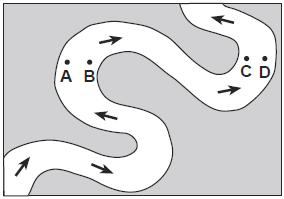
Erosion is most likely greatest at locations

a)

A and B

b)

B and C

c)

C and D

d)

D and A

19.

Which two locations have the greatest stream velocities?

a)

A and B

b)

B and C

c)

C and D

d)

D and A

20.

The process in which sediment settles out (drops to the bottom) of the water or wind that is carrying it

a)

Weathering

b)

Erosion

c)

Sedimentation

d)

Deposition

21.

A landscape region that has broad, U-shaped valleys with polished and grooved bedrock was most likely formed by

a)

running water

b)

glaciers

c)

wind

d)

wave action

22.

Which cross section best represents the valley shape where a rapidly flowing stream is cutting into the bedrock in a mountainous area?

a)
b)
c)
d)
23.
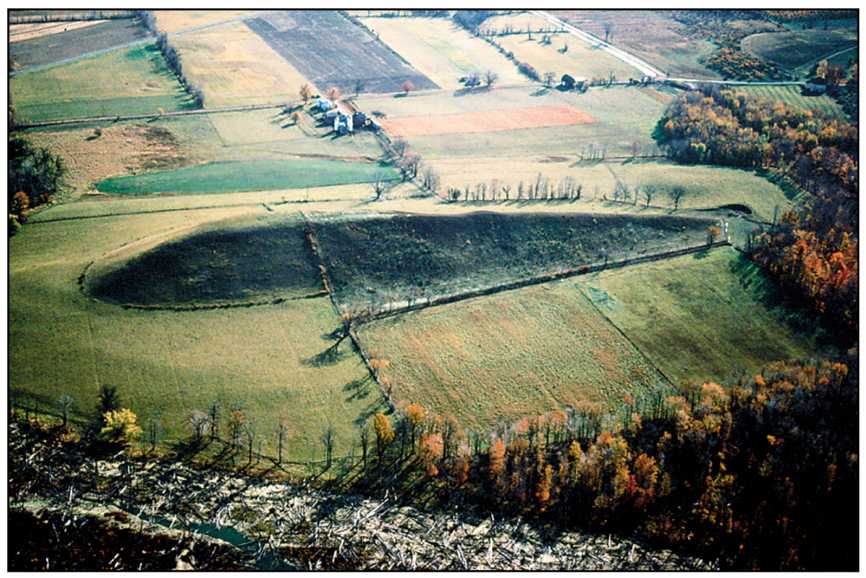
Which agent of erosion most likely formed the drumlins and finger lakes in New York State?
a)
running water
b)
moving ice
c)
wave action
d)
mass movement
24.

The diagram shown represents a geologic landscape.


Which type of stream drainage pattern formed on this landscape?

a)
b)
c)
d)
25.
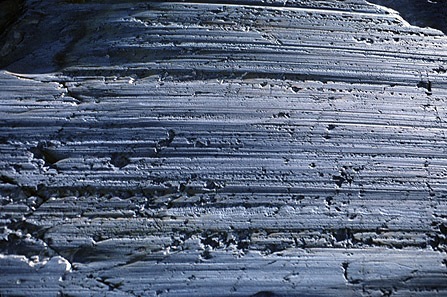
_____ are parallel scratch marks on bedrock
a)
Plucking
b)
Abrasion
c)
Straitions
d)
Till
26.

What will be the most probable arrangement of rock particles deposited directly by a glacier?

a)

unsorted and layered

b)

unsorted and not layered

c)

sorted and not layered

d)

sorted and layered

27.
A _____ is a tear-drop-shaped hill created by ice flow over and around till deposit.
a)
drumlin
b)
esker
c)
moraine
d)
erratic
28.

Humus is:

a)

the part of soil made up of decayed parts of once-living things.

b)

a dip that is made of garbanzo beans.

c)

a bone that can be found in the upper arm.

d)

a sound people make when their lips are together.

29.
What is the name of Horizon 1?
a)
Subsoil 
b)
Topsoil
c)
Bedrock 
d)
Parent Rock
30.

What is longshore drift?

a)

The movement of sediment down the beach.

b)

A pebble drifting slowly into the sea.

c)

When a beach is really long and people sleep on it.
31.
What is the force that moves glaciers?
a)
ice
b)
wind
c)
gravity
d)
energy
32.
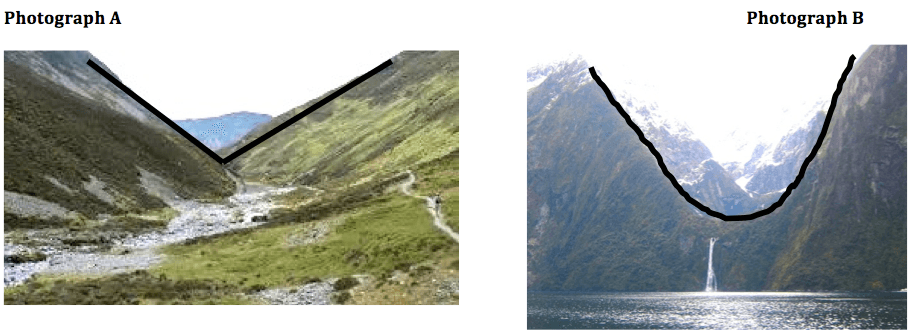
Which list best identifies the agent of erosion that primarily determined the shape of each valley? 
a)
photograph A—glacier; photograph B—river
b)
photograph A—river; photograph B—glacier
c)
Both A and B—river
d)
Both A and B—glacier
33.

Caves being formed by acid rain dissolving underground limestone are examples of what?

a)

Chemical Weathering

b)

Erosion

c)

Deposition

d)

Mechanical Weathering

34.
A ridge of till located at the farthest point reached by a glacier is called a 
a)
horn
b)
fiord
c)
terminal moraine
d)
drumlin
35.
What is one main difference between continental glaciers and valley glaciers? 
a)
Continental glaciers are much larger and thicker
b)
Each type of glacier is made of different