
 Worksheets
Y10 nervous coordination - iGCSE Biology
Total questions: 35
Worksheet time: 29mins
The long, fiber like part of a neuron which the cell sends information to receiving neurons
axon
dendrite
myelin
Node of Ranvier
The part of the neuron that receives messages from adjacent neurons
axon
axon terminal
dendrite
neuron
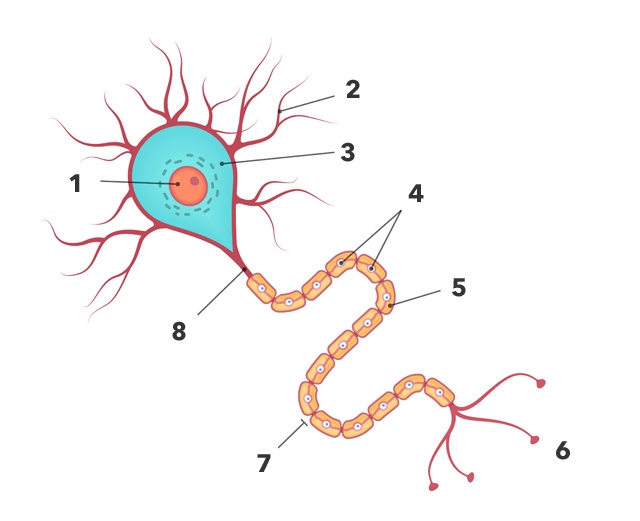
Identify #1
axon
cell body
myelin sheath
nucleus
Identify #2
axon
cell body
dendrite
myelin sheath
Identify #3
axon
cell body
dendrite
myelin sheath
Identify #6
axon terminals
dendrites
dendrite
schwann cells
An example of a reflex action includes
Touching a butterfly
Brushing your hand against the side of your body
Touching a hot stove
Your legs moving as you walk
In a reflex arc, the sensory neuron leads to the ___________ and the motor neuron leads to the __________
Spinal cord, CNS
CNS, muscle
relay neuron, muscle
Muscle, CNS

How does neurotransmitter move across a synapse?
diffusion
osmosis
active transport
electrical impulse
What is the advantage of a reflex? (more than one)
Quick, doesn't need you to think
Protects the body from harm
Always the same
Can change over time
What is the correct order for a reflex?
receptor --> motor neuron --> relay neuron --> sensory neuron --> effector
receptor --> sensory neuron --> relay neuron --> motor neuron --> effector
effector --> sensory neuron --> motor neuron --> relay neuron --> receptor
receptor --> sensory neuron --> motor neuron --> relay neuron --> effector


What happens to the shape of the lens when an object is close?
fatter - refract more
thinner - refract less
What happens to the shape of the lens when an object is far away?
fatter - refract more
thinner - refract less
Which muscle contracts when in a bright room?
ciliary
suspensory
circular
radial
Which muscle contracts when in a dark room?
ciliary
suspensory
circular
radial
Which muscle relaxes when in a bright room?
ciliary
suspensory
circular
radial
Which muscle relaxes when in a dark room?
ciliary
suspensory
circular
radial
What happens to the pupil in a dark room?
dilates - more light in
constricts - less light in
What happens to the pupil in a bright room?
dilates - more light in
constricts - less light in

