Wayground logo

Free Printable Worksheets

Font size

S
M
L
XL
Worksheets

Political Revolutions

Total questions: 57

Worksheet time: 35mins

Name
Class
Date
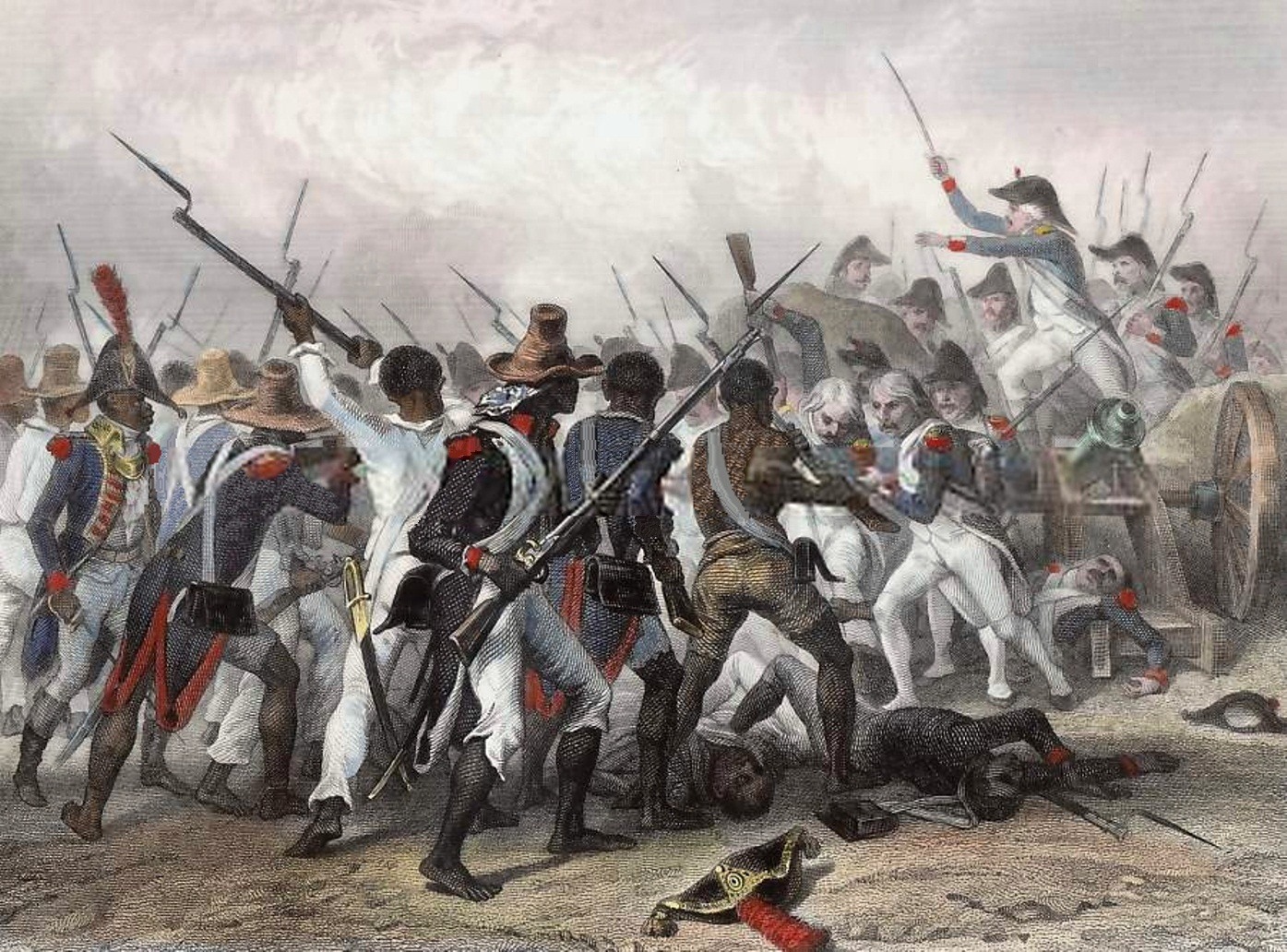
1.
The first strong leader of the slave revolt was?
a)
Toussaint Louverture
b)
Maximilian Robespierre
c)
Henry VIII
d)
Simon Bolivar
2.
The Haitian Revolution was the first completely successful _____ revolt in world history.
a)
Male
b)
Rich landowner
c)
Slave
d)
Nationalistic 
3.
The Haitian Revolution was influenced mainly by which revolution?
a)
French
b)
American
c)
Spanish American
4.
Who assumed control of the slave rebellion in 1794?
a)
St. Domingue
b)
Vincent Oge
c)
Toussaint L'Overture
d)
Thomas Jefferson
5.
Why did the Haitian Revolution start?
a)
The revolution started because of slaves wanting social equality and freedom.
b)
The Haitian Revolution started because of the ideas spread by the many successful slave rebellions in America
c)
The plantation owners of Haiti wanted to be paid a fair price in Europe for their production of Sugar
d)
Pirates invaded the island of Haiti and demanded independence
6.
What was the original name of Haiti. 
a)
Turks
b)
St. Domingue
c)
Brazil
d)
Cuba
7.
Before independence, Haiti was a colony of _____.
a)
Great Britain
b)
France
c)
The United States
d)
Belgium
8.
Slaves made up ___% of the Haitian population.
a)
25
b)
50
c)
80
d)
90
9.
True or False:  Touissant L'Oerture lived to see a free and independent Haiti.
a)
True
b)
False
10.
Who won the Haitian Revolution?
a)
the French
b)
the British
c)
the Haitian Slaves
11.
What type of tactics did Touissant L'Overture use?
a)
Naval attacks
b)
battlefield tactics
c)
trench warfare
d)
geurilla warfare
12.
As a result of the Haitian Revolution, Haiti created the first ever
a)
black monarchy
b)
black dictatorship
c)
black republic
13.
What did most former slaves do after the Haitian Revolution was over?
a)
joined the French Army
b)
Moved to other islands
c)
worked in the sugar fields
d)
owned plantations
14.
Because the French could not defend Haiti and they needed money what did Napoleon decide to do?
a)
Fight America
b)
Invade England
c)
Recapture Haiti for France
d)
Sold the Louisiana territory to the United States
15.

The French Revolution began in

a)

1776

b)

1789

c)

1876

d)

1798

16.

France was deep in debt because

a)

money spent on the American Revolution

b)

Marie Antoinette's lavish spending

c)

the 1st and 2nd estates did not pay taxes

d)

all of the above

17.

The First Estate in French society was composed of 

a)

the Clergy

b)

people with special courts

c)

people who did not pay taxes

d)

all listed

18.

Most of the people of France belonged to the 

a)

1st Estate

b)

2nd Estate

c)

3rd Estate

d)

4th Estate

19.

When the people of Paris heard that the military was going to stop the revolution their response was to 

a)

leave the city

b)

storm the Bastille

c)

force the King to come to Paris

d)

none of the above

20.

The radicals who took over the revolution were led by 

a)

Louis XVI

b)

Robespierre

c)

Rousseau

d)

Thomas Jefferson

21.

The most radical leader during the French Revolution & was the leader during the Reign of Terror.

a)

Robespierre

b)

Napoleon

c)

bourgeoisie

d)

Louis XVI

22.


The King of France during the French Revolution. He was considered a weak, ineffective, & unprepared ruler.

a)

Robespierre

b)

Napoleon Bonaparte

c)

bourgeoisie

d)

Louis XVI

23.

One similarity between the French and American Revolutions is that they both started because of an unfair tax burden.

a)

True

b)

False

24.

The machine used to behead enemies of the revolution is called

a)

The Bastille

b)

Sans-Culottes

c)

Guillotine

d)

The Great Beheader

25.

Q. Which European power controlled territory A?

a)

England

b)

France

c)

Spain

d)

Mexico

26.

Which answer best describes who was fighting in the French and Indian War?

a)

French against the Native Americans

b)

British against the Native Americans

c)

French allied with the British against the Native Americans

d)

French allied with Native Americans against the British and their allies 

27.

In order to pay for the French and Indian War, what did England do?

a)

Stole money from the French

b)

Sold land to Spain

c)

taxed the colonists in the Americas

d)

increased slavery in England

28.

Enlightenment philosopher who believed people had natural rights of life, liberty, and property. His work used to justify American and French Revolution!

a)

John Locke

b)

Montesquieu

c)

Rousseau

d)

Voltaire

29.

Which European power controlled territory B?

a)

England

b)

France

c)

Spain

d)

Canada

30.
When the Third Estate was locked out of the Estates General, they pledged never to disband until a new constitution was created. This event is known as:
a)
Women's March on Versailles
b)
Reign of Terror
c)
The Great Fear
d)
Tennis Court Oath
31.
Who belonged to the First Estate?
a)
nobles
b)
clergy
c)
peasants
d)
royalty
32.
The king of France during the French Revolution:
a)
Napoleon
b)
Leoverture 
c)
Louis XVI
d)
Robespierre
33.
What did the National Assembly promise to do in the Tennis Court Oath?
a)
To execute the king
b)
To write a new constitution
c)
To stage a Coup d'etat
d)
To make France independent
34.
The French Revolution was inspired by _______________ thinkers.
a)
Scientific Revolution
b)
Clergy
c)
Enlightenment
d)
Revolutionary
35.
The Second Estate was composed of 
a)
Church leaders
b)
Nobility
c)
Peasants
d)
none of the above
36.
When the people of Paris heard that the military was going to stop the revolution their response was to 
a)
leave the city
b)
storm the Bastille
c)
force the King to come to Paris
d)
none of the above
37.
Which of these contributed to the French Revolution?
a)
defeat and occupation by Prussian army
b)
rejection of Enlightenment ideas
c)
participation in the American Revolution
d)
the rise of Napoleon
38.
Which of the following was an underlying, or deep-­rooted, cause of the French Revolution? 
a)
unequal tax burdens
b)
equal land ownership
c)
a law granting peasants more freedom 
d)
a growing French empire
39.

Which estate paid the majority of the taxes in France prior to the French Revolution?

a)

1st Estate

b)

2nd Estate

c)

3rd Estate

40.

France was deep in debt because

a)

money spent on the American Revolution

b)

Marie Antoinette's lavish spending

c)

the 1st and 2nd estates barely paid any taxes

d)

all of the above

41.

The idea that reason should guide society rather than tradition helped cause the French Revolution and came from

a)

the Declaration of Independence

b)

the Scientific Revolution

c)

the Enlightenment

d)

all of the above

42.

This document was important in creating the French constitution and declaring its citizens equal.

a)

Declaration of Rights of Man and the Citizen

b)

Declaration of Sentiments

c)

Declaration of French Independence

d)

Declaration of Citizen and Rights

43.
What's another name for the French and Indian War?
a)
Seven Years War
b)
Six Years War
c)
American Revolution
d)
One Hundred Years War
44.
Who won the French and Indian War?
a)
French
b)
Indians
c)
British
d)
Spanish
45.
In order to pay for the French and Indian War, what did England do?
a)
Stole money from the French
b)
Sold land to Spain
c)
taxed the colonists
d)
increased slavery in England
46.
Enlightenment philosopher who believed people had natural rights of life, liberty, and property.
a)
John Locke
b)
Montesquieu
c)
Rousseau
d)
Voltaire
47.
Enlightenment philosphers believe that if government abuses power the people should change it.
a)
True
b)
False
48.
Rousseau wrote, "Man is born free, and everywhere he is in chains." What kind of government did he favor in order to insure greater freedom?
a)
An absolute monarchy
b)
An enlightened monarchy
c)
An Oligarchy
d)
A popularly elected government
49.
"We hold these truths to be self-evident, that all men are created equal, that they are endowed by their Creator with certain inalienable rights, that among these are life, liberty, and the pursuit of happiness . . ."— The Declaration of Independence
Which Enlightenment thinker most directly influenced the notion expressed in this passage?
a)
Montesque
b)
Hobbes
c)
Voltaire
d)
Locke
50.
Who was the major author of the Declaration of Independence?
a)
Benjamin Franklin
b)
John Adams
c)
Thomas Jefferson
d)
Patrick Henry
51.
What event is depicted in this image?
a)
Boston Massacre
b)
Boston Tea Party
c)
Battle of Bunker Hill
d)
Lexington and Concord
52.
Which one of these is not an advantage that helped the American patriots defeat Great Britain.
a)
defense of their own land, principles and beliefs
b)
support from France
c)
superior numbers of soldiers and greater experience
d)
strong leadership from men like George Washington
53.
The U.S. was founded on July 4, 1776, by the approval of this document.
a)
the Treaty of Paris
b)
the Constitution
c)
the Declaration of Independence
d)
the Virginia Charter
54.
What was the name of the British king during the American Revolution?
a)
Charles III
b)
George III
c)
William III
d)
James III
55.
The French and Indian War cost King George and Great Britain a lot of money. To help pay for the war, the British colonies were ordered to 
a)
give up their food
b)
work for free
c)
become a part of the Army
d)
pay taxes without representation
56.
The Enlightenment is
a)
a time of rebirth
b)
a time when science ruled
c)
a time with people used reason and logic to explain the world
d)
a time when technology ruled
57.

Many colonists did not want to remain loyal to Great Britain and King George. They wanted to be free from British rule. These colonists were called

a)

Patriots

b)

Republicans

c)

Democrats

d)

Loyalists