
 Worksheets
Review: Compounds, Mixtures and Reactions
Total questions: 101
Worksheet time: 2hrs 20mins
Na2CO3


This diagram represents...
An element
A molecule
A compound
A mixture of elements and compounds


Which substances, when mixed together, maintain their original physical properties?
gravel and water
wood chips, water and sand
sand and water
all of the above
A cup of orange juice with pulp is poured into a glass. Which of these procedures could be done to separate the juice from the pulp?
pour the juice through a coffee filter
heat the juice in a pot until boiling
pour the juice in another cup
allow the mixture to settle, leaving the pulp at the bottom of the glass
A mixture of iron filings and chalk dust is placed on a plate. Which of the following could be done to gather the iron filings?
Pour the mixture into a funnel
Put the mixture in a pot on the stove
Run a magnet over the mixture
Filter the mixture through a strainer
Brass is an alloy consisting of a mixture of
copper and zinc
copper and lead
copper and tin
tin and lead
Which of the following characteristics belong to pure metals?
I. Ductile
II. Malleable
III. Brittle
IV. Good conductor of electricity
I and II
I and IV
I, II and IV
Wait! What are those letters?
Alloy is a ...
A chemical compound with combination between metal and non-metal
A salt contain of two or more elements where the main element is non-metal
Mixture of two or more elements where the main element is metal
Bronze contain copper and
Zinc
Tin
Magnesium
Antimony

Diagram above shows the arrangement of atoms in brass. Which of the following could be atoms X and Y?
X : Copper Y: Tin
X: Zinc Y: Copper
X: Iron Y: Carbon
X: Copper Y: Zinc
Sieving can separate the components of all kinds of mixtures.
True
False
The sieve, which is the tool used in sieving, can only allow particles that are smaller than the pores in the sieve.
True
False
Sieving is.....
good for separating solids and liquids
good for separating solid of different sizes
good for separating a solid that is dissolved in a liquid

What is the function of 3?
prevents air from entering the flask
provides a large surface area for hot vapour to condense
blocks hot vapour from escaping
collects the distillate

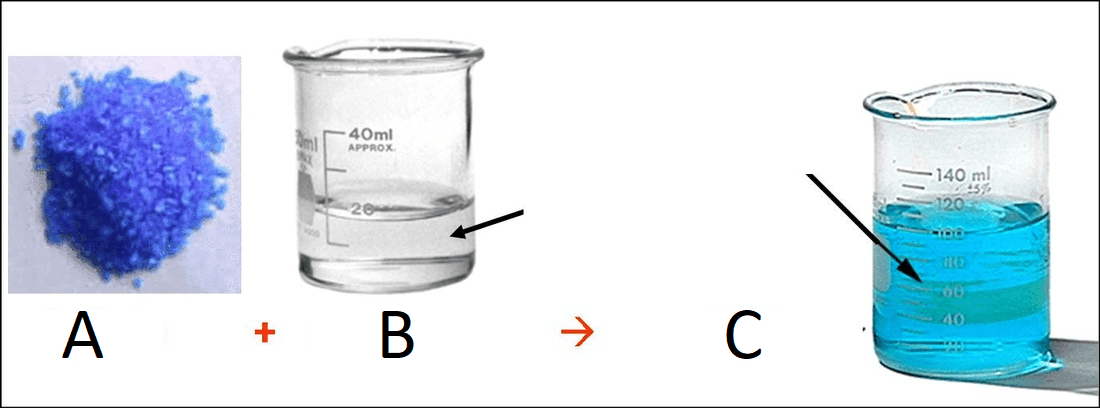
What is C?
solute
solvent
solution
solid
What is A?
solute
solvent
solution
solid
Which of these particles is NOT able to pass through a sand, gravel, and charcoal filter?
bacteria
water
viruses
large piece of dirt
What does fractional distillation specialize at? (not can do but what is it designed to do)
Separating liquids
Separating solutions
Separating solids and liquids
Non of the above
Which of the following is the best method of obtaining pure water from seawater?
Separating funnel
Simple distillation
Filtration
A pure substance shows ------------------ spot on chromatogram


The diagram shows the paper chromatograms of four substances, W, X, Y, and Z.
Which two substance are pure?
W and X
W and Y
X and Y
Z and X

A student is investigating a colored mixture using chromatography.
Where should he place the coloured mixture?
in the solvent
just above the pencil line
just below the pencil line
on the pencil line

Chromatography is used to fin out if a banned dye, P, is present in foodstuffs. The result are shown in the diagram. Which foodstuff contains P?
A
B
C
D

Food colorings contain one or more food dyes. A student used paper colorings (E, F, and G) and one unknown food coloring (H) on the chromatography. The diagram shows the appearance of the paper before and after her experiment. How many food dyes are there in food colouring E?
1
2
5
6
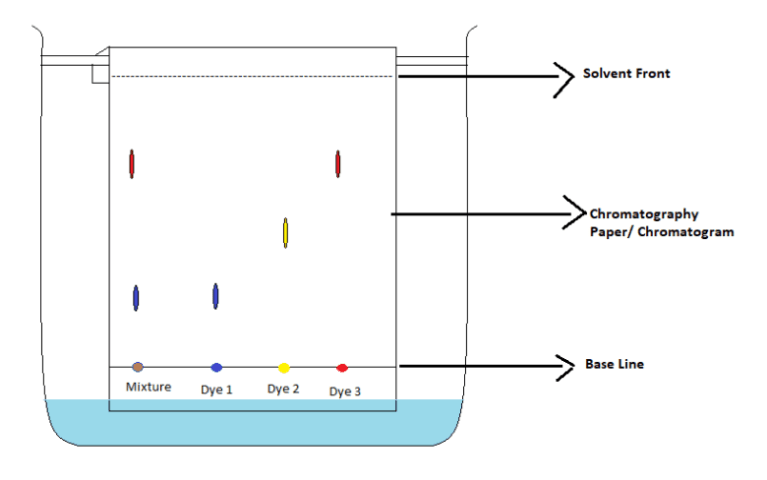
The mixture on the left contains...
All three dyes
None of the dyes
Dye 1 and Dye 2
Dye 1 and Dye 3
Dye 2 and Dye 3

Solubility refers to the ____ of solute that can dissolve in a certain volume or mass of solvent, at a certain temperature.
Mean
Range
Amount
Mode
__________ materials allow some light to pass through.
According to the Law of Conservation of Mass, what happens to the wood and oxygen when it is burned?
The wood disappears.
It stays the same chemically.
The atoms in the wood and oxygen rearrange and form smoke and ash.
Nothing.
15 grams of sugar are dissolved into 300 grams of water. what is the mass of the mixture?
15
315
285
300
250 grams of iron and sand are separated. The mass of the sand is 150 grams. What is the mass of the iron?
is it impossible to determine.
100 grams
150 grams
250 grams
A fair test can be created using what three steps? (Choose three)
Change only one thing
Measure something
Keep everything else the same
Wearing a Scientist's coat
Controlled variables are...
The one variable that is changed
The variable that is measured
The variables that need to be kept the same
What is the best way to collect and record data?
In a data table
On post-it notes
On scrap paper
interpretive dance
The variable that is changed on purpose is..
Constant
Control
Independent Variable
Dependent Variable
You want to check which particles dissolve faster, smaller or bigger ones.
1- What is the independent variable?
2- What are the controlled variables?
You want to know which dissolves faster in hot water: salt or sugar.
What is the independent variable?
What are the controlled variables?
A substance that is formed as the result of a chemical reaction is a __________________
Product
Reactant
Starters
Enders

The new substances after occurring the chemical reaction are called...
Reactants
Products

Metals and acids react to form .....
Salt and hydrogen
Salt and water
Carbon dioxide, salt and water
Hydrogen only
Magnesium + hydrochloric acid-->
Magnesium chloride + water
Magnesium chloride + hydrogen
Magnesium hydrochloride + hydrogen
Magnesium chloride + water + carbon dioxide
Zinc + sulfuric acid -->
Zinc sulfide + hydrogen
Zinc sulfate + hydrogen
Zinc sulfate + Water +Carbon dioxide
Zinc sulfide + water
Iron + hydrochloric acid -->
Iron chloride + hydrogen
Iron chloride + carbondioxide
Iron hydroxide + acid
Iron chloric + hydrogen
How do we test for hydrogen?
Squeaky pop test
Hydrogen extinguishes a lit splint
Bubbling through lime water
Hydrogen makes a glowing splint relight
Metal carbonates react with acid to form....
Salt, carboxylic acid and water
Salt, carbon dioxide and water
Salt and carbonated water
Salt and hydrogen
Calcium carbonate + hydrochloric acid -->
Calcium chloride + hydrogen
Calcium choride + water
Calcium chloride + carbon dioxide + water
Calcium sulfate + carbon dioxide + water
Copper carbonate + hydrochloric acid -->
Copper chloride + hydrogen
Copper chloride + water
Copper chloride + water + hydrogen
Copper chloride + water + carbondioxide
The two tests for carbon dioxide are ...
It will extinguish a lit splint
It will cause a squeaky pop
It will explode
When bubbled through lime water it turns the water cloudy
What gas is always produced when a metal reacts with acid?
Oxygen
Hydrogen
Carbon dioxide
Nitrogen
What gas is always produced when carbonates reacts with acids?
Oxygen
Hydrogen
Carbon dioxide
Nitrogen
three hydrogen (H)
one sulfur (S)
four oxygen (O)
How many elements are in C6H12O6?
1
2
3
4
In the equation, 2Mg + O2 ---> 2MgO, which are the reactants?
2Mg and O2
2MgO
Mg and MgO
O and MgO
2H2O + 2N → 4H + 2NO
The chemical symbols on the RIGHT (at the end of the equation) are called:
products
reactants
yields/produces

