wayground logo

Free Printable Worksheets

Font size

S
M
L
XL
Worksheets

IIT-JEE & NEET LEVEL - 7 (8-T)

Total questions: 100

Worksheet time: 2hrs 40mins

Name
Class
Date
1.

What element rusts?

a)

carbon

b)

manganese

c)

iron

d)

potassium

2.

What environmental element assists rusting?

a)

nitrogen

b)

oxygen

c)

carbon

d)

hydrogen

3.

A rusting bicycle

a)

physical change

b)

chemical change

4.

What conditions are required for rusting?

a)

dry cold conditions

b)

dry hot conditions

c)

hot damp conditions

5.

Rusting is an example of

a)

oxidation

b)

reduction

6.

What two things cause Iron to Rust ?

a)

Air and Oxygen

b)

Water and Carbon dioxide

c)

Oxygen and Water

d)

Carbon dioxide and Air

7.

What is the chemical name given to Rust ?

a)

Iron dioxide

b)

Iron oxide

c)

Steel oxide

d)

Carbon dioxide

8.

What prevents Rusting

a)

Painting , Oiling , Galvinising

b)

Washing with water

9.
How are metal oxides formed?
a)
When metals react with oxide.
b)
When metals react with water.
c)
When metals react with air.
d)
When metals react with oxygen.
10.
How are metal oxides formed?
a)
When metals react with oxide.
b)
When metals react with water.
c)
When metals react with air.
d)
When metals react with oxygen.
11.
What is an example of sublimation?
a)
Ice cream melting
b)
Dry ice
12.
Sublimation is
a)
when solid turns into gas
b)
when gas turns into plasma
c)
when liquid turns into gas
d)
when gas turns into solid
13.
What is the definition of sublimation?
a)
a chemical process where a solid turns into a gas without going through a liquid stage
b)
the process of a liquid changing into a gas
14.
What is evaporization?
a)
a gas becoming a liquid
b)
a liquid becoming a solid
c)
a gas becoming a solid
d)
a liquid becoming a gas
15.
What is sublimation?
a)
phase change between solid and liquid
b)
pahse change from gas to solid
c)
phase change from solid to gas
d)
phase change from solid to solid
16.
Which is the opposite of condensation?
a)
runoff
b)
evaporation
c)
precipitation
d)
transpiration
17.
What is the phase change of a solid to a liquid?
a)
freezing
b)
melting
c)
boiling
d)
condensation
18.
Change from Gas to Solid is called........
a)
Sublimation
b)
Deposition
c)
Fusion
d)
condensation
19.

The process by which liquid water changes into a gas

a)

Evaporation

b)

Sublimation

c)

Precipitation

d)

Condensation

20.
Is the sum of -7 + 5 positive or negative?
a)
Positive
b)
Negative
21.
Adding a negative is the same as subtracting a ______________.
a)
negative
b)
positive
c)
integer
d)
opposite
22.
What is the absolute value:
| 3 + (-2 1/2)|
a)
-1 1/2
b)
1 1/2
c)
-1/2
d)
1/2
23.
Subtracting a ___________ is the same as adding a positive.
a)
integer
b)
positive
c)
negative
d)
fraction
24.

Find -6.23 + 7.5

a)

13.73

b)

1.3

c)

-1.27

d)

1.27

25.

-3/7 + 4/5

a)

43/35

b)

-13/35

c)

13/35

26.
A recipe calls for 1/2 cup of sugar and 1/3 cup of cinnamon. What is the measure of the two ingredients combined?
a)
5/6 cup
b)
2/5 cup
c)
1/6 cup
d)
1/5 cup
27.
- 1/3 + (-1/6)
a)
-1/2
b)
-2/6
c)
1/3
d)
-2/18
28.
−28+(−8)=
a)
36
b)
−36
c)
−20
d)
20
29.
8 + (-12) + 2
a)
-6
b)
-18
c)
22
d)
-2
30.
-23.4 - 3.4= 
a)
-20
b)
26.8
c)
-26.8
d)
20
31.

-4.5 + 7.9 - 6.3

a)

-6.1

b)

-2.9

c)

2.9

d)

6.1

32.
0.3 x 0.5
a)
0.15
b)
1.5
c)
15
d)
150
33.

(-0.2)(-0.8)

a)

16

b)

0.16

c)

0.016

d)

1.6

34.
(-9)(-8)
a)
-72
b)
72
c)
81
d)
-81
35.

(-0.2)(-0.8)

a)

16

b)

0.16

c)

0.016

d)

1.6

36.
What is the definition of rational numbers?
a)
positive and negative fractions
b)
positive and negative decimals
c)
positive and negative whole numbers
d)
All of the above
37.
What operation do we use to turn fractions into decimals?
a)
addition
b)
subtraction
c)
multiplication
d)
division
38.
What is 3/8 written as a decimal?
a)
.37
b)
.375
c)
.38
d)
3.8
39.
When multiplying fractions we...
a)
Multiply by the reciprocal
b)
Cross-multiply
c)
Multiply across
d)
Keep flip change
40.
Find the product.
a)
9/24
b)
9/28
c)
6/32
d)
1/28
41.
What two types of measurements make up DENSITY
a)
Mass and Volume
b)
Temperature and Mass
c)
Grams and Centimeters
d)
Volume and Weight
42.
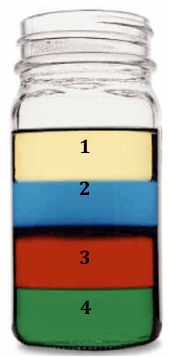
Why do the liquids form different layers?
a)
They have different densities.  
b)
They have different masses.  
c)
They have different volumes.  
d)
They are different temperatures.  
43.
What units can be used to express density?
a)
g/mL
b)
grams
c)
millimeters
d)
milliliters
44.
Frank has an eraser. It has a mass of 4g, and a volume of 2cm3. What is its density?
a)
8 g/cm3
b)
2 g/cm3
c)
1/2 g/cm3
d)
24 g/cm3
45.
What is this tool to get mass?
a)
triple beam balance
b)
ruler
c)
thermometer
d)
graduate cylinder
46.
What is the formula for density?
a)
density = mass x volume
b)
density = mass / volume
c)
density = mass + volume
d)
density = mass - volume
47.
Jack has a rock. The rock has a mass of 14 g and a volume of 2 cm3. What is the density of the rock?
a)
7 mL
b)
7 g/cm3
c)
28 g/cm3
d)
1/7 g/cm3
48.
Frank has a paper clip. It has a mass of 9g and a volume of 3cm3. What is its density?
a)
3 g/cm3
b)
1/3 g/cm3
c)
27 g/cm3
d)
39 g/cm3
49.
Why do some substances float on water?
a)
they are warmer than water
b)
they are cooler than water
c)
they are more dense than water
d)
they are less dense than water
50.
Put the liquids in order from most dense to least dense?
a)
4, 3, 2, 1
b)
1, 2, 3, 4
c)
3, 4, 2, 1, 
d)
4, 3, 1, 2
51.
What is the volume of Object X?
a)
10.0 cm3
b)
15.0 cm3
c)
20.0 cm3
d)
25.0 cm3
52.
Helium balloons rise on earth because
a)
helium is less dense than air
b)
helium is more dense than air
c)
helium is cooler than air
d)
helium is warmer than air
53.
What is the measuring unit for mass?
a)
centimeter 
b)
millimeter 
c)
grams 
d)
pounds
54.
Which units of measurement are used for volume?
a)
grams
b)
centimeters
c)
grams/milliliter
d)
milliliter
55.
What units are used to measure Density?
a)
cm3/g
b)
g
c)
g/cm3
d)
cm3
56.
A crayon has a mass of 10g and volume of 5 mL. What is the density?
a)
30 g/mL
b)
15 g/mL
c)
1 g/mL
d)
2 g/mL
57.
In general what is the most dense form of matter?
a)
solid
b)
liquid
c)
gas
d)
plasmas
58.
Jack has a rock. The rock has a mass of 14 g and a volume of 2 cm3. What is the density of the rock?
a)
7 mL
b)
7 g/cm3
c)
28 g/cm3
d)
1/7 g/cm3
59.
Calculate the density of the cube.
a)
2 g/cm3
b)
4 g/cm3
c)
6 g/cm3
d)
8 g/cm3
60.
Why do ice cubes float in a  glass of water?
a)
the ice cubes are more dense than the water
b)
the water is more dense than the ice cubes
c)
the water is more dense than the glass
d)
the ice is more dense than the glass
61.
The male part of the flower is________
a)
pistil
b)
sepal
c)
ovaries
d)
stamen
62.
The pollen grains are found in this part of the stamen.
a)
anther
b)
style
c)
pistil
63.
The part of the flower on which the pollen grains land.
a)
pistil
b)
stamen
c)
sepals
d)
stigma
64.
The enlarged base of the pistil that stores the eggs of the plant is the ___.
a)
ovary
b)
ovule
c)
stigma
d)
style
65.
Brightly colored parts of flowers that attract insects.
a)
petals
b)
pistils
c)
stamen
d)
filaments
66.
They enclose the egg cells inside the ovaries.
a)
ovules
b)
anther
c)
seeds
d)
stamen
67.
The female part of a flower is
a)
pistil
b)
stamen
c)
filament
d)
sepal
68.
Which is true about Asexual reproduction?
a)
Insects are needed to transfer pollen.
b)
New plants grow from seeds. 
c)
Offspring are genetically identical to their parent.
d)
Two types of gametes are involved. 
69.
Which structure is not essential in wind-pollinated flowers?
a)
anther
b)
ovary
c)
petal
d)
stigma
70.
Many wind-pollinated flowers have __________.
a)
feathery stigmas and light pollen.
b)
feathery stigmas and sticky pollen.
c)
short stigmas and light pollen.
d)
short stigmas and sticky pollen. 
71.

Name the male part of the plant

a)

Stigma

b)

Style

c)

Stamen

d)

Sepal

72.

Name the gametes in a plant

a)

Egg & sperm

b)

Egg & pollen

c)

Pollen & sperm

73.

Name the female part of the plant

a)

Anther

b)

Filament

c)

Petals

d)

Carpel

74.

The stamen is made of the

a)

Anther & filament

b)

Anther & petal

c)

Fliament & ovary

d)

Ovary & style

75.

The carpel is made of the

a)

Stigma & petals

b)

Stigma, style & ovary

c)

Filament & anther

d)

Petals

76.

These parts attract insects

a)

Stem & leaves

b)

Stigma, Style & Ovary

c)

Anther & filament

d)

Petals & nectary

77.

Where does the pollen land

a)

Stigma

b)

Style

c)

Ovary

d)

Petal

78.

Which part makes the egg

a)

Stigma

b)

Style

c)

Ovary

79.

Which part makes the pollen

a)

Stigma

b)

Style

c)

Filament

d)

Anther

80.

Find the area of the right triangle.

a)

30 cm2

b)

60 cm2

c)

62 cm2

d)

31 cm2

81.

What is the area of this parallelogram?

a)

120 m2

b)

60 m2

c)

120 m

d)

60 m

82.

What is the area of this figure?

a)

10 cm2

b)

25 cm2

c)

20 cm2

d)

5 cm2

83.

What is the perimeter of this figure?

a)

20 cm

b)

25 cm

c)

10 cm

d)

5 cm

84.

What is the area of this figure?

a)

20 cm2

b)

72 cm2

c)

96 cm2

d)

12 cm2

85.

What is the perimeter of this figure?

a)

56 cm

b)

24 cm

c)

20 cm

d)

40 cm

86.

What is the name of this figure?

a)

square

b)

trapezoid

c)

triangle

d)

rectangle

87.

What is the name of this figure?

a)

trapezoid

b)

triangle

c)

square

d)

rectangle

88.

Which formula would you use to find area of a triangle?

a)

b x h

b)

b x h ÷ 2

c)

l x w

d)

(b+b) x h ÷ 2

89.

What formula would you use to find the area of a trapezoid?

a)

b x h ÷ 2

b)

l x w

c)

(b+b) x h ÷ 2

d)

b x h x 2

90.
What is the area of a triangle with a base of 10 in. and a height of 4 in?
a)
40 in2
b)
40 in
c)
20 in2 
91.
What is the area of a square with side lengths of 5 cm?
a)
10 in.
b)
25 in.
c)
10 in2
d)
25 in2
92.
What is the area of a rectangle that has a base length of 7 ft. and a width of 5 ft.?
a)
42 ft.
b)
35 ft2
c)
28 ft.
93.
What is the area of the rhombus?
a)
11 cm2
b)
30 cm2
c)
22 cm2
d)
15 cm2
94.
Which description represents the area of a parallelogram? 
a)
The product of the length (base) and the height
b)
The sum of all of the side lengths
c)
The square of the side lengths
d)
Four times the length
95.
Which expression represents the area of the trapezoid?
a)
4(7+5)
----------
3
b)
5(7+7)
---------
  2
c)
4(6+8)
-----------
2
d)
8(4+5)
------------
  7
96.

What is the formula for the area of a square?

a)

A=bh

b)

A=lw

c)

A=s2

d)

A=1/2(bh)

97.

What is the formula for the area of a circle?

a)

A=Pi(d)

b)

A=Pi(r2)

c)

A=bh

d)

A=lw

98.

The formula for the Circumference of a circle is....

a)

A=lw

b)

C=Pi(d)

c)

C=Pi(r)(2)

d)

C=7

99.

How do you find the radius of a circle?

a)

Divide the diameter by 2

b)

Multiply the diameter by 2

c)

Divide by pi

d)

Cry.... Cry a lot...

100.

What is the value of pi

a)

π

b)

3.14

c)

22/7

d)

wavy table