
 Worksheets
DK024_INTRODUCTION ORG CHEMISTRY & ALKANES
Total questions: 30
Worksheet time: 17mins
Which two elements do all organic compounds contain?
Carbon and hydrogen
Carbon and oxygen
Oxygen and hydrogen
Carbon and nitrogen
Organic compounds made only of the elements carbon and hydrogen are called...
Hydrocarbons
Carbohydrogens
Carbohydrates
Hydrocarbonates
Which one of the following characteristics is not correct for all of the members of the same homologous series?
Same general formula
Similar chemical properties, i.e. undergo the same reactions
Varying physical properties, i.e. change in a predictable way
Different functional group
All molecules of the alkane homologous series have which ending in their name?
-ane
-ene
-anol
-anoic acid
The first four alkanes are listed below. In which list are they placed in the correct order, i.e. increasing number of carbon atoms?
methane, ethane, propane, butane
ethane, methane, propane, butane
methane, ethane, butane, propane
methane, propane, ethane, butane
Which is the correct general formula for the alkanes?
CnH2n+2
CnH2n
CnH2n+1OH
CnH2n+1COOH

What is the name of the alkane shown here?
Methane
Ethane
Propane
Butane
Chlorination of alkanes is an example of
Elimination reaction
Free radical substitution reaction
Nucleophilic substitution reaction
Electrophilic addition reaction
The molecular formula C5H12 contains how many isomeric alkanes?
1
2
3
4
What is a functional group?
Atoms or group of atoms that give specific characteristics to a molecule
Group of molecules that make up a group of atoms
Group of molecules that give specific characteristics to an atom
Group of atoms that give specific characteristics to an element

Classify the compound based on the functional group present.
Ketone
Carboxylic acid
Ester
Ether
Which statement best defines chain isomerism?
Existance of chemical compounds with same molecular formula
Different ways the same number of carbons are connected which is either straight or branched
Have mirror image of each other
Similar chemical properties with different physical properties such as solubility
Covalent bonds can break through
Homolytic fission
Homolytic fusion
Heterolytic fission
Heterolytic fusion

What is the condensed formula of this structure?
CH3CH2CH2OH
CH3COCH3
CH3CH2CHO
CH3OCH2CH3

The given structure is an example of ...
Expanded structure
Condensed structure
Skeletal structure

Name the following alkane?
3-ethyl octane
2-ethyl hexane
3-ethyl heptane
5-ethyl heptane

Name the following alkane:
2-methyl pentane
1-methyl hexane
1,1-dimethyl pentane
1,2-dimethyl butane

Name the following alkane:
3-ethyl hexane
3-ethyl 2-methyl pentane
2-methyl 3-ethyl pentane
3-ethyl 4-methyl pentane

Name the following alkane:
4-ethyl 2-methyl cyclohexane
1-methyl 3-ethyl cyclohexane
2-ethyl 4-methyl cyclohexane
1-ethyl 3-methyl cyclohexane

Name the following alkane:
sec-butyl cyclopentane
isopropyl cyclohexane
dimethyl cyclopentane
isopropyl cyclopentane
Alkanes react with excess oxygen to form
carbon dioxide and water
salt and water
carbon monoxide and soot
metal hydroxide and hydrogen
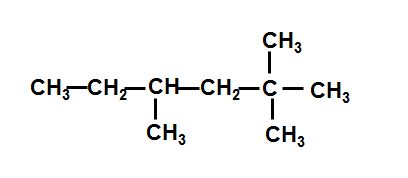
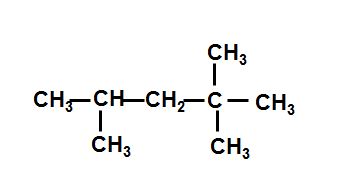
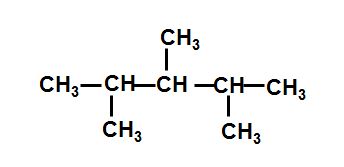
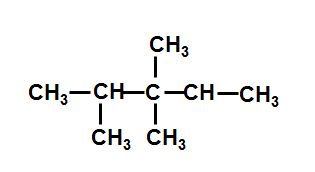
Which is the structures with IUPAC nomenclature
2,2,4-trimethylpentane
Which equation represents a termination step?




Which of the following has the highest boiling point?
heptane
pentane
nonane
The boiling point of a branched alkane is (a) than the boiling point of a straight-chain alkane with the same number of carbon atoms.
Alkanes do not form (a) bonding with water molecules.

Given the formula representing a compound:
Which formula represents an isomer of this compound?


Which is an isomer of



