Wayground logo

Free Printable Worksheets

Font size

S
M
L
XL
Worksheets

Unit 8 Genetics Test Review

Total questions: 41

Worksheet time: 4hrs 30mins

Name
Class
Date
1.

Ends with diploid number of chromosomes

a)

Mitosis

b)

Meiosis

c)

Both

2.

Involves crossing over

a)

Mitosis

b)

Meiosis

c)

Both

3.

Produces four cells

a)

Mitosis

b)

Meiosis

c)

Both

4.

produces identical daughter cells

a)

Mitosis

b)

Meiosis

c)

Both

5.

forms gametes ( sex cells)

a)

Mitosis

b)

Meiosis

c)

Both

6.

produces haploid cells

a)

Mitosis

b)

Meiosis

c)

Both

7.

Which type of reproduction produces offspring that are identical to the parent?

a)

Asexual

b)

Sexual

8.

Which type of reproduction creates genetic variation?

a)

Aesxual

b)

Sexual

9.

"Budding" is a type of _____reproduction.

a)

Asexual

b)

Sexual

10.

The type of reproduction that involves fertilization between egg and sperm is:

a)

Asexual

b)

Sexual

11.

What type of reproduction is happening in this hydra?

a)

Sexual

b)

Asexual

12.

At the end of mitosis, there are ___ daughter cells created.

a)

0

b)

2

c)

4

d)

Daughter cells are not created in mitosis

13.

At the end of meiosis, there are ___ daughter cells created.

a)

0

b)

2

c)

4

d)

Daughter cells are not created in meiosis

14.

A cell that has 2 complete sets of chromosomes.

a)

Haploid

b)

Diploid

15.

The process of mitosis creates:

a)

haploid body cells

b)

haploid sex cells

c)

Diploid body cells

d)

Diploid sex cells

16.

The process of meiosis creates:

a)

Body cells

b)

Sex cells

17.

A cell that contains 1/2 the chromosomes as Parent. Has a single set of unpaired chromosomes.

a)

Haploid

b)

Diploid

18.

Crossing over helps promote ____________

a)

DNA replication

b)

genetic variation

c)

male genotype

d)

mitosis

19.

When an egg and a sperm combine to form a new diploid cell, this is called

a)

Cell organization

b)

Cell specialization

c)

Fertilization

d)

Cell Differentiation

20.
A _____ is formed when egg and sperm cells combine.
a)
diploid
b)
homologous chromosomes
c)
haploid
d)
zygote
21.
In pea plants, the tall allele is dominant to the short allele. What key would demonstrate this?
a)
Tall = T
Short = S
b)
Tall = T
Short = t
c)
Tall = t
Short = T
d)
Tall = TT
Short = tt
22.

A heterozygous long-tusked elephant is crossed with a homozygous recessive short-tusked elephant. What is the probability of the offspring having short tusks? ( * Draw a punnett square!)

a)
0%
b)
25%
c)
50%
d)
75%
23.
A Jawa notices that his beloved pet desert rat, who has brown fur, just had several rat babies, some of which had white fur and some which had brown fur. Brown fur is the dominant trait. This means his rat must have what genotype?
a)
Homozygous Dominant
b)
Heterozygous
c)
Homozygous Recessive
24.
Identify the homozygous dominant genotype:
a)
FF
b)
Ff
c)
ff
25.
Bob the abominable snowman lives in the snowy Andes mountains. He has white fur, which blends in nicely. He is therefore dismayed when his mate keeps having red-furred babies. What is Bob's likely genotype?
a)
Homozygous Dominant
b)
Heterozygous
c)
Homozygous Recessive
26.
What phenotype would result from crossing a homozygous dominant purple-flowered pea plant with a homozygous recessive white-flowered pea plant?
a)
Pp
b)
Purple
c)
White
d)
PP and pp
27.
T - tall and t = short
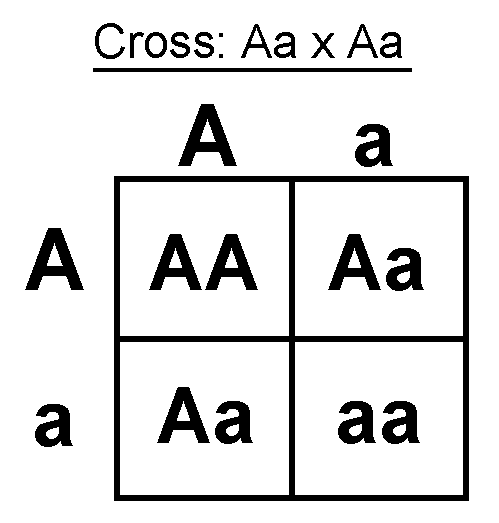
In the punnett square below, what belongs in the missing square
a)
tt
b)
Tt
c)
Bb
d)
TT
28.
What you see, or the physical appearance.
a)
Genotype
b)
Phenotype
c)
Homozygous
d)
Heterozygous
29.
What is the probability of heterozygous offspring?
a)
25%
b)
50%
c)
0%
d)
100%
30.
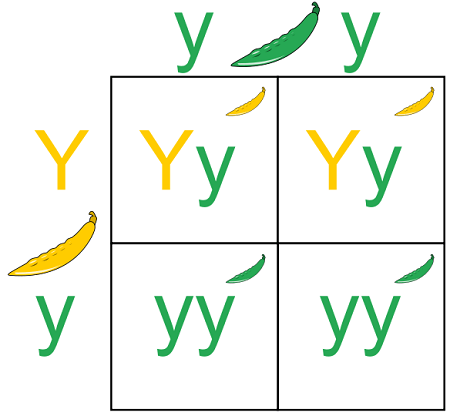
Which choice best represents the genotype of this cross?
a)
1 Yy: 2 yy: 0 YY
b)
2 Yy: 2 yy: 0 YY
c)
3 Yy: 1 yy: 0 YY
d)
1 Yy: 3 yy: 0 YY
31.
What is the phenotype of the offspring? (A-Brown hair; a-blond hair) 
a)
50 % Brown Hair and 50% Blond Hair 
b)
25 % Brown Hair and 75% Blond Hair 
c)
75 % Brown Hair and 25% Blond Hair 
d)
0% Brown Hair and 100% Blond Hair 
32.
Which of the following genotypes is homozygous dominant?
a)
A
b)
Aa
c)
AA
d)
aa
33.
Which of the following genotypes is heterozygous?
a)
Bb
b)
BB
c)
bb
d)
B
34.
Which of the following is homozygous recessive?
a)
Tt
b)
tt
c)
TT
d)
T
35.

What is a gene?

a)

A small section of DNA

b)

The full genetic code of an organism

c)

Chromosomes of the same size and shape and have the same genes in the same location

d)

Physical appearence

36.
During which part of the cell cycle does the cell divide?
a)
Interphase
b)
Mitosis
c)
S phase
37.
Which phase of mitosis is shown in the picture?
a)
Interphase
b)
Metaphase
c)
Telophase
38.
Which phase of mitosis is shown in the picture?
a)
Prophase
b)
Telophase
c)
Metaphase
39.
Which phase of mitosis is shown in the picture?
a)
Prophase
b)
Metaphase
c)
Anaphase
40.
Which phase of mitosis is shown in the picture?
a)
Prophase
b)
Anaphase
c)
Telophase
41.
During which phase of the cell cycle does the cell spend the most time?
a)
Mitosis
b)
Cytokinesis
c)
Interphase