
 Worksheets
Test Review - Sound Waves
Total questions: 72
Worksheet time: 1hrs 11mins
Bats use ________ to locate mosquitoes in the air.
solar
ecology
echolocation
refraction
ex. police car siren sounding lower pitch after the car passes
Sound waves travel as __________ waves.
transverse
electromagnetic
longitudinal
surface
Sound is made when a source of energy forces the matter to _________.
shake
vibrate
move
stay still
A back-and-forth motion causing particles to move close together generates a _________.
rarefaction
surface wave
transverse wave
compression
A rarefaction is generated when particles move _______.
together
apart
closer
under
Sound waves cannot travel through _________.
paper
milk
hydrogen
empty space
In which of these types of media will sound travel fastest?
solid
liquid
gas
vacuum
Which temperature causes sound to travel more slowly?
hot
cold
The amount of energy a sound wave carries per second through a unit of area is its ______________.
pitch
intensity
loudness
frequency
The ____________ of a wave increases with increased energy.
wave length
amplitude
Loudness of waves is measured in ______________.
hertz
decibels
watts
meters/second
The maximum safe level for loudness is __________.
0 dB
60 dB
85 dB
130 dB
Frequency of waves is measured in __________.
hertz
decibels
watts
meters/second
High frequency sounds have ___________ pitch.
high
low
______________ is produced by vibrations.
Sound
Light
Smell
Feeling
The highness or lowness of a sound is its ____________.
pitch
volume
amplitude
frequency
What is transported by a wave?
air
energy
matter
particles

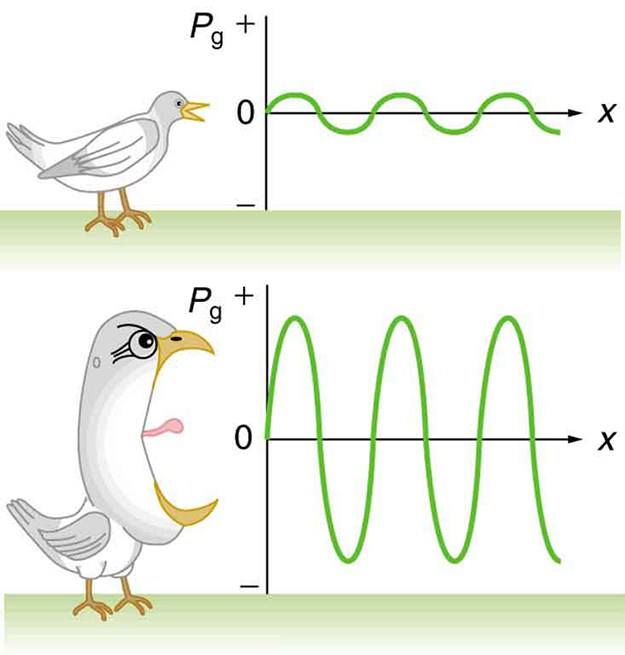
The diagram shows a cartoon of a sound wave produced while a student is speaking.
What happens to the sound wave when the student speaks louder?
The amplitude increases
the wavelength will double
the speed will increase
the amplitude will decrease

The students in the diagram are communicating with the cans and string.
Which is the most likely explanation of how the students can hear and communicate using the objects?
A Mechanical Wave transfers sound through the string
sound bounces off the can and echoes
sound travels through the string as an electromagnetic wave
Transverse wave transfers sound through rope
Through which medium is it impossible to transmit sound waves?
space
rock
air
water
Sound waves travel as ________ waves.
Transverse
Longitudinal
Surface
Sound is made when a source of energy forces the matter to
Vibrate
Move
Stay still
A rarefaction is generated when particles move
Together
Under
Apart
A back-and-forth motion causing particles to move close together generates a ________.
Rarefaction
Surface wave
Compression
Sound waves CANNOT travel through which of these:
Paper
Milk
Outer space
In which of these types of media will sound travel fastest?
Solid
Liquid
Gas
The amount of energy a sound wave carries per second through a unit of area is its
Pitch
Intensity
Loudness
The _______ of a wave increases with increased energy.
Wave length
Amplitude
Loudness of waves is measured in
Hertz
Decibels
Watts

How are sound waves like ripples in a pond?
They are both types of electromagnetic radiation.
They travel faster in water than they do in the air.
They radiate outward from a central point.
They have the same wavelengths.

What is the function of the ridges on your outer ear?
They prevent germs from entering your middle ear.
They direct sound into your middle ear.
They prevent loud noises from damaging your inner ear.
They filter out very high and low-frequency sounds.

How is your eardrum like a real drum?
It produces sound.
It vibrates.
It is frequently struck by the bones in your middle ear.
It is hollow.

What is unique about the hammer, stirrup, and anvil?
They are the smallest bones in your body
They are the only bones in your body that move
They are the only bones located in your head
They are the only bones that cannot be broken

If your inner ear lacked nerve fibers, what might happen?
Sound would be unable to travel to your brain.
Your eardrum would be unable to vibrate.
Your hammer could not tap against your anvil.
Sound waves could not enter your ear.

Place the following events in sequence: A) Your eardrum begins vibrating; B) Electrical impulses travel along nerve fibers; C) The hammer, anvil, and stirrup begin moving
B, C, A
A, B, C
B, A, C
A, C, B
One of the components of a sound is pitch. Pitch is determined by the _____ of a sound wave.
amplitude
complexity
frequency
depth
The ________ ear collects sounds waves and transmits them to the ________ ear, which contains auditory ossicles.
superficial; deep
outer; middle
inner; middl
middle; inne
outer; inner

Name part A
Pinna
Auditory canal
Ear
Eardrum

Sound waves are converted into electrical signals.
What are 2 ways we can protect our ears?
Reduce Reuse Recycle
Earplugs, turning down the volume
The ears are the organs of
hearing
sight
touch
taste
The ear has three parts
the cochlea, the eardrum and the ear canal
the outer, middle and inner ear
the outer ear, earwax and ossicles

The pinna and ear canal belong to:
outer ear
middle ear
inner ear

Inner ear includes:
pinna and ear canal
ossicles
eardrum
cochlea - auditory nerve
The ear is a ...
digestive organ
sense organ
system

