

wayground logo

Free Printable Worksheets

Font size

S
M
L
XL
Worksheets

EOC REview #1

Total questions: 47

Worksheet time: 1hrs 5mins
Name
Class
Date
1.
Which of the following is the smallest unit of life that can carry out all life functions?
a)
the mitochondria
b)
the vacuoles
c)
the nucleus
d)
the cell
2.
Which structures are found in every living cell?
a)
cell membrane and cytoplasm
b)
chloroplasts and mitochondria
c)
a cell wall and nucleus
d)
chloroplasts and cell wall
3.
Which cell structure is found in plant and animals cells and controls what can come into or leave a cell?
a)
cell membrane
b)
cytoplasm
c)
nucleus
d)
vacuole
4.
What is the function of the cell nucleus found in both plant and animal cells?
a)
to produce energy
b)
to control cell activity
c)
to remove waste products
d)
to allow molecules to enter the cell
5.
Cell organelles that are responsible for digesting food, worn out organelles and other cellular wastes are called ___________________.
a)
Mitochondria
b)
Vacuoles
c)
Lysosomes
d)
Chlororplasts
6.
What is one basic function of the vacuoles?
a)
circulating oxygen
b)
producing food
c)
controlling cell processes
d)
storing water
7.
Chloroplasts in plant cells allow the plant to perform a function that animal cells cannot do.  What is the main function of the chloroplasts found in plant cells?
a)
to absorb light energy and manufacture food
b)
to remove waste materials by active transport
c)
to manufacture chemical energy from food
d)
to control the shape of the cell
8.
All cells need energy to function.  Which cell organelle is responsible for producing energy in the cell?
a)
chloroplasts
b)
mitochondria
c)
nucleus
d)
vacuoles
9.

What distinguishes a plant cell from an animal cell? (How do you tell them apart) Hint: There's 3 ways (Check all 3)

a)

Central Vacuole

b)

Mitochondria

c)

Cell Wall

d)

Ribosomes

e)

Chloroplasts

10.

The 3 parts of the Cell Theory are...?

a)

All living things are composed of cells

Cells are the basic units of structure and function in living things

All cells are produced from other cells

b)

All living things are composed of cells

Cells are the basic units of dance and vibes in living things

All cells are destroyed from other aliens

c)

All living things are composed of Jell-O

Cells are the basic units of structure and function in living things

All cells are produced from factories in Canada

d)

All living things are composed of cells

Cells do karate and practice eating whole pies in their free time

All cells are produced from other cells

11.
Which is NOT a step of the scientific method?
a)
hypothesis
b)
draw conclusions
c)
observations
d)
identify boundaries
12.
Which is an example of a hypothesis
a)
The plant will grow.
b)
The plant died after 5 days.
c)
Water the plant with 1/2 cup of water per day.
d)
The plant in the sunlight will grow faster than the plant in the dark.
13.
Which is an example of a producer?
a)
Rabbit
b)
Corn
c)
Deer
d)
Wolf
14.
What does the arrow mean in a food chain?
a)
Who is eating who
b)
The passing of energy
c)
The highest consumer
d)
The direction that water is passed
15.
The top of the food chain is likely to be a...
a)
omnivore
b)
herbivore
c)
carnivore
d)
none of these
16.
Trophic level means...
a)
Located in the tropics
b)
Food level
c)
Energy level
d)
Award-winning
17.
How is a food web different from a food chain?
a)
It shows a more balanced ecosystem
b)
It shows how organisms can get food from various sources
c)
It includes all of the organisms and what they eat
d)
All of the above
18.
What happens to the secondary consumer if the quaternary consumer increases?
a)
it will decrease
b)
it will increase
c)
it will stay the same
19.

Which characteristic of life is shown in the picture?

a)

metabolism

b)

evolution

c)

growth & development

d)

response to stimuli

20.

Which characteristic of life means 'capturing and using energy'?

a)

metabolism

b)

evolution

c)

growth & development

d)

response to stimuli

21.

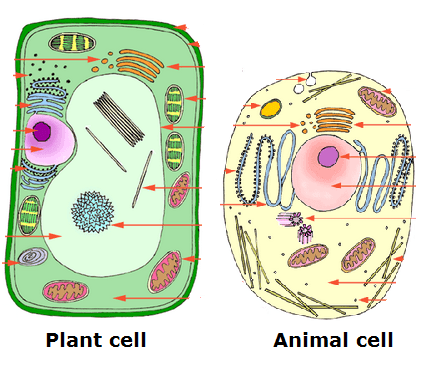
Which type of cell is shown in the picture?

(a)  

22.
What is the correct order of levels of organization that make up an organism?
a)
organ, organ system, cell, tissue
b)
cell, organ, tissue, organ system
c)
cell, tissue, organ, organ system
d)
organ, tissue, organ system, cell 
23.

Which tool would be used to measure the precise volume of a liquid?

a)

Beaker

b)

Test Tube

c)

Petri Dish

d)

Graduated Cylinder

24.

Which level of organization would describe a dog's eye?

a)

Organ

b)

Tissue

c)

Organism

d)

Organ System

25.

How many chromosomes are in the human body cell and human sex cell?

a)

Body cell has 28 and sex cell has 14

b)

Body cell has 46 and sex cell has 23

c)

Body cell has 54 and sex cell has 27

d)

Body cell has 74 and sex cell has 37

26.

Which of the following is an example of a trait a person may have because of heredity?

a)

Table Manners

b)

A Blister on a Finger

c)

Blue Eyes

d)

A Pierced Ear

27.

Which term describes the maintenance of a stable internal condition?

a)

Endocytosis

b)

Exocytosis

c)

Homeostasis

d)

Photosynthesis

28.
surrounds the cell; controls what enters/leaves cell; maintains homeostasis
a)
vacuole
b)
cell wall
c)
cell membrane
d)
lysosome
29.
cells that contain a true nucleus
a)
prokaryotes
b)
eukaryotes
c)
carbohydrate
d)
plant cells
30.
Which is true about active transport?
a)
It requires energy
b)
it does not require energy
c)
It moves substances down the concentration gradient
d)
it moves material from high to low concentration
31.
The concentration of water is higher in the soil than in plant root cells. Water moves into root cells of a plant by...
a)
Facilitated Diffusion
b)
Simple Diffusion
c)
Active Transport
d)
Osmosis
32.
Active transport requires ______, moves materials from __________________, and goes _______ the concentration gradient.
a)
No energy, low to high, against
b)
ATP, high to low, with
c)
ATP, low to high, with
d)
ATP, low to high, against
33.

The graduated cylinder above contains which of the following volumes of liquid?

a)

52.5 mL

b)

53.0 mL

c)

54.0 mL

d)

56.5 mL

34.

​​​​​


What is the mass of the pea seeds on the balance shown above?

a)

17 g

b)

18 g

c)

19 g

d)

20 g

35.

Which side of the equation would be labeled the product side?

a)

The left

b)

The right

c)

The arrow

d)

Neither

36.

What is Biology?

a)

The study of the stars.

b)

The study of plants, animals and the earth.

c)

The study of machines.

d)

The study of history.

37.
An individual belonging to a specific species
a)
Biotic
b)
Community
c)
Organism
d)
Reptile
38.
All of the living and nonliving things in an area that interact with each other are called a/an ______.
a)
community
b)
habitat
c)
population
d)
ecosystem
39.
An area where an organism finds food, shelter and water in a specific arrangement
a)
niche
b)
biosphere
c)
biome
d)
habitat
40.
The living part of an ecosystem
a)
Biotic
b)
Abiotic
c)
Mother Earth
d)
Flowers
41.
The non-living part of an ecosystem
a)
Ocean
b)
Lava Flow
c)
Birds
d)
Abiotic
42.
The study of how living things interact with one another and with their environment.
a)
Biology
b)
Lithology
c)
Ecology
d)
Farmacology
43.
Organisms that look similar and can produce fertile offspring
a)
Species
b)
Fish
c)
Community
d)
Trees
44.
Two or more members of a particular species living and interacting in the same area
a)
Community
b)
Population
c)
Organisms
d)
Biosphere
45.
Different populations living and interacting with each other in the same area
a)
Biome
b)
Ecosystem
c)
Community
d)
Niche
46.
The area between the highest mountain and the deepest ocean where life can be found
a)
Biosphere
b)
Biome
c)
Farm
d)
Ecosystem
47.
Fungi are a  ________
a)
Autotrophs
b)
Heterotroopers
c)
Decomposers
d)
Primary Consumers
