
 Worksheets
LT5.3 Muscle Contractions
Total questions: 64
Worksheet time: 48mins
shortening of thick filaments.
shortening of thin filaments.
sliding of thin filaments past thick filaments.
"accordian-like" folding of thick and thin filaments.
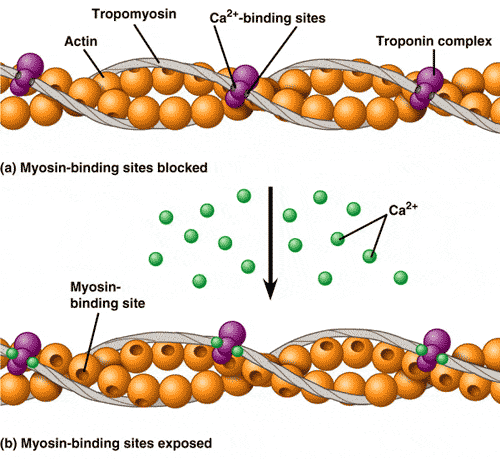
Calcium
causes ATP binding to actin.
increases the action potential along the sarcolemma.
binds to proteins on myosin.
triggers the binding of myosin to actin.
When a muscle contracts, it _____.
States that the muscle fibers shorten as the actin and myosin filaments pull on each other.
Covers the actin and prevents the myosin head from attaching to the actin.
myosin and actin
calcium and oxygen
glycogen and hemoglobin
This type of muscle contraction will fire against a load, but WILL NOT shorten or lengthen.
Tetanic
Isometric
Isotonic
Eccentric
This type of muscle contraction will fire at a constant, unchanging length.
Tetanic
Isometric
Isotonic
Eccentric
These types of muscle contraction will fire against a load, and shorten causing movement at the joint.
Tetanic
Isometric
Isotonic
Eccentric
Which type of contraction, when fired, WILL NOT cause any movement at the joint?
Tetanic
Isometric
Isotonic
Eccentric
These types of muscle contraction will fire against a load, and LENGTHEN while there is movement at the joint.
Tetanic
Isometric
Isotonic
Eccentric
Shoveling dirt, kicking a soccer ball, and swinging a baseball or softball bat are examples of what kind of muscle contraction?
Tetanic
Isometric
Isotonic
Eccentric
Planking, doing a wall sit, carrying a load of firewood, and playing in a tug-of-war where NO ONE is moving are examples of what kind of muscle contraction?
Tetanic
Isometric
Isotonic
Eccentric
These projections, or myosin heads, that are found on the thick filaments are called _____.
cross bridges
Z lines
A bands
actin tails
What happens during the power stroke of muscle contraction?
break down of ATP occurs at the myosin head so that it is ready to pull at actin again
cross bridges attach to actin filaments and pull them toward the middle of the sarcomere
Occurs when a muscle is unable to contract even through it is still being stimulated.
oxygen debt
muscle fatigue
motor units
What two proteins prevent the myosin heads from binding to the actin strands?
troponin
globulins
tropomyosin
fibrin
What substance binds to myosin's "blockers?"
Calcium Ions
Sodium Ions
ATP
____________ attaches to actin to form the cross bridge.
Troponin
Tropomyosin
Myosin
Calcium
What is the name of the neurotransmitter released at a neuromuscular junction?
Calcium
Acetylcholine
Dopamine
Troponin
Power stroke will occur when
ATP binds to myosin head.
Myosin head releases ADP and Pi.
Myosin head hydrolyze ATP.
Myosin binds to actin.
Given the following events:
1. Acetylcholine broken down.
2. Acetylcholine moves across the synaptic cleft.
3. Action potential reaches the presynaptic terminal of a motor neuron.
4. Acetylcholine combines with a receptor molecule on a skeletal muscle.
5. Action potential produced in a skeletal muscle cell.
Choose the arrangement that lists the events in the order they occur at a neuromuscular junction.
a. 2,3,4,1,5
b. 3,2,4,5,1
c. 3,4,2,1,5
d. 4,5,2,1,3
In order for tropomyosin to change conformation, calcium has to bind with _____.
voltage gated ion channels
ligand gated ion channels
troponin proteins
actin proteins
Calcium, that will eventually enter the muscle cell to bind with troponin, is stored in the
T-Tubule of the muscle cell.
sarcoplasmic reticulum of the muscle cell.
the sarcolemma of the muscle cell.
the interstitial space outside the muscle cell near the pre-synaptic terminal.
What is the definition of oxygen debt?
Amount of oxygen used for aerobic activity minus amount of oxygen actually used
Amount of oxygen needed at the end of a physical activity to break down any lactic acid
An oxygen debt occurs in muscles when
more carbon dioxide has been produced.
the breathing rate increases.
anaerobic respiration has taken place.
the pulse rate increases.
The LESS moveable end of a skeletal muscle.
origin
insertion
antagonist
synergist
The MORE moveable end of a skeletal muscle.
origin
insertion
antagonist
synergist
When muscles contract, it pulls
the insertion toward the origin.
the origin toward the insertion.
the less moveable end toward the more moveable end.
The muscle that causes the action and does the majority of the work. (there is more than one answer)
agonist
prime mover
antagonist
synergist
The muscles that assist the prime mover.
agonist
prime mover
antagonist
synergist
The muscles that oppose an action.
agonist
prime mover
antagonist
synergist

Muscles that are not used, may shrink/"decay" or undergo a process of _____.
hypertrophy
atrophy
fatigue
Muscle fatigue occurs when
ATP production can’t keep up with use.
lactic acid is being removed from the body.
there is an ionic imbalance in the body.
there is accumulation of lactic acid.
_____ are "helper muscles" that stabilize joints against dislocation.
Fixators
Prime movers
Agonists
Antagonists
A(n) ____________________ is a single stimulus-contraction-relaxation sequence in a muscle fiber. It is a single, short contraction involving only a few motor units.
twitch
origin
recruitment
antagonist
In a single muscle twitch, the ____________________ occurs when calcium (Ca2+) is being pumped back into the sarcoplasmic reticulum (SR) and actin and myosin stop the binding cycle.
latent period
contraction phase
relaxation phase

What does the myosin do to the actin?
Nothing
Pushes on it
Pulls on it
Breaks it into pieces
When a muscle is in a contracted position, what is the relationship between actin filaments?
they are on top of one another
they are beside each other
they are close to each other
they are far apart from each other

What is the name of structure #1?
Troponin
Tropomyosin
Actin
ATP
What is the name of structure #2?
Troponin
Tropomyosin
Actin
ATP

The correct sequence of cross- bridge formation is represented by
A, B, C, & D
D, A, B & C
C, A, B & D
D, C, B & A
A sarcomere in relaxed state.


A sarcomere in contracting state.


Identify #1
vesicles with acetylcholine
acetylcholine receptors
axon terminals
synaptic cleft

Identify #2
vesicles with acetylcholine
acetylcholine receptors
axon terminal
synaptic cleft

Identify #3
vesicles with acetylcholine
acetylcholine receptors
axon terminal
synaptic cleft

Identify #4
vesicles with acetylcholine
acetylcholine receptors
axon terminals
synaptic cleft
The point where a motor nerve connects to a muscle.
synapse
neuronervosa juncture
neuromuscular junction
synaptic juncture

A maximum level of muscle tension is reached and the muscle stays contracted.
all or none law
fast twitch
tetanus
charlie horse

When stimulated by the action potential, the myosin “heads” attach to a receptor site on the actin filament and form a
muscle spasm.
neuromuscular junction.
wave polarization.
cross-bridge.
An electrical charge in the nerve or muscle fiber is known as a(an)
electrical charge.
nerve option.
action potential.
electrical potential.
What structure connects the message from the brain to a muscle?
Motor Neuron
Sarcomere
Sarcoplasmic Reticulum
Muscle Fiber
What structure stores and releases calcium ions?
Myofybril
Sarcomere
Sarcoplasmic Reticulum
ATP
What structure in the muscle disperses the signal out to each muscle fiber?
Sarcomere
Myofibril
T-Tubules
Sarcoplasmic Reticulum
Which myofibril is thin and light?
Actin
Myosin
Myoglobin
Hemoglobin
Which myofibril is thick and dark?
Actin
Myosin
Myoglobin
Hemoglobin
The point at which the nerve cell reaches the sarcolemma of the muscle fiber is the _____.
neurotransmitter
acetylcholine
synaptic cleft
neuromuscular junction
The gap between the nerve cell and sarcolemma is the _____.
synaptic cleft
neurotransmitter
motor unit
neuromuscular junction
The energy needed to perform a muscle contraction comes directly from _____.
oxygen
glucose
calcium
What is released by axon terminals into the synaptic cleft to stimulate a muscle to contract?
potassium ions
sodium ions
acetylcholine
actin
What must rush into a muscle cell to promote its depolarization?
potassium ions
calcium ions
acetylcholine
sodium ions

