wayground logo

Free Printable Worksheets

NEW

Font size

S
M
L
XL
Worksheets

Unit Review for Evolution and Taxonomy

Total questions: 58

Worksheet time: 57mins

Name
Class
Date
1.
Which of the following are homologous structures?
a)
Bee wings and bird wings
b)
legs on a beetle and legs on a cat
c)
whale flipper and bat wing
d)
human eyebrows and ant antenna 
2.
Organisms with different structures that provide the same function are a result of...
a)
convergent evolution
b)
divergent evolution
c)
coevolution
d)
parallel evoltion
3.
Which images illustrate analogous structures?
a)
1, 2
b)
1, 3
c)
2, 3
d)
1, 2, 3
4.
These limbs provide evidence of common ancestry because they....
a)
have the same basic structure
b)
Perform the same function
c)
Are the same size
d)
Are parts of mammals
5.
Organisms with similar structures but different functions are a result of...
a)
convergent evolution
b)
divergent evolution
c)
coevoltion
d)
parallel evolution
6.
Which images illustrate homologous structures?
a)
1, 2
b)
1, 3
c)
2, 3
d)
1, 2, 3
7.
The cave fish and minnow are related to each other but the cave fish is blind and only has the remnants of an eye. What type of structure is this?
a)
homologous
b)
analogous
c)
vestigial
d)
convergent
8.

A change in a species over time is

a)

Adaptation

b)

Evolution

c)

Diversity

d)

Morphology

9.

Similar embryological development in different organisms indicating a common ancestry or evolutionary origin.

a)

Molecular Homology

b)

Morphology

c)

Adaptation

d)

Embryology

10.

The form and structure of an organisms traits, its characteristics.

a)

Molecular Homology

b)

Embryology

c)

Morphology

d)

Phylogony

11.

Preserved remains or evidence of ancient organism.

a)

Vestigial Structure

b)

Fossils

c)

Homologous structure

d)

Analogous structure

12.

States that layers of sediment and rock are older at the bottom levels of younger as they move up to the surface.

a)

Fossils

b)

Law of Superposition

c)

Vestigial Structure

d)

Adaptation

13.

Similar DNA sequence between different organisms indicating a common ancestry or evolutionary origin.

a)

morphology

b)

Embryology

c)

Molecular Homology

d)

Adaptation

14.

Father of Evolution, wrote origins of species and studied organisms from Galapagos to support his proposal that natural selection occurs.

a)

Hooke

b)

Darwin

c)

Lamarck

d)

Markiewicz

15.
According to the law of superposition, the oldest fossils are found 
a)
At the top of the rock layers
b)
Near the bottom of the rock layers
c)
In the middle of the rock layers
d)
Somewhat near the surface
16.
The closest evolutionary relationship most likely exists between the....
a)
human and gorilla
b)
horse and zebra
c)
human and chimpanzee
d)
chimpanzee and gorilla
17.
Which of these factors should be compared to determine how closely species are related to each other?
a)
number of genes
b)
sequence of amino acids
c)
location of chromosomes
d)
physical similarities in body structure
18.
The similarities in embryonic development shown in the diagram suggest that these organisms...
a)
are all members of the same species
b)
may have evolved from a common ancesor
c)
have adaptations for the same environment
d)
all undergo external development
19.

Two organisms that are closely related would have

a)

very similar DNA sequence

b)

exactly the same DNA sequences

c)

no proteins in common

d)

completely different DNA sequence

20.
Peppered moths can have either a light wing color or a dark wing color. A scientist studied populations of both light and dark peppered moths over a 10-year period. A graph of the data he collected is shown. Based on the graph, which is the best conclusion to make about changes in the moth populations by the end of the study period? 
a)
A disease has affected only the dark winged peppered moth. 
b)
At present, wing color is not a factor in the success of peppered moths. 
c)
A new food source has become available only to the light winged peppered moth. 
d)
At present, dark-winged peppered moths are being naturally selected for survival. 
21.
A scientist puts 100 houseflies in a sealed container; then sprays an insecticide into the container.  Ninety-six of the flies die.  Four survive.  The scientist lets the survivors mate and produce offspring, then repeats the experiment with 100 offspring.  Fifty-six of them survive the spray.  This experimental result is evidence of – 
a)
adaptive radiation 
b)
speciation
c)
natural selection
d)
extinction
22.
What genetic change allows organisms to survive natural selection in their environments? 
a)
learned behavior
b)
acquired traits
c)
analogies
d)
adaptations
23.
Which statement does not accurately describe natural selection?
a)
Individual organisms change their genes to adapt to their environment
b)
The genetic composition of a population changes from one generation to the next
c)
More advantageous traits become more common in population
d)
Beneficial and useful traits are inheritable
24.
Why are advantageous traits more likely to be passed onto offspring?
a)
Because they are more likely to survive and reproduce.
b)
Because they come from dominant alleles.
c)
Because they come from recessive alleles.
d)
Because the trait is an acquired phenotype.
25.
What is the study of the distribution of species in geographic space and through time?
a)
Biology
b)
Geology
c)
Geography
d)
Biogeography
26.
Natural selection results in change over time by acting on traits that are
a)
heritable
b)
new
c)
mutated 
d)
better than the best
27.
Which of the graphs best illustrates the evolutionary process called punctuated equilibrium? 
a)
A
b)
B
c)
C
d)
D
28.
Other insects can not, but, a bumble bee has just enough weight to open up the snapdragon flower and pollinate.  This adaption is ....
a)
convergent evolution
b)
Divergent evolution
c)
speciation
d)
coevolution
29.
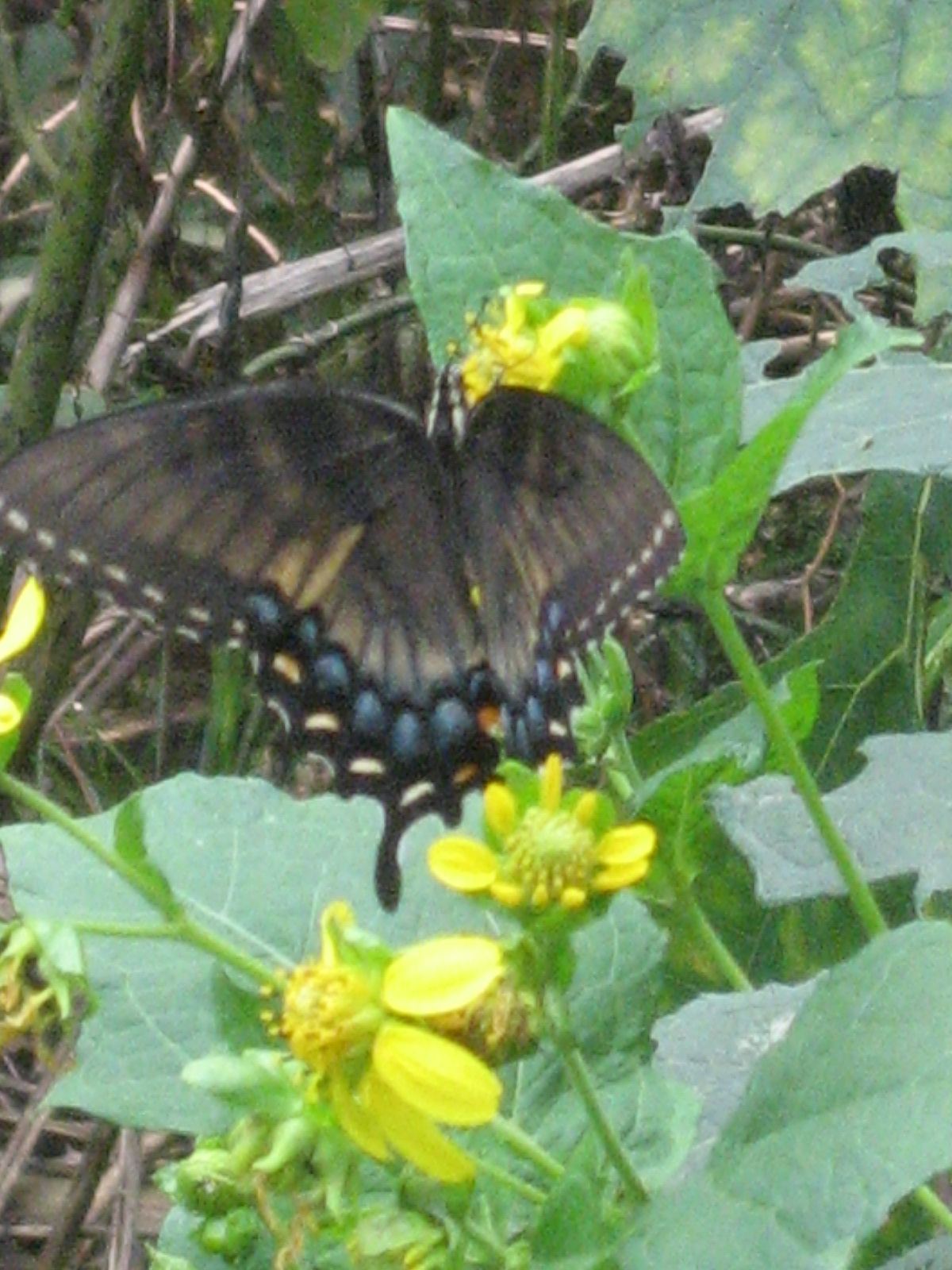
What type of evolution is demonstrated in this photo?
a)
Coevolution
b)
Convergent evolution
c)
Punctuated evolution
d)
Gradualistic evolution
30.
Which of the three graphs shows stabilizing selection?
a)
A
b)
B
c)
C
31.
Which of the three graphs shows disruptive selection?
a)
A
b)
B
c)
C
32.
What type of selection is depicted in the picture? 
a)
stabilizing 
b)
directional 
c)
disruptive 
d)
parallel
33.
Which best explains why antibiotics lose their effectiveness over a period of years?
a)
Antibiotics break down very quickly when digested in the body
b)
Antibiotics can kill bacteria only within the first few hours of illness
c)
Antibiotics are effective at first but become weak before killing off harmful bacteria
d)
Antibiotics are effective at killing some bacteria, but the stronger bacteria survive and reproduce
34.
European rabbits were introduced to Australia in 1859. The rabbits reproduced rapidly in their new habitat, displaced other animals, and overgrazed vegetation. In an attempt to reduce the rabbit population, a virus was introduced in 1951. This virus is usually deadly to European rabbits. When the virus was first introduced, the rabbits died in large numbers, but the death rate decreased over time. Which of the following best explains the decrease in the rabbit death rate? 
a)
Young rabbits learned to avoid being infected with the virus.
b)
The lifespan of the virus was too short to affect rabbits over a long period of time.
c)
Natural selection favored rabbits that were resistant to the virus. 
d)
No correct choices.
35.
Members of different subspecies
a)
Are considered to be entirely different species.
b)
Can no longer interbreed successfully.
c)
Differ genetically because of adaptations for different living conditions.
d)
Will never diverge to become different species.
36.
Cladograms are constructed by grouping organisms together based on their____________ characteristics.
a)
shared
b)
different
c)
similar
d)
opposite
37.

Deer fighting for a mate is an example of which type of Reproductive Isolation ____________.

a)

Temporal Isolation

b)

Geographical Isolation

c)

Behavioral Isolation

d)

Artificial Selection

38.
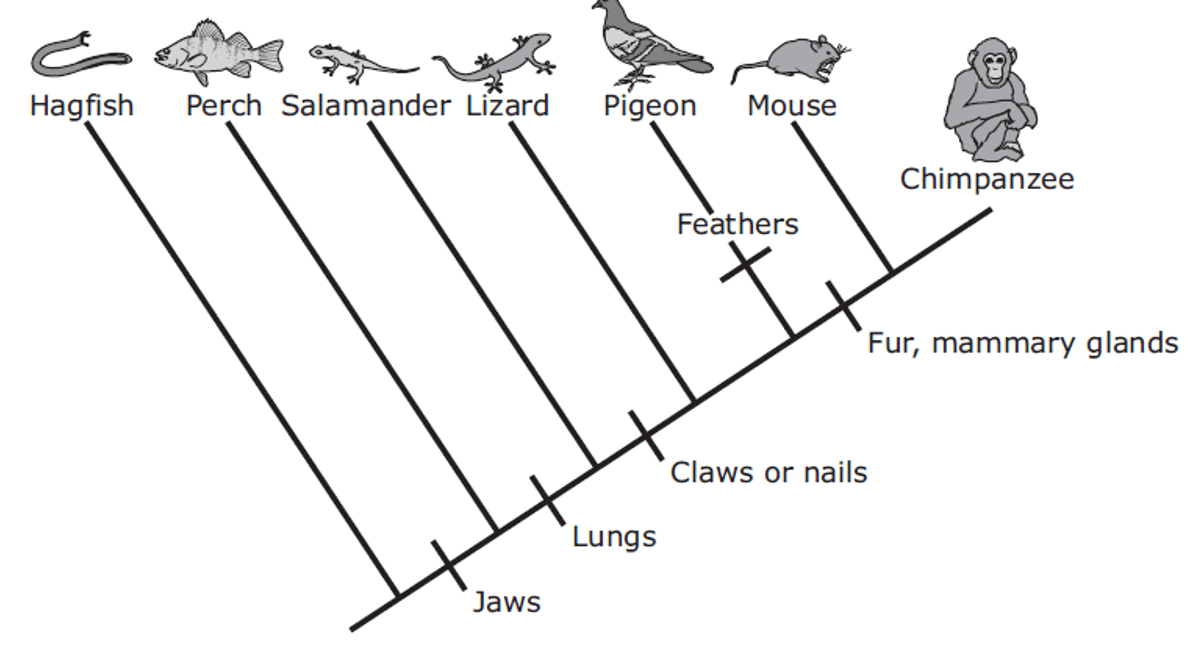
All the animals to the right of the hagfish would have the common characteristic of -
a)
Fur
b)
Claws or nails
c)
Lungs
d)
Jaws
39.
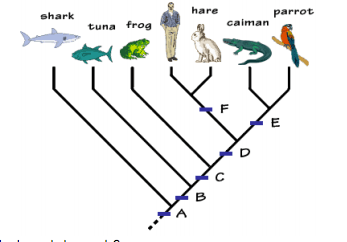
On the cladogram, which organism is the closest relative of the human?
a)
Frog
b)
Hare
c)
Caiman
d)
Parrot
40.
Kangaroos and opossums both incubate their immature in pouches. This means they -
a)
share a common ancestor
b)
possess vestigial organs
c)
have similar skeleltal structures
d)
belong to the same species
41.
The scientific name for an organism is made from the:
a)
class and family name
b)
genus and species name
c)
domain and kingdom name
d)
kingdom and phylum name
42.
The 8 levels of classification, most broad to most specific.
a)
Domain, Genus, Family, Order, Class, Phylum, Kingdom, Species
b)
Domain, Species, Kingdom, Genus, Phylum, Family, Class, Order
c)
Domain, Kingdom, Phylum, Class, Order, Family, Genus, Species
d)
Order, Kingdom, Species, Domain, Phylum, Family, Class, Genus
43.
Term given to describe the 2 name naming system is:
a)
dichotmous key
b)
binomial nomenclature
c)
2 scientific names
d)
binomial key
44.
Who first proposed binomial nomenclature as a way of classifying organisms?
a)
Carolus Linnaeus
b)
Carl's Jr.
c)
Charles Darwin
d)
Henry Groseclose
45.
Organisms are the same ___________ when they can have offspring.
a)
Class
b)
Family
c)
Species
d)
Phylum
46.
Fill-in-the-blank:
Domain--Kingdom--Phylum--____________
a)
Order
b)
Family
c)
Class
d)
Species
47.
Which organisms are closely related? 
a)
American badger and leopard
b)
coyote and gray wolf
c)
european otter and leopard
d)
coyote and american badger
48.
Which of the following organisms are LEAST closely related?
a)
organisms that share a domain
b)
organisms that share a family 
c)
organisms that share a genus 
d)
organisms that share a species 
49.
Which organism in the table shown is most closely related to the common dolphin?
a)
human
b)
killer whale
c)
giant kelp
d)
bat star
50.
Why do scientists use the taxonomic system?
a)
To torture Biology students
b)
To avoid confusion in classifying organisms
c)
Because Linnaeus made it
d)
To place organisms in different groups
51.

Five general characteristics of organisms in kingdoms Plantae or Fungi are listed in the box.

a)
b)
c)
d)
52.
A dichotomous key for trees is provided. Hikers found a tree that has large brown cones and single sharp needles. What species of tree have the hikers found?
a)
Juniper
b)
Pine
c)
Spruce
d)
Fir
53.
What is the purpose of a dichotomous key?
a)
to find a common ancestor
b)
to show the evolution of organisms
c)
to show relationships between organisms
d)
to identify organisms
54.

Which kingdom is autotrophic, multicellular, eukaryotic and has cells with a cell wall?

a)

Bacteria

b)

Fungi

c)

Plantae

d)

Protista

55.
Which domain is capable of living in extreme environments like hot springs, geysers, or very salty waters?
a)
Bacteria
b)
Archaea
c)
Eukarya
56.
Organisms whose cells have NO nucleus are classified as...
a)
Eukaryotic
b)
Prokaryotic
c)
Dead
57.
I can be either a heterotroph or an autotroph-
I can be either multicellular or unicellular-
I can have cell walls or not-
The only thing for sure about me is that I have a nucleus in my cells...
I am Kingdom ____________ .
a)
Plantae
b)
Protista
c)
Animalia
d)
of Oz
58.
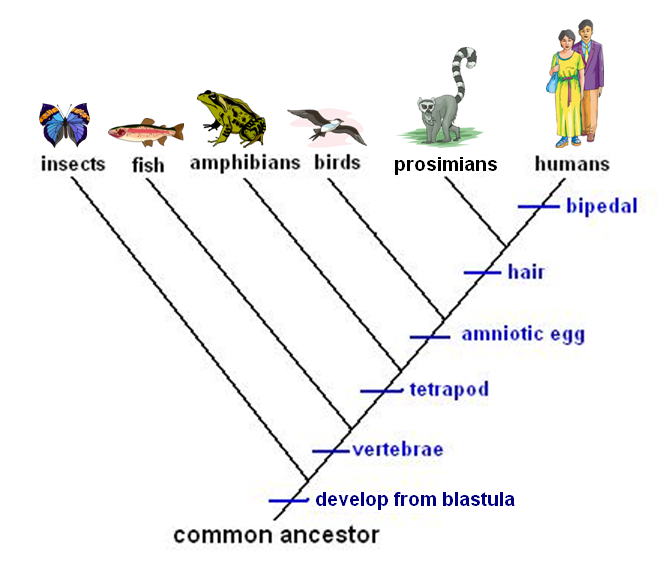
Which organisms pictured on the cladogram have hair?
a)
prosimians only
b)
prosimians and humans
c)
humans only
d)
prosimians and birds