
 Worksheets
Conservation of Angular Momentum
Total questions: 72
Worksheet time: 1hrs 11mins


A uniform solid cylinder with a radius of 10 cm and a mass of 3.0 kg is rotating about its center with an angular speed of 33.4 rpm. What is its kinetic energy? (Hint: I=1/2 MR2)
0.092 J
17 J
1.1 J
0.18 J


What is happening to the ice skater?
Decreased Angular velocity, decreased rotational inertia
Decreased Angular velocity, increased rotational inertia
Increased Angular velocity, increased rotational inertia
Increased Angular velocity, decreased rotational inertia
How many radians make up one revolution of 360 degrees?
π/2
π
2π
3π/2

What does Rotational Inertia depend on?
Mass
Mass Distribution
Both Mass and its Distribution
Neither Mass nor its distribution

Does this woman have a high or low rotational inertia?
High
Low
Angular Momentum is the product of...
rotational inertia and linear velocity.
linear inertia and angular velocity.
linear momentum and angular velocity
rotational inertia and angular velocity.

Which of these objects has the most rotational inertia?
Left
Middle
Right

What happens to rotational inertia of an object when mass is moved close to axis of rotation?
Decreases
Increases
Stays the Same
Find the angular momentum for a 5 kg solid cylinder with a 20 cm radius rotating at 3 rad/s.
3000 kg-m2/sec
0,3 kg-m2/sec
0,6 kg-m2/sec
1.2 kg-m2/sec

Two football players with mass 75 kg and 100 kg run directly toward each other with speeds of 6 m/s and -8 m/s respectively. If they grab each other as they collide, the combined speed of the two players just after the collision would be:
-2.0 m/s
3.4 m/s
-4.6 m/s
7.1 m/s

The Law of Conservation of Momentum states:
The total momentum before a collision is equal to the total momentum after a collision.
The total momentum before a collision is greater than the total momentum after a collision.
The total momentum before a collision is less than the total momentum after a collision.
The total momentum before a collision is not related to the total momentum after a collision.
According to Newton's Laws, for every action there is an ....
equal and opposite reaction.
equal and parallel reaction.
unequal and opposite reaction.
unequal and unrelated reaction.
Pick all of the scenarios below that are collisions.
A catcher catches a baseball.
A pitcher throws a baseball.
Two cars smash into each other.
Two students on roller skates push away from each other.
A bug smashes into a windshield.
.
.

An object that is moving has
chemical energy
chemical energy
potential energy
kinetic energy
elastic energy
An object that is at rest on top of a bookshelf has
chemical energy
chemical energy
potential energy
kinetic energy
elastic energy
If you are rolling down a big hill you are (a) the kinetic energy.

Which letter shows the ball when it has THE MOST potential energy?
A
B
C
F
G
Which letter shows the ball when it has NO potential energy?
B
C
D
E
F
Which letter shows the ball when it has THE MOST kinetic energy?
B
C
D
E
F
Which letter shows the ball when it has THE LEAST kinetic energy?
A
B
C
F
G
Which letter shows the ball when it is moving the fastest?
B
C
D
E
F

Which letters shows the ball when it has BOTH kinetic and potential energy?
The ball starts and ends AT REST. List all that apply in alphabetic order!
(a)
Which of the following best represents the Law of Conservation of Energy?
Energy CAN be created but NOT destroyed
Energy CAN be destroyed but NOT created
Energy can NOT be created Nor destroyed
Energy CAN be created and CAN destroyed
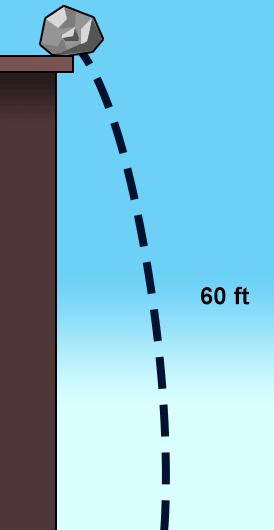
The rock in the picture is pushed over the edge and it begins to fall. Which type of energy conversion is taking place?
mechanical to heat
sound to mechanical
potential to kinetic
kinetic to potential

A ball is projected into the air. Where is potential energy the greatest?


How does the mass of a bowling ball that has been rolled down the lane affect the kinetic energy?
The kinetic energy does not depend on the mass of the bowling ball.
The kinetic energy is increasing proportional to the mass of the bowling ball.
The kinetic energy is decreasing proportional to the mass of the bowling ball.
The kinetic energy is increasing proportional to the square of the mass of the bowling ball.

Which point on the roller coaster's path represents the maximum potential energy?


As a roller coaster goes downhill
kinetic energy is converted into potential energy.
potential energy is converted into kinetic energy.
electrical energy is converted into potential energy.
potential energy is converted into electrical energy.

When gasoline is burned in a car engine, ________ energy is converted into _________ energy.
heat, chemical
chemical, potential
mechanical, chemical
chemical, mechanical

Muscles convert chemical energy into
light energy.
nuclear energy.
mechanical energy.
electromagnetic energy.

What form of energy does a compressed spring have?
heat energy
kinetic energy
chemical energy
potential energy

Maria’s father started a fire in the fireplace. He crumpled some paper, lit a match, and soon the logs in the fireplace were burning. In this case, the stored chemical energy in the logs was changed into
electrical energy.
mechanical motion.
heat and light energy.
electrical and heat energy.

Energy is transferred in solids by conduction, which means that
heat travels in both directions.
heat travels from the cooler object to the hotter object.
heat travels from the hotter object to the cooler object.
heat does not travel between objects of different temperatures.

A change from one form of energy to another is known as:
energy conversion
chemical energy
solar energy

Energy cannot be created or destroyed. It can only be changed from one form to another. This is known as the law of conservation of ___________:
mass
energy
temperature

What energy conversion is taking place in this picture?
solar energy to thermal energy
thermal energy to chemical energy
chemical energy to thermal and light energy

________________ is the sum of an object's kinetic energy and potential energy. The energy that a car has while moving is __________________ energy, as in the energy a book has on top of a desk.
mechanical energy
sound energy
electromagnetic energy
chemical energy
thermal energy and heat

What is the GPE at point A
14 J
12 J
6 J
8 J

What is the KE at point B?
14 J
12 J
6 J
8 J

What is the Total Energy of the system?
14 J
12 J
6 J
8 J

What is the KE at point D?
14 J
12 J
6 J
8 J

What is the GPE at point E?
14 J
12 J
6 J
8 J

What is the Total Mechanical Energy at point A?
500,000 J
400,000 J
200,000 J
50,000 J
What is the Kinetic Energy at point B?
500,000 J
400,000 J
300,000 J
50,000 J
What is the Kinetic Energy at point C?
500,000 J
400,000 J
300,000 J
50,000 J
What is the Kinetic Energy at point D?
500,000 J
250,000 J
300,000 J
50,000 J
What is the GPE at point E?
500,000 J
250,000 J
300,000 J
100,000 J
What is the GPE at point F?
500,000 J
250,000 J
300,000 J
0 J
What is the KE at point F?
500,000 J
250,000 J
300,000 J
0 J

What is the Total Energy at the top?
15,000 J
3,750 J
7,500 J
11,250 J
What is the KE 1/4th of the way down?
15,000 J
3,750 J
7,500 J
11,250 J
What is the KE 1/2 of the way down?
15,000 J
3,750 J
7,500 J
11,250 J
What is the KE 3/4th of the way down?
15,000 J
3,750 J
7,500 J
11,250 J
What is the KE at the bottom?
15,000 J
3,750 J
7,500 J
11,250 J

What is the GPE at the top?
50 J
25 J
0 J
100 J
What is the KE half way down?
50 J
25 J
0 J
100 J
What is the Total Energy at the bottom?
50 J
25 J
0 J
100 J

