wayground logo

Free Printable Worksheets

Font size

S
M
L
XL
Worksheets

Body Coordination Revision

Total questions: 55

Worksheet time: 54mins

Name
Class
Date
1.

How do your nerves work?

a)

They carry messages back and forth from the brain to the rest of the body

b)

The send messages only to the spinal cord

c)

They only receive messages from the spinal cord

d)

They really don't work. They are lazy and want everything done for them.

2.

Why is your spinal cord important?

a)

Because it holds our spine together

b)

Because all communication needs to travel through the spinal cord, towards and away from the brain.

c)

Because it controls our senses

d)

It's not

3.

What other systems does your nervous system work with?

a)

Circulatory

b)

Respiratory

c)

Skeletal

d)

Muscular

e)

Immune

4.
What is the central nervous system (CNS) made of?
a)
brain and spinal cord
b)
brain and cranial nerves
c)
spinal cord and spinal nerves
d)
cranial nerves and spinal nerves
5.
What are the 2 major divisions of the peripheral nervous system (PNS)?
a)
Sensory & Motor
b)
Peripheral & Central
c)
Somatic & Autonomic
d)
Brain & Spinal Cord
6.
What is the purpose of the myelin sheath on the axon?
a)
To maintain temperature
b)
To improve conductivity
c)
To protect the axon
d)
To release neurotransmitters
7.
Sensory neurons carry nerve impulses from the sense organs and internal organs (like your stomach) to the
a)
peripheral nervous system (PNS)
b)
central nervous system (CNS)
c)
muscles
d)
sense organs
8.
What is NOT part of the peripheral nervous system (PNS)?
a)
axons
b)
sensory receptors
c)
spinal cord
d)
motor neurons
9.
a signal molecule that transmits nerve impulses across synapses
a)
neuron
b)
neurotransmitter
c)
nerve
d)
action potential
10.
part of a neuron that receives information from other neurons
a)
axon
b)
dendrites
c)
myelin sheath
d)
synapse
11.
Location at which a neuron can transfer an impulse to another cell with the use of neurotransmitters is called __________.
a)
myelin sheath
b)
axon
c)
threshold
d)
synapse
12.
Label the Neuron-What does the letter "H" represent?
a)
Myelin Sheath
b)
Axon
c)
Axon Terminal
d)
Dendrite
13.
Label the Neuron-What does the letter "F" represent?
a)
Myelin Sheath
b)
Axon
c)
Axon Terminal
d)
Dendrite
14.
Label the Neuron-What does the letter "C" represent?
a)
Dendrite
b)
Axon
c)
Axon Terminal
d)
Cell Body
15.
Label the Neuron-What does the letter "A" represent?
a)
Dendrite
b)
Axon
c)
Myelin Sheath
d)
Node of Ranvier
16.
These carry signals from tissues and organs to the brain and spinal cord
a)
Sensory Neurons
b)
Motor Neurons
c)
Efferent Neurons
d)
Glial Cells
17.
The long, fiber like part of a neuron which the cell sends information to receiving neurons
a)
axon 
b)
dendrite
c)
axon terminal
d)
gene
18.
This part of the nervous system regulates involuntary actions such as heart function, blood pressure, breathing, digestion.
a)
Autonomic Nervous System
b)
Sensory Nervous System
c)
Motor Nervous System
d)
Peripheral Nervous System
19.

Endocrine glands secrete _

a)

Hormones

b)

Neurotransmitters

c)

A wide range of chemical substances

20.

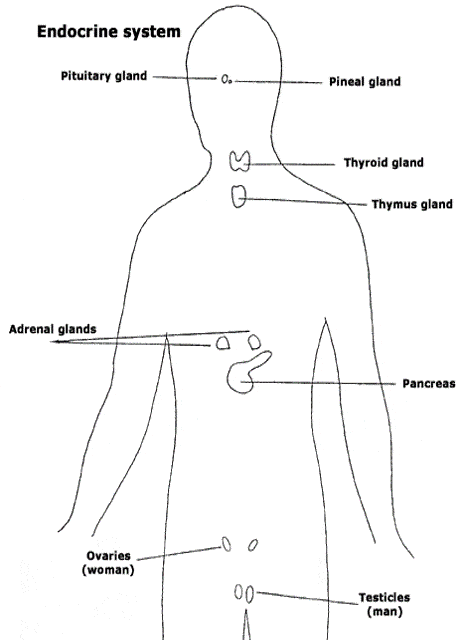
What is the endocrine system?

a)

A system of vessels that circulates blood around the body.

b)

A group of bones and tissue that provides support and structure for the body.

c)

A group of glands that work together with the nervous system to coordinate all body functions

d)

A group of organs that is responsible for eliminating wastes.

21.

The "master gland" is known as the __________________.

a)

thyroid gland.

b)

adrenal gland.

c)

pancreas.

d)

pituitary gland.

22.

Which of the following are chemicals that travel in the blood and cause changes in different parts of the body?

a)

Hormones

b)

Glands

c)

Parathyroid

d)

Adrenal Gland

23.

The response to stress is called

a)

Stay or Stray Response

b)

Fight or Stay Response

c)

Flee or Stray Response

d)

Fight or Flight Response

24.

Hormone regulation operates under which type of feedback mechanism?

a)

positive feedback

b)

negative feedback

c)

zero feedback

d)

Hormones are not regulated

25.

Feedback loops are important because they allow organisms and the environment to

a)

change based on new inputs

b)

fall apart

c)

change based on new outputs

d)

maintain balance

26.
If the environment gets cold, we will often shiver in order to:
a)
keep body temperature the same as the external temperature
b)
decrease body temperature
c)
increase body temperature
d)
regulate blood pressure
27.
Function of pituitary gland:
a)
produces the highest number of different hormones
b)
senses the hormone levels in the blood
c)
increase bone calcium levels
d)
decrease blood calcium
28.
What is the function of ovaries?
a)
control female characteristics and menstrual cycle
b)
control male characteristics
c)
produces hormones that control BSL (blood sugar level)
d)
control blood pressure
29.
What are the testes?
a)
control menstrual cycle
b)
produces hormones that control BSL (blood sugar level)
c)
control blood pressure
d)
control male characteristics
30.
What is the target cell?
a)
A cell that a hormone is specifically directed towards
b)
produces a large number of different hormones
c)
secretes digestive juices including enzymes
d)
secretes molecular messengers
31.

Can a hormone affect any cell?

a)

Yes, they affect all cells

b)

No, the cell has to have a matching receptor

c)

Maybe

d)

Depends on the situation

32.

How do hormones get to their target cells?

a)

nerve impulses

b)

floating in the blood stream

c)

electric and chemical signals

d)

respiration

33.

Which of the following is NOT a major endocrine gland.

a)

pituitary

b)

hypothalymus

c)

sweat gland

d)

ovaries

e)

pancreas

34.

Which gland is the connection between the nervous system and endocrine system?

a)

pineal

b)

pituitary

c)

hypothalamus

d)

adrenal

35.

Passive Transport is the movement of particles across the membrane from an area of [ ___ ] to an area of [ ___ ]

a)

high to low

b)

low to high

c)

low to low

d)

high to high

36.

Which body system controls the body to maintain homeostasis?

a)

excretory

b)

nervous

c)

circulatory

d)

skeletal

37.
Homeostasis
a)
allows for a wildly fluctuating internal environment
b)
is impossible in vertebrates
c)
is the maintenance of a relatively stable internal environment and often incorporates a form of feedback regulation
d)
is the maintenance of a relatively stable external environment and often incorporates a form of feedback regulation
38.
The maintenance of an organism’s internal environment is called:
a)
compensating
b)
homeostasis
c)
balancing
d)
routine
39.
a body system that controls and coordinates all body activities through electric impulses/messages between brain, spinal cord and nerves.
a)
endocrine system 
b)
nervous system
c)
nerve
d)
neuron
40.
a body system that controls growth and homeostasis by secreting hormones from glands.
a)
skeletal system
b)
nervous system
c)
endocrine sytem
d)
integumentary system
41.
organ of the endocrine system that secretes hormones.
a)
heart
b)
gland
c)
brain
d)
skin
42.

When the body temperature drop below normal ranges, arterioles in the skin will

a)

dilate to allow less blood to flow to skin surface

b)

constrict to allow less blood to flow to skin surface

c)

dilate to allow more blood to flow to skin surface

d)

constrict to allow more blood to flow to skin surface

43.

A reflex reaction is an .....

a)

involuntary response

b)

voluntary response

c)

conscious response

d)

response

44.

Look at the reflex arc shown in the diagram. Which neurone is marked by the letter X?

a)

Sensory neurone

b)

Relay neurone

c)

Motor neurone

d)

CNS

45.

Look at the reflex arc shown in the diagram. Which neurone is marked by the letter Y?

a)

Sensory Neurone

b)

Relay Neurone

c)

Motor neurone

d)

CNS

46.

What type of neuron is illustrated in #2?

a)

CNS

b)

Integrating

c)

Sensory

d)

Motor

47.

What type of neuron is illustrated in #5?

a)

Parasympathetic

b)

Integrating

c)

Sensory

d)

Motor

48.

Why are reflexes important?

a)

They are rapid

b)

They don't involve the conscious part of the brain

c)

They are voluntary

d)

They are involuntary

e)

They cause harm

49.

What is the name of the gaps between neurones?

(a)  

50.

Enzymes are an example of

a)

Lipids

b)

Carbohydrate

c)

Protein

d)

Nucleic Acid

51.
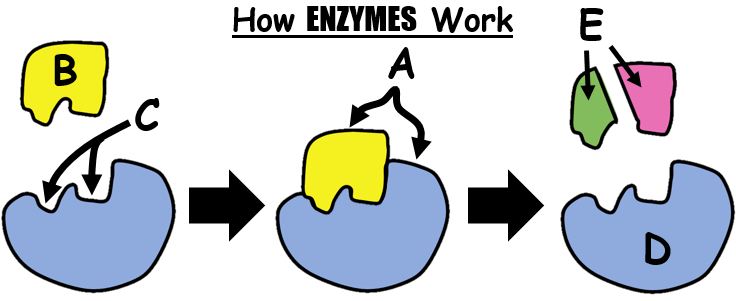
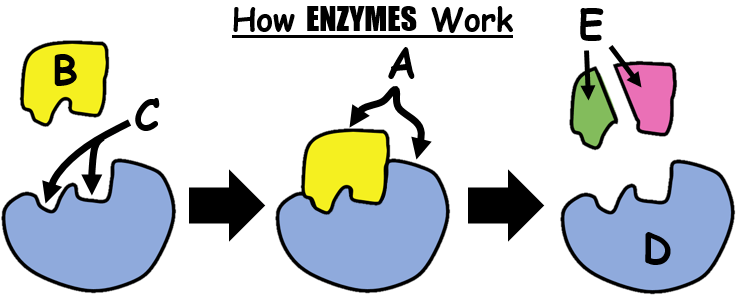
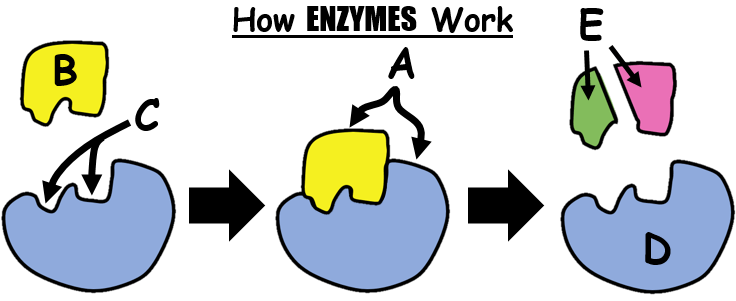
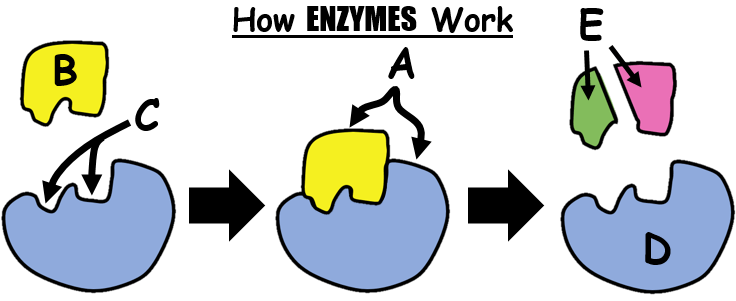
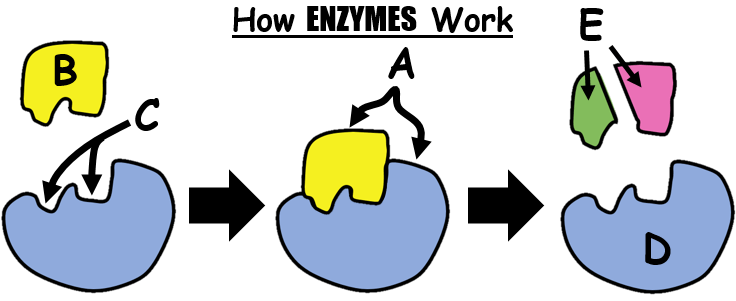
In the diagram, what is letter A? 
a)
product
b)
substrate
c)
enzyme-substrate complex
d)
active site
52.
Letter D...
a)
active site
b)
enzyme
c)
substrate
d)
products
53.
Letter B...
a)
active site
b)
enzyme
c)
substrate
d)
products
54.
Letter C...
a)
active site
b)
enzymes
c)
substrate
d)
products
55.
Letter E...
a)
active site
b)
enzyme
c)
substrate
d)
products