wayground logo

Free Printable Worksheets

Font size

S
M
L
XL
Worksheets

Term 3 Grade Recovery (8th)

Total questions: 125

Worksheet time: 2hrs 48mins
Name
Class
Date
1.

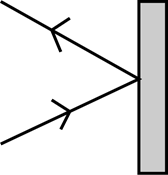
The illustration shows a light ray striking an object.

In the illustration, the light ray striking the object is-

a)

diffraction

b)

Deflection

c)

reflection

d)

all of these

2.
A student placed a pencil in a cup of water.  The pencil appears broken because light-
a)
always travels in a straight line
b)
bends when it passes through water
c)
makes the water in the glass evaporate
d)
reflects the pencil on the water's surface
3.
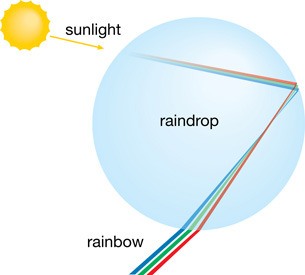
Light bending as it passes through a rain drop is an example of...
a)
Refraction
b)
Reflection
4.
a)

Reflection

b)

Refraction

c)

Diffraction

5.

The wave goes around something that gets in the way.

a)

Reflection

b)

Refraction

c)

Diffraction

6.

What would you call this?

a)

Refraction

b)

Diffraction

c)

Bends

d)

Reflection

7.
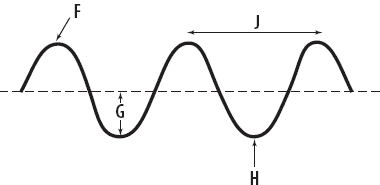
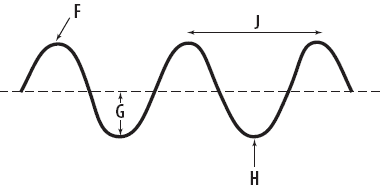
Which letter is a crest?
a)
F
b)
G
c)
H
d)
J
8.
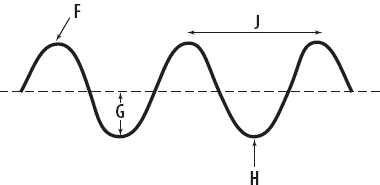
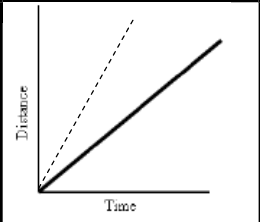
Which letter is a trough?
a)
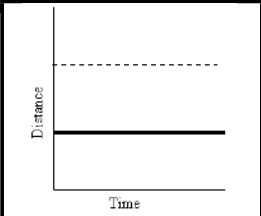
F
b)
G
c)
H
d)
J
9.
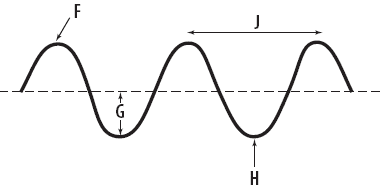
Which letter shows amplitude?
a)
F
b)
G
c)
H
d)
J
10.
Which letter identifies the wavelength?
a)
F
b)
G
c)
H
d)
J
11.
In a sound wave, the area where molecules have been pressed together is a...
a)
Compression
b)
Rarefaction
c)
Wavelength
12.
In a sound wave, the area where there are fewer molecules and they are spread out is a...
a)
Compression
b)
Rarefaction
13.

In sound waves, the most dense area of dots is called ____ and the least dense areas is called _____

a)

compression, rarefaction

b)

rarefaction, compression

c)

Wavelength

d)

all of these

14.
What is the frequency of this wave?
a)
3 Hertz
b)
4 Hertz
c)
5 Hertz
d)
6 Hertz
15.

In a solid, sound waves travel _____ in a liquid.

a)

faster than

b)

slower than

c)

the same as

d)

all of these

16.

Frequency is measured in _____

a)

hertz

b)

meters

c)

decibels

d)

meters/second

17.

Refraction happens because the wave ____

a)

changes speed as it changes mediums

b)

changes speed as it changes directions

c)

changes color as it changes mediums

d)

the type of wave changes

18.

Waves that need a medium are called

a)

electromagnetic

b)

light

c)

mechanical

d)

microwaves

19.

When the car moves AWAY from you, its horn seems_____.

a)

Low frequency

b)

High frequency

c)

greater amplitude

d)

the same as when it is coming towards you
20.

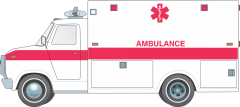
When an ambulance move TOWARD you it has a ________.

a)

high frequency

b)

low frequency

c)

medium frequency

d)

the same as when it moves away

21.
What does a wave carry?
a)
boats
b)
matter
c)
energy
d)
water
22.

Increasing the amplitude will increase the _____.

a)

energy

b)

frequency

c)

wavelength

d)

all of these

23.

In space,you cannot hear because _____

a)

there are no air molecules to carry sound.

b)

the sounds o space are too loud

c)

the sun destroys the sound waves

d)

there is no magnetic field

24.

Sound travels through all of these EXCEPT _____

a)

water

b)

helium

c)

metal

d)

vacuum

25.
Which wave has a greater frequency?
a)
wave B
b)
wave C
26.
Sound waves are what kind of wave?
a)
Longitudinal
b)
Transverse
c)
Surface
d)
Electromagnetic
27.
Which wave is pictured?
a)
Transverse
b)
Longitudinal
c)
Both
d)
Neither
28.
This picture (B) shows light moving as a...
a)
Transverse Wave
b)
Ocean Wave
c)
Compression Wave
d)
Slinky Wave
29.
When light hits a black object, like the one in the picture, what will happen to the different colors?
a)
All colors of light will bounce off
b)
All colors of light pass through it
c)
All colors of light will be absorbed
d)
None of the above
30.
When light hits the shirt in the picture, which color will bounce off?
a)
Blue
b)
Indigo
c)
Orange
d)
Violet
31.
When light hits something like a raindrop or a prism, it will...
a)
Be absorbed
b)
Refract, or bend
c)
Neither 
32.

Which color of light will help this plant grow best?

a)

Green light

b)

Red Light

33.

On the EMS, which wave has the shortest wavelength?

a)

Radio

b)

Gamma

c)

Soft X-Rays

d)

Ultraviolet

34.

Which type of wave does sunscreen protect you from?

a)

Radio

b)

Infrared

c)

Ultraviolet

d)

Gamma

35.
What is the measure of how many waves pass a point in a certain amount of time?
a)
frequency
b)
wavelength
c)
midpoint
d)
crest and trough
36.
Which wave has a greater frequency?
a)
A
b)
B
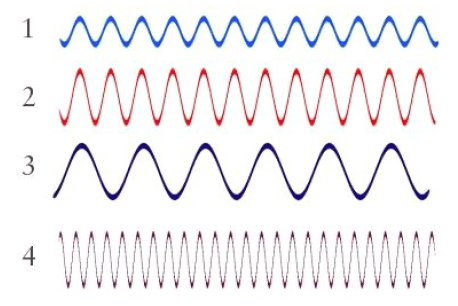
37.
Which wave in the diagram has the greatest wavelength?
a)
1
b)
2
c)
3
d)
4
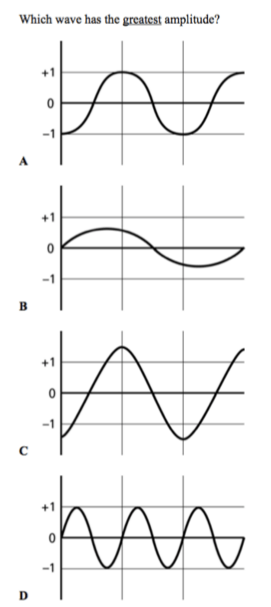
38.
Which wave has the greatest amplitude?
a)
A
b)
B
c)
C
d)
D
39.
Which EM wave has the longest wavelength?
a)
light
b)
radio
c)
ultraviolet
d)
red
40.
Energy can neither be created or destroyed
a)
Law of conservation of Mass
b)
Law of conservation of Energy
41.
A leaf is green, what does this tell you about the light that is being absorbed?
a)
no light is being absorbed
b)
green is being refracted and all the colors are being absorbed.
c)
green is being absorbed and all the other colors are reflected
d)
green is being reflected and all the other colors are being absorbed
42.

Visible light is which type of wave?

a)

seismic

b)

mechanical

c)

longitudinal

d)

electromagnetic

43.
Why do we see objects as white?
a)
They absorb all light
b)
They reflect all light
c)
They absorb some light and reflect some light
44.
When light cannot pass through an object, that object is:
a)
transparent
b)
translucent
c)
opaque
d)
a prism
45.
When some light can pass through and some light cannot, that object is:
a)
transparent
b)
translucent
c)
opaque
d)
a prism
46.
Light travels in ____ lines called waves.
a)
straight
b)
curvy
47.
A ___ lens makes objects appear bigger.
a)
concave
b)
convex
c)
prism
d)
flat
48.
A __ lens makes objects appear smaller and further away.
a)
convex
b)
concave
c)
prism
d)
flat
49.
Light will be reflected in many different directions off of a ___ surface.
a)
rough
b)
smooth
c)
flat
d)
mirrored
50.
Which window is opaque?
a)
Window 1
b)
Window 2
c)
Window 3
d)
None
51.
What does the word "converging" mean?
a)
to separate
b)
to come together
c)
parallel 
d)
perpendicular
52.
_____ is a lens that is thicker in the middle and makes an object appear bigger.
a)
prism
b)
convex lens
c)
concave lens
d)
mirror
53.
Is a convex lens thicker or thinner in the middle?
a)
Thicker 
b)
Thinner 
54.
Is a concave lens thicker or thinner in the middle? 
a)
Thicker 
b)
Thinner 
55.

When light continues to pass through an object without changing its path

a)

reflect

b)

transmit

c)

absorb

d)

refract

56.

The bending of waves around a barrier.

a)

refraction

b)

diffraction

c)

resonance

57.
Why can you see most objects? 
a)
they emit light
b)
light refracts through them
c)
light reflects off them
d)
They absorb light
58.

What would you call this?

a)

Reflection

b)

Diffraction

c)

Refraction

d)

Friction

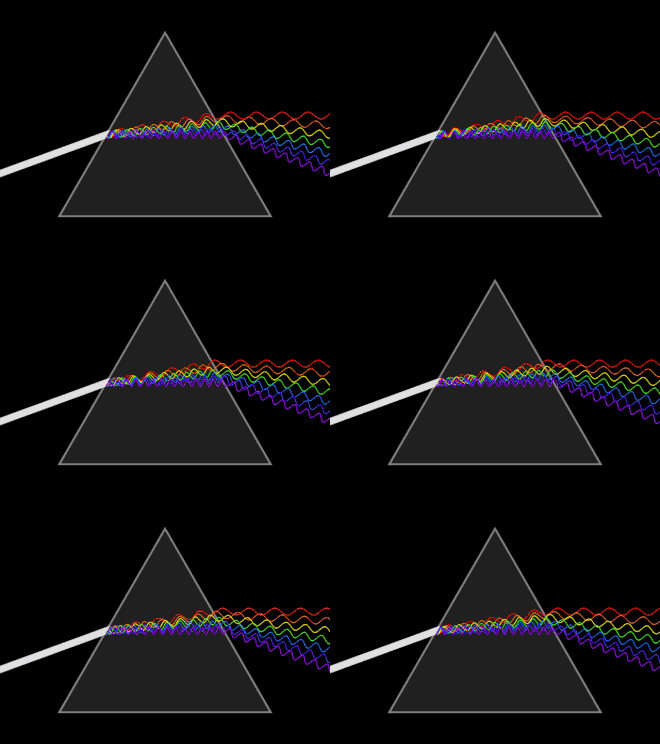
59.

witch picture is diffraction

a)
b)
c)
d)
60.
What is the speed of a car that travels 400 m in 20 minutes?
a)
20 miles/hr
b)
20 m/min
c)
800 m/min
d)
200 miles/hr
61.
What is the equation to calculate speed?
a)
speed = distance/time
b)
speed = time/distance
c)
speed = time x distance 
d)
speed = speed/time 
62.

The location of an object in relation to a nearby object or place is called . . .

a)

reference point

b)

motion

c)

position

d)

frame of reference

63.

A change in position is called . . .

a)

position

b)

frame of reference

c)

reference point

d)

motion

64.

A push or pull on matter from all directions is called . . .

a)

speed

b)

velocity

c)

acceleration

d)

force

65.

Forces that cause a change in motion are . . .

a)

gravity

b)

friction

c)

balanced forces

d)

unbalanced forces

66.

Forces on an object that are equal in size & opposite direction, cancelling each other out, are called . . .

a)

unbalanced forces

b)

balanced force

c)

friction

d)

gravity

67.

A force that opposes motion; can act between two objects that are touching, or between air & a moving object . . .

a)

gravity

b)

friction

c)

balanced forces

d)

unbalanced forces

68.
How fast does the plane appear to be moving to a person riding in the car?
a)
520 m/s
b)
460 m/s
c)
30 m/s
d)
490 m/s
69.
How fast does the hot air balloon appear to be moving to the person in the canoe?
a)
1 m/s to the left
b)
1 m/s to the right
c)
5 m/s to the left
d)
5 m/s to the right
70.
The sum of all forces acting on an object.
a)
Contact Force
b)
Balanced Force
c)
Unbalanced Force
d)
Net Force
71.
Balanced or Unbalanced?
a)
Balanced 
b)
Unbalanced
72.
What is the net force?
a)
400 N Up
b)
400 N Down
c)
- 400 N Down
d)
800 N Down
73.
What is the net force
a)
10 N
b)
0 N
c)
25 N
d)
1 N
74.
Students are playing tug-of-war. If group B pulls the rope to the right with a force of 400 N and group A pulls the rope to the left with a force of 250 N, what will happen to the ribbon in the middle of the rope?
a)
The ribbon will move to the left and group A will win the tug-of-war.
b)
The ribbon will move to the left and group B will win the tug-of-war.
c)
The ribbon will move to the right and group B will win the tug-of-war.
d)
The ribbon will move to the right and group A will win the tug-of-war.
75.

Which type of friction is shown in the picture?

a)

fluid

b)

static

c)

rolling

d)

sliding

76.
How can friction be reduced?
a)
reduce the force acting between the 2 surfaces
b)
reduce the roughness of the 2 surfaces coming in contact
c)
use wax, grease or oil
d)
all of the above are ways of reducing friction
77.
Which runner won the race?
a)
A
b)
B
c)
C
78.
Which runner had a head start?
a)
A
b)
B
c)
C
79.
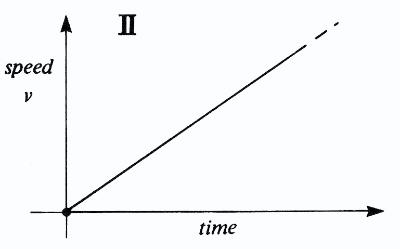
What does this graph represent?
a)
Constant Speed
b)
Acceleration
c)
Not moving
80.
How long did it take this object to travel 10 m?
a)
0 s
b)
10 s
c)
15 s
d)
20 s
81.
At 60 seconds, how far had this object traveled? 
a)
0 m
b)
10 m
c)
20 m
d)
40 m
82.
What does this graph represent?
a)
Constant speed
b)
Acceleration
c)
Not moving
83.
What is happening at D?
a)
Stationary
b)
Accelerating
c)
Fast steady speed; moving away from the starting position
d)
Slower steady speed; moving away from the starting position
84.
What is happening at C?
a)
Stationary
b)
Accelerating
c)
Fast steady speed; moving away from the starting position
d)
Slower steady speed; moving away from the starting position
85.

Segment O-A The bus is _________________.

a)

at rest

b)

returning (to original position)

c)

moving forward

86.

Segment A-B The bus is _________________.

a)

at rest

b)

returning (to original position)

c)

moving forward

87.
A measurement of how fast an object is moving
a)
Velocity
b)
Speed
c)
Vector
d)
Acceleration
88.
What is happening at C?
a)
Stationary
b)
Accelerating
c)
Fast steady speed; moving away from the starting position
d)
Slower steady speed; moving away from the starting position
89.
Marta rides her bike 10 miles in 5 hours. Joel rides his bike 11 miles in 5 hours. Avery rides her bike 15 miles in 5 hours. Which child rides her bike faster?
a)
Marta
b)
Avery 
c)
Joel
90.
Which runner won the race?
a)
Albert
b)
Bob
c)
Charlie
91.
During which interval is the object traveling at a constant velocity?
a)
B to C
b)
D to E
c)
F to G
d)
it traveling at a constant velocity during all of the intervals shown.
92.

During which interval is the object speeding up?

a)

A to B

b)

B to C

c)

D to E

d)

E to F

93.
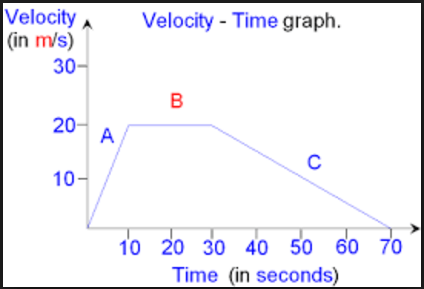
This is a velocity-time graph.  What is the object doing in segment C?
a)
Positive acceleration
b)
Negative acceleration
c)
Constant Velocity
d)
Not moving
94.
How long did it take this object to travel 10 m?
a)
0 s
b)
10 s
c)
15 s
d)
20 s
95.

What is represented by this graph?

a)

constant speed

b)

not moving

c)

speed increasing

d)

speed increasing at a constant rate

96.

what is the motion described in the graph

a)

all of above

b)

constant speed

c)

acceleration

d)

constant position

97.
An object at rest remains at rest and an object in motion remains in motion unless it experiences an unbalanced force is what law?
a)
First Law
b)
Second Law
c)
Third Law
d)
Ninth Symphony
98.
The tendency of an object to resist being moved or if in motion, being stopped is...
a)
Inertia
b)
Force
c)
Fricition
d)
Monty
99.
What is the SI unit for measuring force?
a)
Newtons
b)
Pounds
c)
Carls
d)
Isaacs
100.
The unbalanced force acting on an object equals the object's mass times its acceleration is which law...?
a)
First Law
b)
Second Law
c)
Third Law
d)
Murphy's Law
101.
The formula we get from the second law is...?
a)
F = m*a
b)
v = d/t
c)
a = v/t
d)
f = 1/T
102.
Which statement illustrates Newton’s first law?
a)
A stone will not move unless something pushes or pulls it
b)
As a car comes to a stop, the passengers continue to move forward
c)
A ball rolling across the floor eventually slows down
d)
All of them!
103.
If an object has zero net force, can it be moving? 
a)
Yes. In constant motion.
b)
No. It is balanced.
c)
Yes. It is accelerating.
d)
No it equals zero.
104.
What is the Net Force?
a)
17 N Right
b)
3 N Right
c)
3 N Left
d)
17 N Left
105.
What is the Net Force?
a)
5 N to the right
b)
10 N to the right
c)
15 N to the right
d)
0 N
106.
An object at rest will _______ if no outside forces are applied.
a)
Stay at rest
b)
Increase Velocity
c)
Decrease Mass
d)
Go to sleep
107.
Which of the following shows the direction of the friction force?
a)
A
b)
B
c)
C
d)
D
108.
An ice skater at rest pushes against a sled at rest, causing both the skater and sled to move away from each other with different accelerations. This is an example best described by
a)
Newton’s first law of motion for objects at rest.
b)
Newton’s first law of motion for objects in motion.
c)
Newton’s second law of motion. F=ma
d)
Newton’s third law of motion: Equal and opposite reaction
109.
A crumpled piece of paper hits the ground before a flat sheet of paper because
a)
the acceleration of gravity is greater on the  crumpled paper.
b)
there is more air resistance against the flat paper.
c)
the crumpled paper is more massive
d)
the crumpled paper is less massive.
110.
When you kick a ball across a feild and it hits someone in the face and they fly backwards
a)
Action=Reaction
b)
Speed
c)
Motion
d)
Air 
111.
Which of Newton's laws is illustrated when a magician pulls a tablecloth out from under the dishes without disturbing them?
a)
first
b)
second
c)
third 
d)
fourth
112.
What is Newtons 2nd law of motion?
a)
Pancakes 
b)
Force= Mass multiplied by acceleration
c)
For every action there is a equal and opposite  re-action.
d)
Law of gravity 
113.
What law of motion does this picture represent?
a)
Newtons 1st law
b)
law of gravity 
c)
Newtons 4th law 
d)
Newtons 2nd law
114.
What law of motion does this picture represent?
a)
Newtons 1st law
b)
Newtons 4th law 
c)
Newtons 3rd law 
d)
Newtons 2nd law
115.
What is the tendency of an object to resist a change in motion?
a)
coffee
b)
motion
c)
inertia
d)
gravity
116.

The upward force on an object falling through the air is__________

a)

air resistance

b)

inertia

c)

momentum

d)

terminal velocty

117.
What is the net force?
a)
4.2 N left
b)
4.2 N right
c)
2.2 N left
d)
2.2 N right
118.
The combination of all the forces acting on an object is the...
a)
net force
b)
action force
c)
reaction force
d)
balance force
119.
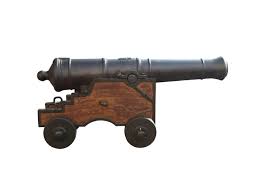
When a cannon fires a cannonball we observe Newton's third law. Which force is the reaction force?
a)
The cannon moving forward
b)
The cannonball moving forward
c)
The cannon moving backward
d)
The cannonball moving backward
120.

If you increase the mass on an object while the force remains the same, its acceleration

a)

decreases

b)

stays the same

c)

also increases

d)

stops

121.

If you increase the force on an object, its acceleration

a)

decreases

b)

stays the same

c)

also increases

d)

stops

122.

Pushing a child on a swing is easier than pushing an adult on the same swing, because the adult has more mass.

a)

Newton's 1st Law

b)

Newton's 2nd Law

c)

Newton's 3rd Law

d)

None of them

123.

A rocket launches because of ______.

a)

gravity

b)

air resistance

c)

an opposite reaction

124.

If a car is moving fast and hits a wall, the wall will....

a)

apply an equal and opposite force back on the car

b)

allow the car to run through the wall

c)

open up and swallow the car

125.

Jupiter has about 317 times more mass than Earth. What can you infer from this fact?

a)

That Jupiter’s and Earth’s gravitational forces are equal.

b)

That Jupiter’s gravitational force is much stronger than Earth’s gravitational force.

c)

Mass has no effect on the gravitational force between two objects