wayground logo

Free Printable Worksheets

Font size

S
M
L
XL
Worksheets

Earth's Structure and Landforms Review

Total questions: 125

Worksheet time: 1hrs 5mins

Name
Class
Date
1.
Which type of soil will water puddle on?
a)
Clay
b)
Sand
c)
Silt
d)
Loam
2.
Which type of soils does water go straight through?
a)
Sand
b)
Clay
c)
Loam
d)
Silt
3.
Which type of soil do plants grow the best in?
a)
Loam
b)
Silt
c)
Clay
d)
Sand
4.
Which type of soil has medium sized particles?
a)
Loam
b)
Sand
c)
Clay
5.
Which type of soil has the smallest particles?
a)
Clay
b)
Sand
c)
Silt
d)
Loam
6.
Which type of soil has the largest particles?
a)
Sand
b)
Silt
c)
Clay
d)
Loam
7.
Which layer of soil is at the top?
a)
Topsoil
b)
Subsoil
c)
Bedrock
8.
Crust
a)
Earth's Outer Layer
b)
type of rock found commonly in continental plates
c)
a type of fault where rocks on either side move past each other sideways with little up or down motion; transform boundary
d)
Hot, Molten rock that flows from a volcano (on earth's surface)
9.
Which layer is plastic-like and allows the crust to flow over it?
a)
lithosphere
b)
asthenosphere
c)
mantle
d)
outer core
10.
The __________________ forms the continents and consists mainly of granite.
a)
continental crust
b)
oceanic crust
c)
magma
d)
volcano
11.
How do scientists know about Earth's layers?
a)
By studying seismic waves and volcanic activity
b)
They have gone to the center of the Earth.
c)
By comparing it to Earth's Moon.
d)
By conducting water quality tests.
12.
What is the correct order of the layers of the Earth starting with the outermost layer?
a)
crust, mantle, lithosphere, asthenosphere, mesosphere, outer core, inner core
b)
inner core, outer core, mantle, mesosphere,asthenosphere, lithosphere, crust
c)
asthenosphere, mesosphere, crust, inner core, lithosphere, mantle, outer core
d)
crust, asthenosphere, lithosphere, mantle, inner core, mesosphere, outer core
13.
Why is the Inner Core solid when it's so hot?
a)
There is so much pressure, that it can't become a liquid.
b)
iron and magnesium
c)
the amount of mass in a given volume
d)
Waves produced by earthquakes that help us study the inner layers of Earth.
14.
Crust
a)
The thin and solid outermost layer of the Earth above the mantle.
b)
A dense sphere of solid iron and nickel at the center of Earth.
c)
A rigid layer made up of the uppermost part of the mantle and the crust.
d)
Plastic, putty-like part of the mantle underneath the lithosphere.
15.
Which layer is made up of two different kinds of layers (oceanic and continental)?
a)
crust
b)
mantle
c)
outer core
d)
inner core
16.
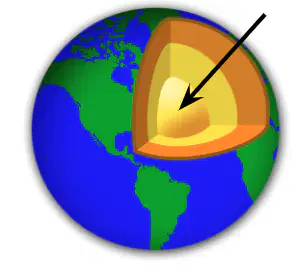
Which layer of the Earth is shown here?
a)
Crust
b)
Mantle
c)
Outer Core
d)
Inner Core
17.
Which layer has strong convection currents, which are responsible for the crust's movement?
a)
crust
b)
mantle
c)
outer core
d)
inner core
18.
The _____________ is earth's crust located under the ocean.
a)
oceanic crust
b)
continental crust
c)
magma
d)
core
19.
Which layer is broken into many large and small tectonic plates?
a)
crust
b)
mantle
c)
outer core
d)
inner core
20.
Which layer of the Earth is shown here?
a)
Crust
b)
Mantle
c)
Outer Core
d)
Inner Core
21.
How does oceanic crust compare to continental crust?
a)
Oceanic crust is thinner and more dense than continental crust.
b)
Oceanic crust is thicker and more dense than continental crust.
c)
Oceanic crust is thinner and less dense than continental crust.
d)
Oceanic crust is thicker and less dense than continental crust.
22.
Which layer of the Earth is shown here?
a)
Crust
b)
Mantle
c)
Outer Core
d)
Inner Core
23.
The continental crust is
a)
Less dense than oceanic crust
b)
Mostly basalt rock
c)
younger than oceanic crust
d)
more dense than oceanic crust
24.
What state of matter is the crust?
a)
Solid
b)
Liquid
c)
Gas
d)
Non-Newtonian fluid
25.
This layer is responsible for the Earth's magnetic field.
a)
Crust
b)
Mantle
c)
Outer Core
d)
Inner Core
26.
The _____________ is the rigid outer part of the earth, consisting of the crust and upper mantle.
a)
lithosphere
b)
athenosphere
c)
atmosphere
d)
carbon dioxide
27.
A _________________ is a wave of energy that travels through the earth, away from an earthquake in all directions.
a)
seismic wave
b)
volcano
c)
earthquake
d)
oceanic wave
28.
Which two elements are mainly found in the inner and outer core?
a)
iron and nickel
b)
iron and silver
c)
nickel and silver
d)
silver and carbon
29.
_______________ means melted or made liquid by heat.
a)
molten
b)
melted
c)
lava
d)
boiling
30.
This layer has strong convection currents, which are responsible for the crust's movement.
a)
Crust
b)
Mantle
c)
Outer Core
d)
Inner Core
31.
This is the hottest layer of the Earth
a)
Inner Core
b)
mantle
c)
crust
d)
outer core
32.
The _____________ is the thin and solid outermost layer of the Earth above the mantle.
a)
crust
b)
core
c)
mantle
d)
athenosphere
33.
The _____________ is the soft layer of the mantle on which the lithosphere floats.
a)
athenosphere
b)
lithosphere
c)
mantle
d)
crust
34.
This layer is a solid metal ball made of Nickel (Ni) and Iron (Fe)
a)
Crust
b)
Mantle
c)
Outer Core
d)
Inner Core
35.
This is the thickest layer of the Earth
a)
Crust
b)
Mantle
c)
Outer Core
d)
Inner Core
36.
LIQUID iron and nickel
a)
Earth's outer core
b)
mantle
c)
Earth's inner core
d)
crust
37.
What state of matter is the outer core?
a)
Solid
b)
Liquid
c)
Gas
d)
Non-Newtonian fluid
38.
Which layer of the Earth is shown here?
a)
Crust
b)
Mantle
c)
Outer Core
d)
Inner Core
39.
A deep depression on the sea floor caused by the subduction of one plate under another.
a)
trench
b)
rift valley
c)
hot spot
d)
volcano
40.
Pieces of the Earth's lithosphere.
a)
tectonic plate
b)
trench
c)
subduction
d)
volcano
41.
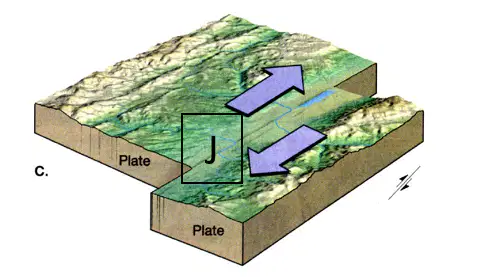
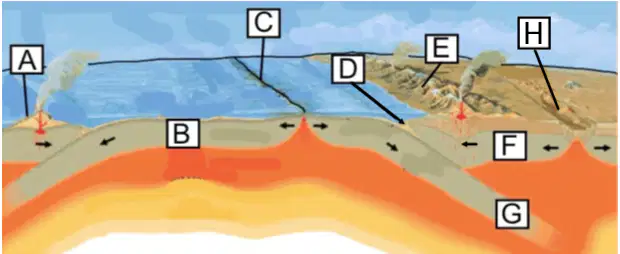
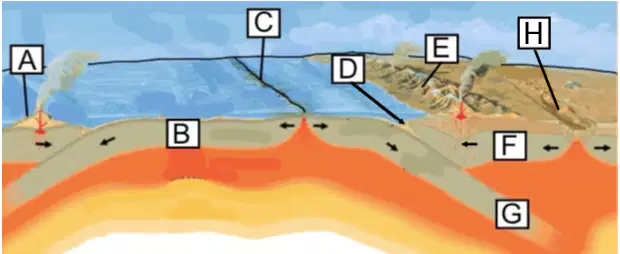
Which type of boundary is shown in the diagram?
a)
Divergent
b)
Convergent
c)
Transform
d)
All of the above
42.
An undersea mountain chain where new ocean floor is produced.
a)
mid-ocean ridge
b)
volcano
c)
fault
d)
trench
43.
The San Andreas Fault in California is on what type of plate boundary?
a)
Transform
b)
Convergent
c)
Divergent
d)
Subduction
44.
A break in the Earth's crust where masses of rock slip past each other.
a)
fault
b)
volcano
c)
rift valley
d)
mountain
45.
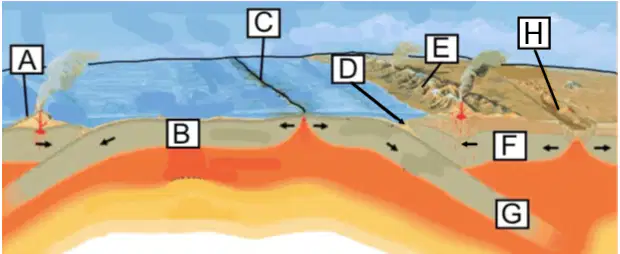
What can be found at letter G?
a)
Subduction Zone
b)
Convection Current
c)
Trench
d)
Hot Spot
46.
Which type of boundary is shown in the diagram?
a)
Transform
b)
Convergent
c)
Divergent
d)
All of the above
47.
Which type of boundary is shown in the diagram?
a)
Convergent
b)
Divergent
c)
Transform
d)
All of the above
48.
An area where two or more plates move away from each other.
a)
divergent boundary
b)
transform boundary
c)
convergent boundary
d)
fault
49.
Mountains occur at ___________ boundaries.
a)
Convergent
b)
Divergent
c)
Transform
d)
All of the above
50.
A plate boundary where two plates move away from each other. (Divide)
a)
Divergent Boundary
b)
Convergent Boundary
c)
Subduction
d)
Transform Boundary
51.
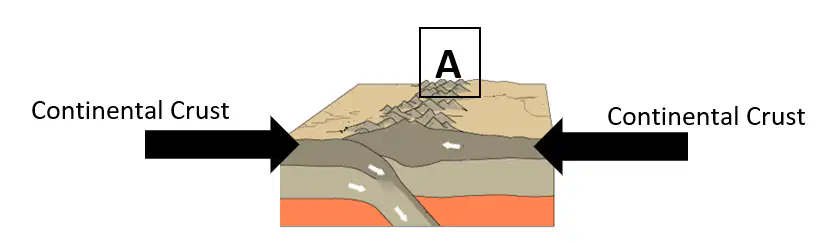
What type of boundary is created when continental crust collides with continental crust?
a)
Convergent
b)
Divergent
c)
Transform
d)
All of the above
52.
The area where two plates meet.
a)
plate boundary
b)
divergent boundary
c)
rift valley
d)
mid-ocean ridge
53.
What type of boundary can be found at letter C?
a)
Divergent (Oceanic-Oceanic)
b)
Convergent (Oceanic-Continental)
c)
Divergent (Continental-Continental)
d)
Convergent (Continental-Continental)
54.
What type of boundary can be found at letter H?
a)
Divergent (Continental-Continental)
b)
Convergent (Continental-Continental)
c)
Divergent (Oceanic-Oceanic)
d)
Convergent (Oceanic-Continental)
55.
Which type of boundary is shown in the diagram?
a)
Convergent
b)
Divergent
c)
Transform
d)
All of the above
56.
What type of boundary is created when two plates slide passed each other?
a)
Transform
b)
Convergent
c)
Divergent
d)
All of the above
57.
The less dense and thicker of the two plate types.
a)
continental crust
b)
mantle
c)
lithosphere
d)
oceanic crust
58.
Plates slide past each other at ___________ boundaries.
a)
Transform
b)
Convergent
c)
Divergent
d)
All of the above
59.
A boundary where plates slide past each other.
a)
transform boundary
b)
rift valley
c)
plate boundary
d)
convergent boundary
60.
A deep valley that forms where two plates move apart.
a)
rift valley
b)
fault
c)
mid-ocean ridge
d)
mountains
61.
Which type of boundary is shown in the diagram?
a)
Convergent
b)
Divergent
c)
Transform
d)
All of the above
62.
A plate boundary where two plates move past each other in opposite directions. (Slide)
a)
Transform Boundary
b)
Convergent: Continental-Continental
c)
Divergent
d)
Subduction
63.
The denser and thinner of the two plate types.
a)
oceanic crust
b)
continental crust
c)
subduction
d)
trench
64.
Heat from Earth’s core cause hot rock in the mantle to rise and cool rock in the mantle to sink - pulling the crust with it and making the plates move.
a)
convection current
b)
subduction
c)
earthquake
d)
convergent boundary
65.
The theory that pieces of Earth's lithosphere are in constant motion, driven by convection currents in the mantle.
a)
plate tectonics/ continental drift
b)
convection currents
c)
plate boundaries
d)
Layer's of the Earth theory
66.
What type of plate boundary is shown in the diagram?
a)
Convergent (Oceanic-Continental)
b)
Divergent (Oceanic-Oceanic)
c)
Convergent (Continental- Continental)
d)
Transform
67.
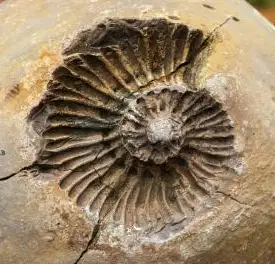
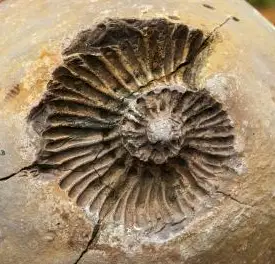
What type of fossil is shown? Hint: The shape of the fossil is raised up.
a)
Cast
b)
Mold
c)
True Form
d)
Imprint
68.
Paleontologist
a)
people who study ancient life
b)
biologist
c)
people who study rocks
d)
people who study dinosaurs
69.
Fossils of plants are found in Antarctica. Antarctica is almost completely covered in ice. What might this tell us?
a)
Antarctica once had a warmer climate
b)
Antarctica's climate has not changed much
c)
these plants grew very well in ice
d)
the tooth fairy dropped the plants in Antarctica
70.
What type of fossil is shown? Hint: The shape is a hollow form
a)
Mold
b)
Cast
c)
True Form
d)
Trace
71.
fossil
a)
Evidence of organisms that lived long ago
b)
A fossil that consists of the preserved body of an animal or plant or an imprint of the body
c)
A skeleton
d)
partially decayed plant matter found in bogs
72.
Fossilized animal droppings are what type of fossil?
a)
Trace
b)
Cast
c)
Mold
d)
Preserved
73.
An insect trapped in amber is what type of fossil?
a)
Preserved
b)
Trace
c)
Cast
d)
Mold
74.
In which type of fossil can you still see the color of the organism?
a)
Preserved
b)
Trace
c)
Cast
d)
Mold
75.
Which of the following would be considered a fossil?
a)
A rock in the shape of a bone
b)
An imprint of a footprint in a rock
c)
A leaf imprint in a rock
d)
All of the above
76.
What is a cast fossil?
a)
A fossil that is formed or shaped in a mold
b)
Fossils made when animals got stuck in tar pits. The flesh decayed, but the animals' bones were preserved in tar.
c)
Fossils that form when an animal dies and slowly dries out.
d)
Fossils that form when minerals replace the bones or once living parts of a plant turning it to stone.
77.
What is a mold fossil?
a)
A fossil that is a hollow form. The shell or bone that was in a space, dissolved and left a hollow space.
b)
A fossil made by pressing
c)
A fossil that is formed or shaped in a mold
d)
Fossils made when insects are trapped in tree sap.
78.
What type of fossil is shown?
a)
Cast Fossil
b)
Mold Fossil
c)
Trace Fossil
d)
Petrified Fossil
79.
What type of fossil is this?
a)
Mold
b)
Carbon Film
c)
Trace
d)
Cast
80.
Fossils that show the activities of an organism, such as tracks, footprints and nests
a)
Trace fossil
b)
Carbon film
c)
Cast fossil
d)
Mold fossil
81.
Which parts of an organism are most likely to become fossils?
a)
hard parts, such as bones, teeth and shells
b)
skin and fur
c)
fins
d)
arms and legs
82.
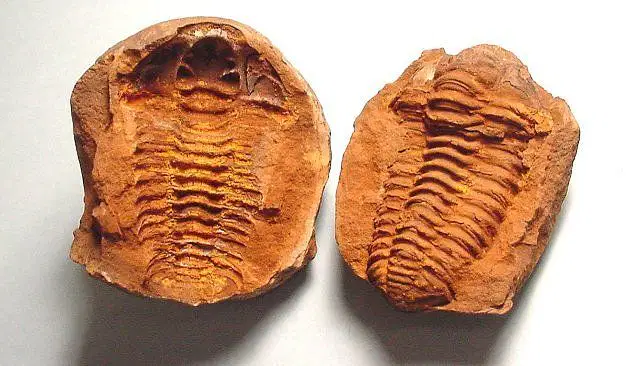
The fossil on the left is a...
a)
mold
b)
cast
c)
trace
d)
carbon film
83.
What type of fossil is pictured?
a)
Mold Fossil
b)
Cast Fossil
c)
Trace Fossil
d)
Body Fossil
84.
What type of fossil is shown?
a)
Trace Fossil
b)
Cast Fossil
c)
Preserved Fossil
d)
Petrified Fossil
85.
Footprint fossils are what type of fossil?
a)
Trace
b)
Cast
c)
Mold
d)
True Form
86.
What is one way a fossil is created
a)
Amber
b)
Gold
c)
Rubies
d)
Sparkles
87.
These include coal, petroleum, and natural gas.
a)
footprints
b)
cast fossil
c)
mold fossil
d)
fossil fuels
88.
Fossils of ocean organisms are found up high on a mountain range. How did those fossils get there?
a)
the rock on the mountains was once beneath the sea
b)
birds dropped them there
c)
the tooth fairy left them there
d)
they were shot out of a volcano
89.
Organisms get stuck in this hard yellow-orange tree sap:
a)
amber
b)
gold
c)
crystals
d)
sedimentary rock
90.
The fossil to the right is a.....
a)
cast
b)
mold
c)
trace
d)
petrified
91.
What type of scientist studies fossils?
a)
Paleontologist
b)
Scatologist
c)
Archaeologist
d)
Botanist
92.
What is an amber fossil?
a)
Fossils made when insects are trapped in tree sap.
b)
A fossil made by pressing
c)
A fossil that is formed or shaped in a mold.
d)
Fossils that form when minerals replace the bones or once living parts of a plant turning it to stone.
93.
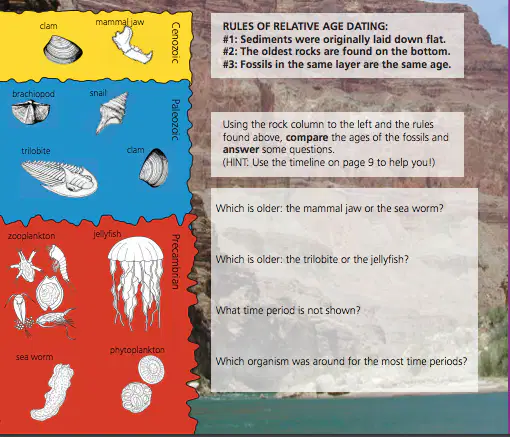
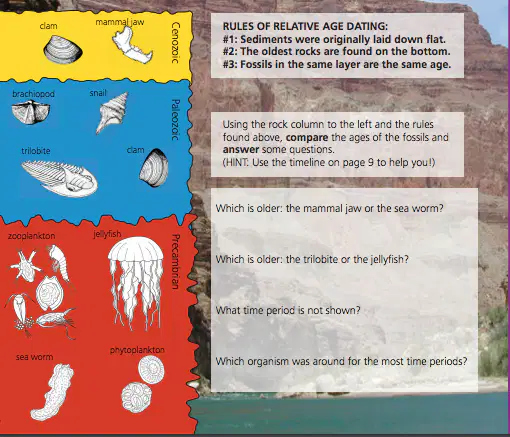
Use the picture to answer the question. Which is older the trilobite or the jellyfish?
a)
------
b)
Trilobite
c)
Jellyfish
d)
------
94.
Layers of rock below the Earth's surface are ______________.
a)
older
b)
newer
c)
tired
d)
retired
95.
The upper layers of rock, those that are closest to the surface of the Earth, are the _________ layers to be laid down.
a)
oldest
b)
tired
c)
newest
d)
retired
96.
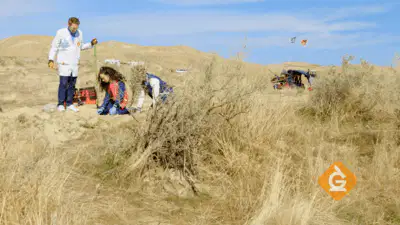
What evidence was found that this place was once under the ocean?
a)
a shark tooth
b)
dinosaur skeleton
c)
ancient saltwater
d)
an old boat
97.
Use the picture to answer the question. Which is older: the mammal jaw or the sea worm?
a)
Sea Worm
b)
Mammal Jaw
c)
-----
d)
-----
98.
the process of moving small pieces of the earth from one place to another
a)
landscape
b)
erosion
c)
topography
d)
rock
99.
What formed the Grand Canyon?
a)
a river
b)
a glacier
c)
dinosaurs
d)
humans
100.
Which rocks are the youngest in this photo?
a)
the rocks at the top
b)
the rocks on the right side
c)
the rocks at the bottom
d)
the rocks on the left side
101.
What type of fossil is shown? Hint: The shape is a hollow form
a)
Mold
b)
Cast
c)
True Form
d)
Trace
102.
Fossilized animal droppings are what type of fossil?
a)
Trace
b)
Cast
c)
Mold
d)
Preserved
103.
What type of fossil is shown?
a)
Cast Fossil
b)
Mold Fossil
c)
Trace Fossil
d)
Petrified Fossil
104.
Footprint fossils are what type of fossil?
a)
Trace
b)
Cast
c)
Mold
d)
True Form
105.
Fossils of ocean organisms are found up high on a mountain range. How did those fossils get there?
a)
the rock on the mountains was once beneath the sea
b)
birds dropped them there
c)
the tooth fairy left them there
d)
they were shot out of a volcano
106.
An insect trapped in amber is what type of fossil?
a)
Preserved
b)
Trace
c)
Cast
d)
Mold
107.
What type of fossil is this?
a)
Mold
b)
Carbon Film
c)
Trace
d)
Cast
108.
Which of the following would be considered a fossil?
a)
A rock in the shape of a bone
b)
An imprint of a footprint in a rock
c)
A leaf imprint in a rock
d)
All of the above
109.
These include coal, petroleum, and natural gas.
a)
footprints
b)
cast fossil
c)
mold fossil
d)
fossil fuels
110.
What is a mold fossil?
a)
A fossil that is a hollow form. The shell or bone that was in a space, dissolved and left a hollow space.
b)
A fossil made by pressing
c)
A fossil that is formed or shaped in a mold
d)
Fossils made when insects are trapped in tree sap.
111.
The fossil to the right is a.....
a)
cast
b)
mold
c)
trace
d)
petrified
112.
Which parts of an organism are most likely to become fossils?
a)
hard parts, such as bones, teeth and shells
b)
skin and fur
c)
fins
d)
arms and legs
113.
What type of fossil is shown?
a)
Trace Fossil
b)
Cast Fossil
c)
Preserved Fossil
d)
Petrified Fossil
114.

Which type of rock is formed from intense heat and pressure?

a)

Metamorphic

b)

Igneous

c)

Obsidian

d)

Sedimentary

115.

What type of property test is a mineralogist conducting when she rubs a mineral over a mirror, tile, or hard surface?

a)

Streak Test

b)

Luster Test

c)

Appearance Test

d)

Cracking Test

116.
What are the 3 major types of rocks?
a)
Igneous, Metamorphic, Sedimentary
b)
Metamorphic, Igneous, Cementation
c)
Brown, Red, Gray
d)
Streak, Hardness, Breakage
117.

Two types of igneous rocks are:

a)

Interior and exterior

b)

Intrusive and extrusive

c)

Inside and outside

d)

Enter and exit

118.
Rock formed from materials that have settles into layers from weathering
a)
igneous rock
b)
sedimentary rock
c)
metamorphic rock
119.
What is the small broken down pieces of rock called?
a)
dirt
b)
grime
c)
sediment
d)
popcorn
120.
When sediments are pressed together tightly, this is called ____________.
a)
Compaction
b)
Cementation
c)
Weathering
d)
Erosion
121.

What causes igneous rocks to form

a)

pressure

b)

cooling magma and lava

c)

compaction

d)

cementation

122.

A rock made of magma that cools inside the Earth and contains large crystals?

a)

Igneous

b)

Sedimentary

c)

Metamorphic

d)

Magma

123.

Has larger crystals, cools slowly

a)

intrusive igneous rock

b)

extrusive igneous rock

124.

has smaller crystals, cools quickly.

a)

Intrusive igneous rock

b)

extrusive igneous rock

125.

Rocks are different from minerals because

a)

Rocks are organic

b)

Rocks are made of minerals

c)

Minerals are rocks

d)

Rocks are not naturally occuring