wayground logo

Free Printable Worksheets

NEW

Font size

S
M
L
XL
Worksheets

HB Punnett Squares

Total questions: 40

Worksheet time: 50mins

Name
Class
Date
1.
In pea plants, the tall allele is dominant to the short allele. What key would demonstrate this?
a)
Tall = T
Short = S
b)
Tall = T
Short = t
c)
Tall = t
Short = T
d)
Tall = TT
Short = tt
2.
A heterozygous long-tusked elephant is crossed with a homozygous recessive short-tusked elephant. What is the probability of the offspring having short tusks?
a)
0%
b)
25%
c)
50%
d)
75%
3.

What is the probability of a purple-horned unicorn if a heterozygous pink-horned unicorn is crossed with a heterozygous pink-horned unicorn? (Assume the genes are dominant and recessive and P - pink and p-purple

a)

0%

b)

25%

c)

50%

d)

75%

4.
Georgette wants to breed her pet phoenixes, but she isn't sure if the babies will burst into blue flames or red flames. Her documents show that her female phoenix is homozygous dominant for red flames, while her male phoenix is homozygous recessive for blue flames. What color flames will the babies have?
a)
Red
b)
Blue
c)
Purple
d)
50% Red, 50% Blue
5.
T - tall and t = short
In the punnett square below, what belongs in the missing square
a)
tt
b)
Tt
c)
Bb
d)
TT
6.

What is the observable trait?

a)
Genotype
b)
Phenotype
c)
Homozygous
d)
Heterozygous
7.
What is the probability of heterozygous offspring?
a)
25%
b)
50%
c)
0%
d)
100%
8.
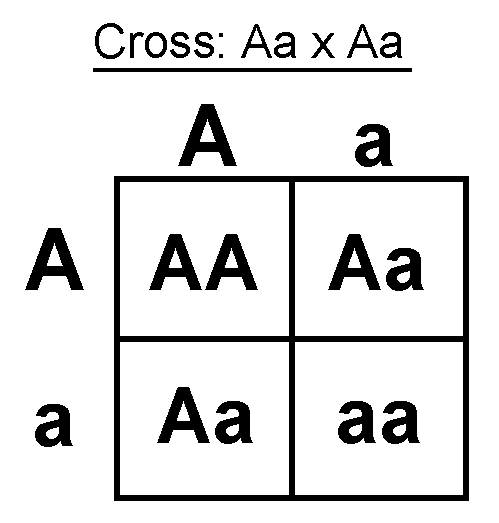
What allele combination should go in the missing box?
a)
AA
b)
Aa
c)
aa
d)
none of these
9.
Each one of the boxes on the Punnett Square represents what probability of an offsprings' genotype?
a)
25%
b)
1%
c)
10%
d)
0%
10.
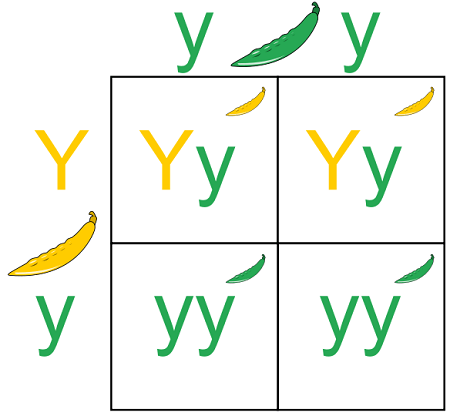
Which choice best represents the genotype of this cross?
a)
1 Yy: 2 yy: 0 YY
b)
2 Yy: 2 yy: 0 YY
c)
3 Yy: 1 yy: 0 YY
d)
1 Yy: 3 yy: 0 YY
11.
What is the phenotype of the offspring? (A-Brown hair; a-blond hair) 
a)
50 % Brown Hair and 50% Blond Hair 
b)
25 % Brown Hair and 75% Blond Hair 
c)
75 % Brown Hair and 25% Blond Hair 
d)
0% Brown Hair and 100% Blond Hair 
12.
Which of the following genotypes is homozygous dominant?
a)
A
b)
Aa
c)
AA
d)
aa
13.
Which of the following genotypes is heterozygous?
a)
Bb
b)
BB
c)
bb
d)
B
14.
Which of the following is homozygous recessive?
a)
Tt
b)
tt
c)
TT
d)
T
15.
Dominant or recessive?
tt
a)
Dominant 
b)
Recessive
16.
Dominant or recessive?
Dd
a)
Dominant
b)
recessive
c)
neither
d)
homozygous
17.
What should students use to identify the percent chance of a trait being passed down from a parent to its offspring?
a)
a graph
b)
a flow chart
c)
a data table
d)
a Punnett square
18.
Which statement best supports why many offspring look similar to their parents?
a)
Offspring inherit characteristics from one parent.
b)
Offspring inherit characteristics from both parents.
c)
Parents choose which characteristics to pass on to their offspring.
d)
Parents choose to change their appearance to match that of their offspring.
19.

What are the possible combinations of a pea plant with the alleles PP and a pea plant with the alleles pp. P= purple p= white

a)
all Pp
b)
all PP
c)
Pp,PP,Pp,PP
d)
all pp
20.
When the allele combination is a dominate and a recessive trait together which trait will be seen?
a)

Dominant

b)
Recessive
c)
none
d)
both
21.
Homozygous is when...
a)
the alleles are the same
b)
the alleles are different
c)
the alleles are absent
d)
the alleles are present
22.
B = brown fur  b = white fur
In the punnett square, what is the probability for white fur? 
a)
0%
b)
25%
c)
50%
d)
75%
23.
Aa is
a)
homozygous (purebred)
b)
heterozygous (hybrid)
24.
What is a phenotype?
a)

The expression of a trait; observable appearance.

b)
refers to the genetic makeup of an individual
c)
An organism that has the same genes for a trait (ex. TT or tt)
d)
the passing of traits from parent to offspring
25.
Homozygous or heterozygous?
BB
a)
Homozygous
b)
Heterozygous
26.
Which of the following is a phenotype?
a)
Aa
b)
red hair
c)
heterozygous
d)
DNA
27.
Gregor Mendel is often called ....
a)
The father of heredity.
b)
The father of genetics.
c)
The king of peas
d)
The father of punnett squares.
28.

A heterozygous woman marries a heterozygous man. What are the chances of a blonde hair baby?

a)

0%

b)

25%

c)

50%

d)

75%

e)

100%

29.
What are genes?
a)
Something you wear.
b)
Segments of DNA that carry traits for offspring.
c)
The powerhouse of cells.
d)
None of the above.
30.
Which of the following is an example of phenotype?
a)
bb
b)
blue eyes
31.
Which of the following genotypes are purebred?
a)
Pf
b)
Pp
c)
PP
d)
pP
32.
If you are purebred dominant for a trait, your genotype would be...
a)
Tt
b)
TT
c)
tt
d)
tall
33.

The different forms of a gene

a)

alleles

b)

atoms

c)

proteins

d)

wheels

34.

This trait is hidden whenever the dominant allele is present

a)

dominant allele

b)

codominance

c)

recessive allele

d)

Punnett Square

35.

An organism's physical appearance or visible traits. (what it looks like)

a)

phenotype

b)

genotype

36.

An organism's genetic makeup, or allele combination. The letters we use to show the allele combination.

a)

phenotype

b)

genotype

37.

An organism that has two identical (THE SAME) alleles for a trait (purebred)

a)

homozygous

b)

heterozygous

38.

An organism that has two different alleles for a trait (heterozygous)

a)

homozygous

b)

hybrid

39.

B = brown fur b = white fur

In the Punnett square, what is the probability for tan fur? (assume an incomplete dominance inheritance pattern)

a)

0%

b)

25%

c)

50%

d)

75%

40.

A heterozygous long-tusked elephant is crossed with a heterozygous short-tusked elephant. What is the probability of the offspring having short tusks?

a)
0%
b)
25%
c)
50%
d)
75%