
 Worksheets
Optics Review
Total questions: 89
Worksheet time: 2hrs 8mins
Towards Center of curvature
Towards Focal point
Parallel to the principle axis


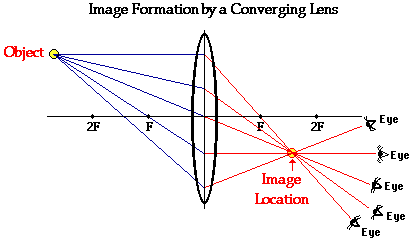
Concave lenses, like the ones found on many people's front door, always produce images that are .....
A 25.0 m object is placed 30.0 m from a convex lens, which has a focal length of 5.0 m. What is the distance of the image?
6 m
7 m
8 m
9 m
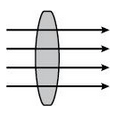
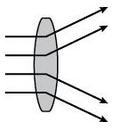
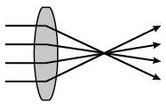
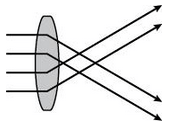
Which figure represents the path light takes through a converging lens?
Critical angle and refractive index are:
Directly related
Equal
Inversely related
None of these
For total internal reflection (incident light is past the critical angle), which of the following is correct?
Light travels from rarer to denser medium.
Light travels from denser to rarer medium.
Light travels in air only.
Light travels in water only.

The optical density of turpentine is higher than that of water while its mass density is lower. Figure shows a layer of turpentine floating over water in a container. For which one of the four rays incident on turpentine in figure the path shown is correct?
1
2
3
4
The optical density of turpentine is higher than that of water while its mass density is lower. Figure shows a layer of turpentine floating over water in a container. For which one of the four rays incident on turpentine in figure the path shown is correct?
1
2
3
4

which type of lens
opaque
convex
concave
plano

which type of lens
concave
convex
opaque
plano
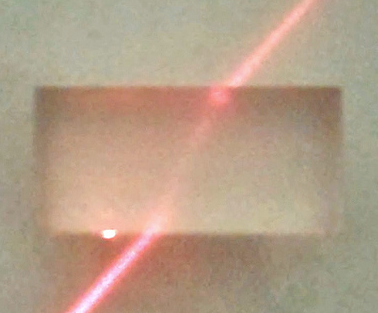
this is an example of
refraction
diffraction
infraction
reflection

what type of mirror is this
concave
convex
translucent
plano

what type of mirror is this
concave
convex
translucent
plano
a convex mirror does what to rays
diverges
converges
implodes
merges
Which of the following are the characteristics of the image formed in a plane mirror?
Virtual and upright
Virtual and inverted
Real and inverted
Real and upright
The angle of incidence for an equilateral prism is 600. What should be the refractive index of prism so that the ray is parallel to the base inside the prism?
1.414
1.732
1.33
9/8
A concave lens forms the image of an object such that the distance between the object and image is 10 cm and the magnification produced is 1/4. The focal length of the lens will be : __________
8.6 cm
6.2 cm
10 cm
4.4 cm
When a ray of light enters a glass slab from air
its wavelength decreases
its wavelength increases
its frequency increases
neither its wavelength nor its frequency changes.
Which ray diagram shows a real image?


None of the above
Four ray diagrams show the images formed in mirrors and lenses. Which shows a virtual image?


All of the above.

What happens to the frequency of a wave as it passes through a gap?
Increases
Decreases
No change
None of above

Two waves E and G are shown. The waves have the same speed.
Which statement is correct?
Wave E has a greater amplitude than wave G.
Wave E has a greater intensity than wave G.
Wave E has a smaller frequency than wave G.
Wave E has a smaller wavelength than wave G.

The diagram shows a displacement-time graph for a progressive wave.
Amplitude: 5 mm; Frequency: 40 Hz
Amplitude: 5 mm; Frequency: 50 Hz
Amplitude: 10 mm; Frequency: 40 Hz
Amplitude: 10 mm; Frequency: 50 Hz
Which observation indicates that sound waves are longitudinal?
Sound can be reflected from a solid surface.
Sound cannot be polarised.
Sound is diffracted around corners.
Sound is refracted as it passes from hot air to cold air.

A diffraction grating is used to measure the wavelength of monochromatic light, as shown in the diagram.
The spacing of the slits in the grating is 1.00 x10⁻⁶ m. The angle between the first order diffraction maxima is 70.0o.
What is the wavelength of the light?
287 nm
470 nm
574 nm
940 nm
Interference of light is evidence that:
the speed of light is very large
light is a transverse wave
light is electromagnetic in character
light is a wave phenomenon
In a Young's double-slit experiment the centre of a bright fringe occurs wherever waves from the slits differ in the distance they travel by a multiple of:
quarter of a wavelength.
half a wavelength.
a wavelength.
three-fourths of a wavelength.
In a Young's double-slit experiment, the slit separation is doubled. To maintain the same fringe spacing on the screen, the screen-to-slit distance D must be changed to:
D/2
D 2
2D
4D
Two waves that have a phase difference 180°, pi, or half wavelength between each other will have a final interference of amplitude
one.
zero.
same as the single wave.
doubles the single wave.
Extra distance travelled by one of waves compared with other is called
path.
displacement.
phase difference.
path difference.
When a light wave enters into a medium of different optical density,
its speed and frequency change.
its speed and wavelength change.
its frequency and wavelength change.
its speed, frequency, and wavelength change.
Light of wavelength 575 nm falls on a double-slit and the third order bright fringe is seen at an angle of 6.5o. What is the separation between the double slits?
5.0 micro-m
10 micro-m
15 micro-m
20 micro-m
One beam of coherent light travels path P1 in arriving at point Q and another coherent beam travels path P2 in arriving at the same point. If these two beams are to interfere destructively, the path difference P1 - P2 must be equal to
an odd number of half-wavelengths.
zero.
a whole number of wavelengths.
a whole number of half-wavelengths.
Laser is a monochromatic source of light- they have only one color. This means all the light waves have...
same frequency
same phase shift
same intensity (amplitude)
same direction of velocity

Diagram shows a water wave propagating through a small gap.
What happen to the speed of diffracted wave?
Increase
Decrease
Unchanged

The diagram shows a series of wave fronts approaching an opening in a barrier. Point P is located on the opposite side of the barrier. The wave fronts reach point P as a result of
resonance
refraction
reflection
diffraction
Which diagram best represents the shape and direction of a series of wave fronts after they have passed through a small opening in a barrier?
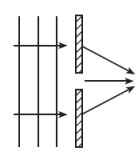
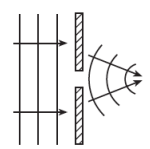
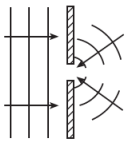
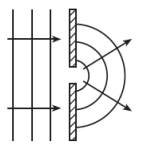


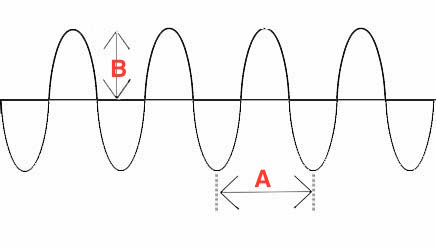
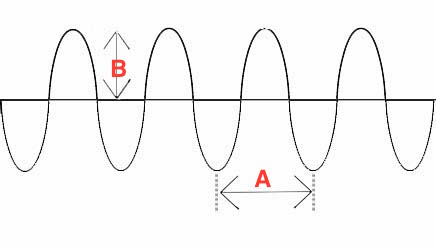
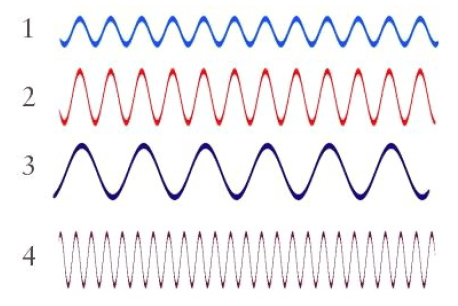

The image depicts which of the following wave behaviors?
Resonance
Doppler Effect
Polarization
Diffraction

The two blue and purple waves will undergo _________________ when they meet.
Constructive interference
Destructive interference
Wavelength= .5m
Frequency= 150 hertz
The EM spectrum travels as what type of wave?
Transverse
Longitudinal
Sound
S-Waves

What part of a wave is represented by letter F?
Trough
Crest
Amplitude
Wavelength

Figure 2 shows three experiments for studying the interaction of monochromatic light with thin films of glass of various thickness t. The eye represents the position of the observer. The observer sees constructive interference in
I only
II only
III only
I and III only
II and III only
Colours are often observed when gasoline is poured onto water. This effect is primarily produced by
diffraction
diffuse reflection
interference
absorption
incandescence
A thin coating, of refractive index 1.2, is applied to a glass camera lens, of refractive index n > 1.2, to minimize the intensity of the light reflected. The wavelength of the light is . The coating thickness required to minimize the intensity of reflected light is
2λ
2×1.2λ
41.2λ
4×1.2λ

The index of refraction of the thin film (water) is higher than air as shown in Figure above - the reflected ray will undergo a phase change of ½λ ( or π rad).
True
False

If the index of refraction of the film is higher than air - the reflected ray will undergo a phase shift.
TRUE
FALSE
Everytime light hits a "thin film" - there is a phase shift.
TRUE
FALSE

What is the phase difference between the reflected and refracted rays if they (assuming n_surfaceB > n_film > n_air)?
the thickness of the film (t)
2t
t + half of a wavelength
2t + half a wavelength

At the first air-soap interface (assuming soap has a higher index of refraction) there will be a phase shift.
TRUE
FALSE

At the bottom soap-air interface ( soap film has a higher index of refraction n > 1) there will be a phase change for ray 2.
TRUE
FALSE

What is the path difference of the reflected rays traveling through the film?
t
2nt
t/2
0

Given the index of refractive for oil and water is 1.40 and 1.33 respectively. Both of the reflected rays act as inphase coherent source.
TRUE
FALSE

The index of refraction of the thin film (water) is higher than air as shown in Figure above - the reflected ray will undergo a phase change of ½λ ( or π rad).
TRUE
FALSE


This open end tube is in the
1st harmonic
2nd harmonic
3rd harmonic
4th harmonic
How many wavelengths are there on a string (two fixed ends) vibrating at its fundamental frequency?
How many wavelengths are there on a string (one fixed end, one free end) vibrating at its fundamental frequency?

The pictured tube is 1.2 meters long. What is the wavelength of the wave inside?
.6 m
1.2 m
1.6 m

What is the frequency of the pictured wave on a string if the speed of the string wave is 1000 m/s and the length of the string is .75 meters?
1,667 Hz
3,333 Hz
1133 Hz
340 Hz
The speed of sound is ________ on a cold day versus a hotter one.
slower
faster
same speed
depends on other factors

When the frequency of a wave on a string increases, what happens to the wavelength?
The wavelength is not directly affected by the frequency of a wave.
The wavelength increases.
The wavelength decreases.
More specific information is needed to form a conclusion about the wavelength.

You stand on the sidewalk next to the street. A fire truck is moving towards you. The frequency of the siren on the fire truck is 600 Hz.
What should you hear?
Frequency higher than 600 Hz
Frequency lower than 600 Hz
Exactly 600 Hz
No sound, silence.
You stand on the sidewalk next to the street. A fire truck is away from you. The frequency of the siren on the fire truck is 600 Hz.
What should you hear?
Frequency higher than 600 Hz
Frequency lower than 600 Hz
Exactly 600 Hz
No sound, silence.

None of these answers

Even numbered harmonics do not form in a pipe with one end closed because
the pipe “fits” only an odd number of quarter wavelengths
the pipe “fits” only an even number of quarter wavelengths
the pipe cannot put an anti-node at the open end
the pipe cannot get enough air to vibrate in the pipe at these lengths

