
 Worksheets
Q3 Ecology Review
Total questions: 43
Worksheet time: 22mins


Which group is not represented in the food web?
producers
primary consumers
secondary consumers
decomposers
A ____________________ shows how energy is passed from one living thing to another...
ecosystem
food chain
habitat

In this energy pyramid, which organism would most likely be in level 2?
bird
fox
caterpillar
tree

How would the removal of earthworms from the food chain affect the other organisms?
The number of bass will increase.
The number of crayfish will decrease.
The crayfish will get their energy directly from the sun.
The number of bass and ospreys (bird) will increase.

Suppose that a new predator of the rabbit migrated to this ecosystem. What is the most likely initial effect on the other organisms?
More competition among the mice for food
More competition among the hawks for food
Less competition among snakes for food
Less grass available for food

The picture shows an energy pyramid. What will most likely happen to the foxes and the wolves if the rabbits are removed?
The foxes will eat more wolves.
The foxes will eat fewer wolves.
There will be more foxes and wolves.
There will be fewer foxes and wolves.

Click on the image to make it larger-- Choose all that apply: The hawk gets energy from...
mouse
rabbit
wildflowers
snake

Click on the image to make it larger-- Choose the living things that are producers...
wildflowers
rabbit
snake
grass

Click on the imgae to make it larger-- Choose the herbivores in the food web....
hawk
mouse
rabbit
snake
A cow eats grass found in its habitat. A cow is a
producer
consumer
herbivore
Bears eat berries and salmon. Bears are ...
producers
carnivores
omnivores

Why might an organism have more than one arrow coming from them in a food web?
More than one organism may eat them.
They may eat more than one other organism.
This organism gets its energy from multiple sources.

In the food web shown, who is the secondary consumer?
grass
mouse
rabbit
fox

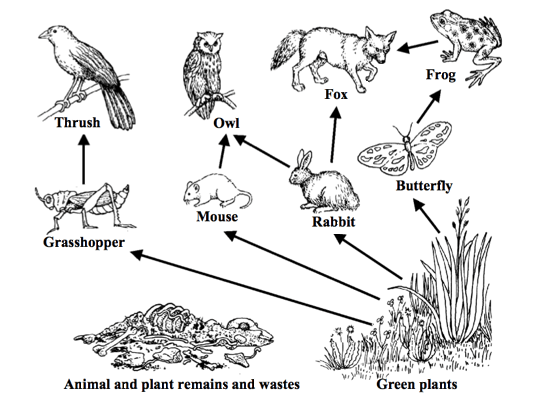


Using food web which of the following is a secondary consumer?
snake
worm
butterfy
squirrel

Using the food web which of the following is a primary consumer?
butterfy
snake
fox
frog

Using the food web which of the following is a tertiary consumer?
frog
bird
eagle
worm


If the rat population greatly decreases in both locations, which location will be the least affected?
Location 1 is less affected because the lizards are predators and are not affected by the decrease in the rat population.
Location 1 is less affected because the red-tailed hawk population can consume more rattlesnakes to make up for the loss of the rat population.
Location 2 is less affected because the rattlesnake and red-tailed hawk populations have food options other than the rat population.
Location 2 is less affected because the grasshopper population will increase due to greater access to food because of a decrease in the rat population.
How can an invasive species threaten the biodiversity of an ecosystem?
When the species creates a new habitat
When the species provide a food source
When the species is a predator.

What two organisms obtain their energy from the sun?
Elephant
Acacia Tree
Lion
Bermuda Grass

Examine the food web with organisms W, X, Y, and Z indicated
Which organism in this food web undergoes photosynthesis to obtain its energy?
W
X
Y
Z

The table shows the main food source of different organisms that make up a food chain.
Which set of trophic levels correctly describes the organisms?


The diagram shows a grassland food web.
Which two organisms share the same trophic level?
hawk and mouse
lizard and rabbit
mouse and rabbit
grass and grasshopper

The diagram shows an energy pyramid.
Which statement is true about the energy pyramid shown?
Both the biomass and amount of available energy increase while moving up the pyramid.
Both the biomass and amount of available energy decrease while moving up the pyramid.
The biomass increases, and the amount of available energy decreases while moving up the pyramid.
The biomass decreases, and the amount of available energy increases while moving up the pyramid.

A mouse eats grasshoppers that feed on plants. An incomplete energy pyramid diagram is shown.
At which level do the grasshoppers belong in the energy pyramid?
level P
level Q
level R
level S

Study the diagram of an energy pyramid for an environment.
Which word represents the organisms in level X?
Consumers
Omnivores
Predators
Producers

Study the diagram of an energy pyramid for an environment.
Which statement summarizes the relationship between energy and trophic level?
Animals in a higher trophic level have more energy available to them.
Animals in the lowest trophic level have the most energy available to them.
Energy consumption equals energy production at each trophic level.
Energy is available equally to organisms at all trophic levels.

The diagram shows an energy pyramid
Which animal in the pyramid represents a top carnivore?
crow
mouse
owl
rabbit

The diagram shows a food web.
Which type of organism is a decomposer?
copepods
dead algae
snails
zooplankton

The organisms in the diagram are found in many different ecosystems and play an important role.
carnivores
decomposers
herbivores
producers

Examine the food chain
What do the arrows represent in the food web?
life cycle stages
flow of energy
renewable resource depletion
one community replacing another

