wayground logo

Free Printable Worksheets

Font size

S
M
L
XL
Worksheets

Evolution Unit Review 21-22

Total questions: 52

Worksheet time: 36mins
Name
Class
Date
1.
Which is not an example of an adaptation?
a)
A bird's beak allows it to crack open hard nuts.
b)
A zebra's stripes allow it to confuse its predators.
c)
A frog's large hind legs allow it to jump from danger.
d)
A cat sleeps on the sofa to avoid the vacuum cleaner.
2.
Which of the following is a term for a group of similar organisms that can reproduce fertile offspring?
a)
individual
b)
population
c)
species
d)
fossil
3.
What is it called when better adapted organisms survive to pass traits along to their offspring.
a)
Evolution
b)
Natural Selection
c)
Extinction
d)
Artifical Selection
4.
"Survival of the Fittest" describes which theory
a)
a) natural selection
b)
b) gravity
c)
c) heredity
d)
d) string theory
5.
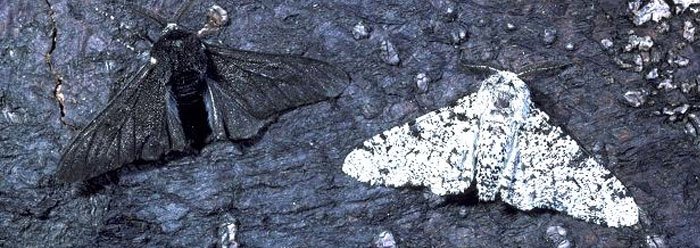
Why did the population of peppered moths in England change from light to dark after the Industrial Revolution?
a)
Light moths were easy to see against sooty trees and were eaten
b)
Light moths were killed by soot
c)
The birds that ate the dark moths were killed by soot
d)
Dark moths were produced by industrial processes
6.
The example of the peppered (brown) moths living near English industrial cities demonstrates that
a)
A change in an environment can result in the evolution of species living there
b)
Evolution occurs so slowly that is it not possible to determine that it has happened in less than a million years
c)
The environment near these cities has always favored dark colored moths
7.
Why are advantageous traits more likely to be passed onto offspring?
a)
Because they are more likely to survive and reproduce.
b)
Because they come from dominant alleles.
c)
Because they come from recessive alleles.
d)
Because the trait is an acquired phenotype.
8.
Any inherited trait that gives an organism an advantage in its environment is called ___.
a)
a mutation
b)
an adaptation
c)
evolution
d)
natural selection
9.
The trees these moths used to live on were white, but have been covered in soot from coal factories. Which moth will be more successful in this environment?
a)
Dark moth
b)
Light moth
c)
Both will be equally successful
d)
Neither will be successful
10.

What type of selection is depicted in the picture?

a)

stabilizing

b)

directional

c)

disruptive

11.

Robins typically lay fours eggs. If more then four eggs are produced then the baby chicks are malnourished while smaller egg numbers result in no viable (able to live) baby chicks. This is an example of

a)

stabalizing

b)

disruptive

c)

directional

12.
What type of selection?
a)
Directional 
b)
Stabilizing
c)
Disruptive
13.
Which of the three graphs shows stabilizing selection?
a)
A
b)
B
c)
C
14.
Which of the three graphs shows disruptive selection?
a)
A
b)
B
c)
C
15.
If finches with large beaks and finches with small beaks increase in a population while finches with average sized beaks decreases, which pattern of natural selection has occurred?
a)
Directional selection
b)
Disruptive selection 
c)
Stabilizing selection
16.
An extreme phenotype is favored causing the alleles to shift toward that phenotype
a)
Disruptive Selection
b)
Directional  Selection
c)
Stabilizing Selection
d)
Artificial Selection
17.
Genetic diversity decreases and individuals at the center of the curve have higher fitness.
a)
Disruptive Selection
b)
Directional  Selection
c)
Stabilizing Selection
d)
Artificial Selection
18.

Light colored crayfish hide in rocks. Dark colored crayfish hide in shadows. Light and dark are both ______.

a)

variations

b)

likely to be eaten by predators

c)

different traits in crayfish

d)

causes of selection

19.

A drought causes finches with small beaks to starve. Beak size is __________.

a)

a trait

b)

irrelevant to survival

c)

a cause for selection

d)

advantageous to finches

20.

What do we call different versions of a gene?

a)

adaptations

b)

carrying capacity

c)

alleles

d)

phenotype

21.

What do we call the physical expression of a genetic trait?

a)

alleles

b)

phenotypes

c)

genotypes

d)

genes

22.

What process creates new versions of a gene?

a)

alleles

b)

extinctions

c)

adaptations

d)

mutations

23.

If an allele produces a beneficial adaptation, then the organism is more likely to –

a)

leave the population

b)

create offspring with mutations

c)

survive and reproduce

d)

be outcompeted for food

24.

A plant population lives in a climate where rainfall is common. Over time, the entire plant population has become well adapted to these conditions. Which of the following would be the greatest threat to the entire population’s survival?

a)

mutations producing new alleles

b)

a period of drought

c)

a short period of increased rainfall

d)

reduce numbers of herbivores

25.

Over many generations, the length of necks in the giraffe population increased. This occurred as new alleles were introduced that created longer necks in individuals, and these individuals -

a)

reproduced, increasing the frequency of these alleles in the population

b)

died, removing the mutations from the gene pool of the population

c)

migrated, taking their new alleles with them to new ecosystems

d)

were captured, allowing scientists to isolate the new genes

26.

Longer necks are an adaption that allows giraffes to do which of the following?

a)

reach more food sources

b)

reduce acid reflux in stomach

c)

prevent water loss

d)

defend themselves from predators

27.

Natural selection is the process that increases the frequency of beneficial alleles in a –

a)

tissue

b)

cell

c)

population

d)

organism

28.

Does natural selection change individuals or populations?

a)

Individuals

b)

Populations

29.
Structures are similar in appearance but not in structure
a)
Vestigial 
b)
Homologous 
c)
Analogous Structures 
d)
Embryonic 
30.

Similar structures with different purposes found in different species are known as _____

a)

vestigial structures

b)

DNA

c)

homologous structures

d)

the fossil record

31.
The changes of species over time
a)
Embryonic 
b)
Natural selection 
c)
Mimicry 
d)
Evolution 
32.

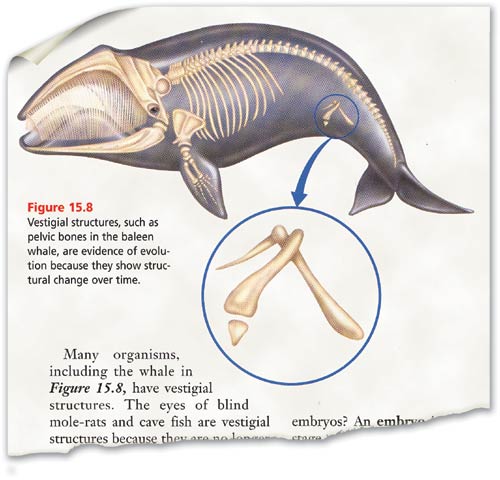
The picture shows a/an ___________

a)

homologous structure

b)

vestigial structure

33.
The opossum and kangaroo both incubate their young in a pouch. This provides evidence that they---
a)
are descended from a common ancestor
b)
Have very similar skeletal structures
c)
belong to the same species
d)
must range great distances to eat
34.
Which of the following is an example of a vestigial structure?
a)
the wings of a red-tailed hawk
b)
the hind limbs of a house cat
c)
the fins of sharks
d)
the tailbone of a human
35.
Which is not evidence for evolution?
a)
many animals have homologous structures due to common ancestry
b)
Many animals have vestigial structures from an ancestor
c)
We can observe changes in life forms by observing the fossil record
d)
All of these are evidence for evolution
36.
How do fossils provide evidence that evolution has happened on Earth?
a)
Fossils show how the sizes of certain animals has changed drastically over millions of years
b)
Fossils show that some species have gone extinct
c)
Fossils show how life forms present today are different than those from the past
d)
Different sedimentary rock layers provide evidence for how the environment has changed over time
37.
A change in the inherited characteristics of an organism over time is ________
a)
evolution.
b)
development.
c)
growth.
d)
ancestry.
38.
If two organisms have similar traits of DNA they are probably
a)
share a common ancestor
b)
share a common environment
c)
share a common population
d)
speciation
39.

Similarities in bone arrangements, like those in the picture, support the hypothesis that...

a)

these organisms are not well adapted

b)

these organisms share a common ancestor

c)

these organisms all share the same DNA sequences

d)

these organisms are members of the same species

40.
Study of embryos of various organisms to show a common ancestor because of similarities in development
a)
natural selection
b)
embryology
c)
speciation
d)
evolution
41.
Two organisms that are closely related would have
a)
very similar DNA sequence
b)
exactly the same DNA sequences
c)
no proteins in common
d)
completely different DNA sequence
42.
If modern organisms have a lot of homologous structures, what inference might paleontologists make about those organisms?
a)
They are reptiles
b)
One organism evolved from the other.
c)
The organisms have a common ancestor
43.
The diagram illustrates an embryonic stage of two organisms.

Which of the following can be determined by observing the embryos shown in the diagram
a)
The organisms share a common ancestry.
b)
The organisms belong to the same genus.
c)
The organisms are native to the same geographic areas.
d)
The organisms will grow into anatomically similar adults.
44.

Recently, scientists have been able to use ___________to find common proteins and amino acids to determine how closely related species are.

a)

DNA

b)

Vestigial structures

c)

Fossils

d)

Homologous structures

45.

Indigenous (native) people of which country would be expected to have the darkest skin color?

a)

Southwestern Canada

b)

Northwestern Brazil

c)

Southwestern China

d)

Western Australia

46.

Indigenous (native) people of which country would be expected to have the lightest skin color?

a)

Southwestern Canada

b)

Northwestern Brazil

c)

Southwestern China

d)

Western Australia

47.

Which factor is directly responsible for the skin pigmentation you were born with?

a)

Your exposure to the sun

b)

Different amounts and types of melanin

c)

The food you eat

d)

Weather you live in hot or cold temperatures

48.

What selective advantage did people have to lose increased melanin production? (Or in other words, to have less melanin?)

a)

Increased protection from skin cancer

b)

Increased protection from folate destruction

c)

Increased synthesis of vitamin D

d)

All of the above

49.

What selective advantage did people have to increase melanin production?

a)

Increased protection from skin cancer

b)

Increased protection from predators

c)

Increased synthesis of vitamin D

d)

All of the above

50.

Which population would be most at risk for developing rickets, a skeletal disorder that is caused by a lack of vitamin D, calcium, or phosphate?

a)

People with less melanin living near the equator

b)

People with less melanin living near the poles

c)

People with more melanin living near the equator

d)

People with more melanin living near the poles

51.

Claim: Biological traits are features that enhance an organism’s odds of survival.

a)

True

b)

False

52.

Claim: Human populations changed over many, many generations because they needed to change to increase their fitness (chance of surviving to reproduce and pass on their traits to their offspring).

a)

True

b)

False