
 Worksheets
CH Ch. 10 Redox Reactions Study Guide Quizizz
Total questions: 42
Worksheet time: 1hrs 28mins

A
B
C
D

Galvanic (voltaic) cells convert
mechanical energy in to electrical energy
potential energy in to electrical energy
electrical energy in to chemical energy
chemical energy in to electrical energy
What is a redox reaction?
A reaction where both reactants get reduced.
A reaction where both reactants get oxidized.
A reaction that involves a transfer of electrons between reactants.
A reaction that involves the combustion of at least one reactant.
What is reduction?
It is the gain of electrons.
It is the loss of electrons.
It is the creation of electrons.
It is the destruction of electrons.
What is oxidation?
It is the gain of electrons.
It is the loss of electrons.
It is the creation of electrons.
It is the destruction of electrons.
What is an anode?
It is the electrode where oxidation takes place.
It is the electrode where reduction takes place.
It is an aqueous solution containing an electrode.
It is the salt bridge that connects half-cells.
What is a cathode?
It is the electrode where oxidation takes place.
It is the electrode where reduction takes place.
It is an aqueous solution containing an electrode.
It is the salt bridge that connects half-cells.
Electrons always flow from
cathode to anode
anode to cathode
Oxidation occurs at the
anode
cathode
Electrons are gained at the
anode
cathode

As an element is oxidized, its oxidation number
decreases as electrons are lost
increases as electrons are lost
decreases as electrons are gained
increases as electrons are gained

The reaction 2NaCl → 2Na + Cl2 is an example of
a reduction reaction, only
both an oxidation and reduction reaction
an oxidation reaction, only
neither an oxidation nor a reduction reaction

Mg + PbCl2 → MgCl2 + Pb
Which statement correctly describes the oxidation and reduction that occur?
Mg is oxidized and Pb+2 is reduced
Mg is oxidized and Cl- is reduced
Mg is reduced and Cl- is oxidized
Mg is reduced and Pb+2 is oxidized

Pb + 2Ag+ → Pb+2 + 2Ag
The chemical species being reduced is
Ag
Pb
Pb+2
Ag+

2 CaO--> 2 Ca + O2
Which of the following correctly represents a reduction (unbalanced by atom or charge)?
Fe → Fe2+
Pb4+ → Pb2+
O-2 → O2
Fe → Fe3+
In a galvanic cell the ions flow through the
In a galvanic cell electrons flow
Oxidation is the _________ of electrons.
loss
gain
sharing
transfer

Ni (s) + H2O (l) →

Au (s) + HCl (l) →

Cd (s) + HCl (aq) →

Which metal is more reactive than calcium?
magnesium
potassium
silver
aluminum

Which one of the following would result in a reaction?
Iron with magnesium chloride
magnesium with iron chloride
Iron with Zinc Sulphate
gold with silver nitrate
A certain galvanic cell has the reaction: Zn + HgO → ZnO + Hg
Which is the unbalanced (by atom & charge)reaction occurring at the cathode?
Hg2+ → Hg
Hg → Hg2+
Zn → Zn2+
Zn2+ → Zn
What is the overall charge of MnO2 ?
What is the oxidation number for Br2
-2
-1
0
+2
What is the balanced reduction half-reaction of 2 Na + Cl2 --> 2 NaCl ?
Cl2 + 2 e- --> 2 Cl-
Cl2 - 2 e- --> 2 Cl-
Na --> Na+ + e-
Na° + Cl2°--> Na+1Cl-1
An increase in oxidation number.
more acidic
reduction
less basic
oxidation
What is the oxidation half-reaction of this equation: 3 CuCl + Fe --> FeCl3 + 3Cu?
Cu+ --> Cu
Fe --> Fe3+
Cu+ + e- --> Cu
Fe + 3e- --> Fe3+
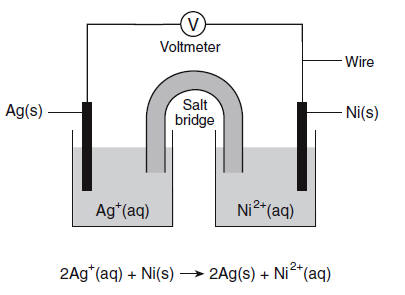
What half-reaction reaction occurs at the anode?
Ag+ + e- →Ag
Ag → Ag+ + e-
Ni2+ + 2e- → Ni
Ni → Ni2+ + 2e-

For the reaction, Cu(NO3)2 + Zn --> Zn(NO3)2 + Cu, what is the balanced reduction half-reaction?
Zn(s) → Zn2+ + 2e-
Zn2+ + 2e- → Zn(s)
Cu(s) → Cu2+ + 2e-
Cu2+ + 2e- → Cu(s)
What is the balanced oxidation half-reaction for this reaction?
Ag+ + e- → Ag
Fe → Fe2+ + 2 e-
Pb4+ + 2 e- → Pb2+
2 O-2 → O2 + 4 e-
Fe + 3 e- →Fe3+



