wayground logo

Free Printable Worksheets

Font size

S
M
L
XL
Worksheets

Unit 5 Review PT and Bonding

Total questions: 100

Worksheet time: 4hrs 31mins

Name
Class
Date
1.

The chemical bond between a non-metal and another non-metal will be a ________ bond.

a)

metal

b)

ionic

c)

covalent

d)

polar

2.

The chemical bond between a metal and a non-metal will be a _____ bond.

a)

metal

b)

ionic

c)

covalent

d)

polar

3.

Sodium and Bromine will make a _____ bond.

a)

ionic

b)

covalent

c)

metallic

4.

Carbon and Oxygen will make a ___________ bond.

a)

ionic

b)

covalent

c)

metallic

5.
Ionic compounds are formed when one or more valence electrons are transferred from _____
a)
a nonmetal atom to a metal atom
b)
a nonmetal atom to a nonmetal atom
c)
a metal atom to a nonmetal atom
d)
a metal atom to a metal atom
6.

When a metal loses an electron(s) it becomes a ...

a)

positive ion

b)

negative ion

c)

metalloid

d)

nonmetal

7.

In an ionic bond the non-metal wants to ______ electron(s).

a)

lose

b)

gain

c)

share

8.

In a covalent bond both non-metals _____ electrons.

a)

transfer

b)

share

9.

Which type of bonding does this diagram represent?

a)

covalent

b)

ionic

c)

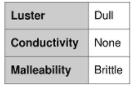
metallic

d)

none of these

10.

Objects that have opposite charges will

a)

repel each other

b)

attract each other

c)

push away from each other

d)

avoid each other

11.

How many atoms are in this molecule? C6H12O6

a)

6

b)

12

c)

18

d)

24

12.
What would be the proper chemical formula for combining Al3+ and l- :
a)
Al l3
b)
Al3l
c)
Al l
d)
All3
13.
Have a high m.p. (1000°C-3000°C)
a)
ionic compounds
b)
covalent compounds
14.
When dissolved in water, the solution is a good conductor of electricity.
a)
ionic compounds
b)
covalent compounds
15.
forms ions in solution
a)
ionic compounds
b)
covalent compounds
16.
electrolytes
a)
ionic compounds
b)
covalent compounds
17.

Why do atoms form bonds?

a)

to attain a noble gas configuration

b)

to increase their mass

c)

to increase their atomic number

d)

to attain an alkali metal configuration

18.
Some are solids, some are liquids, and some are gases at room temperature.
a)
ionic compounds
b)
covalent compounds
19.
What type of bond forms when 2 or more electrons are SHARED?
a)
Covalent bond
b)
Incomplete bond
c)
Ionic bond
d)
Metallic bond
20.
A(n) _________ is an ion with a positive (+) charge.
a)
anion
b)
cation
c)
ion
d)
solute
21.
A(n) _________ is an ion with a negative (-) charge.
a)
anion
b)
ion
c)
cation
d)
solute
22.
Which of the following is NOT a characteristic of a COVALENT COMPOUNDS
a)
High melting point
b)
Contains only nonmetals
c)
Low boiling point
d)
All solids
23.
Which of the following is an example of an IONIC COMPOUND?
a)
NaCl
b)
H2O
c)
CO2
d)
NO
24.
Which of the following is an example of a COVALENT COMPOUND?
a)
H2S
b)
KI
c)
CaCl2
d)
MgO
25.
___________ is the tendency of an atom to attract (pull) electrons away from other atoms.
a)
Electronegativity
b)
Octet rule
c)
Solubility
d)
Conductivity
26.
What charge does a potassium (K) ion have?
a)
+1
b)
-1
c)
+2 
d)
-2
27.
What charge does a bromine (Br) ion have?
a)
-1
b)
-2
c)
-3
d)
-4
28.
What charge does a calcium (Ca) ion have?
a)
+1
b)
+2
c)
+3
d)
+4
29.
What charge does a carbon (C) ion have?
a)
-2/+2
b)
-1/+1
c)
-3/+3
d)
-4/+4
30.

Nonmetals tend to

a)

gain electrons

b)

lose electrons

31.

Metals tend to

a)

gain electrons

b)

lose electrons

32.
How do the following two elements bond together?
Cr3+  O2-         
a)
CrO
b)
Cr3O2
c)
Cr2O3
d)
CrO3
33.
How do the following two elements bond together?
K1+  S2- 
a)
KS
b)
K8S
c)
K6S3
d)
K2S
34.
How do the following two elements bond together?
Al3+  O2-         
a)
AlO
b)
Al2O3
c)
Al3O6
d)
Al3O2
35.

Is the following compound ionic or covalent?

Ag2O

a)

Ionic

b)

Covalent

36.
Metalloids _____________
a)
have no properties of metals.
b)
have no properties of nonmetals.
c)
have some properties of both metals and nonmetals.
d)
none of the above
37.

Vertical columns on the periodic table are called ___?

a)

groups

b)

periods

c)

rows

d)

families

38.

Which color on the image of the periodic table corresponds with the lanthanides.

a)

red

b)

black

c)

blue

d)

orange

39.

Which color on the image of the periodic table corresponds with the transition metals.

a)

red

b)

black

c)

blue

d)

orange

40.

Which color on the image of the periodic table corresponds with the alkaline earth metals.

a)

yellow

b)

dark yellow

c)

blue/green

d)

teal

41.

Horizontal rows on the periodic table are called ___?

a)

groups

b)

periods

c)

rows

d)

families

42.

Most metals share four common physical characteristics. Which of the options is not one of the four?

a)

Luster

b)

Conductivity

c)

Ductility

d)

Malleability

e)

Reactivity

43.

Which family of elements reacts violently with water and exposure to oxygen?

a)

alkali metals

b)

alkaline earth metals

c)

lanthanides

d)

actanides

e)

transition metals

44.

Which two families of elements are soft and silvery and have low densities? Choose two.

a)

alkali metals

b)

alkaline earth metals

c)

lanthanides

d)

actanides

e)

transition metals

45.

The periodic table is mostly comprised of what type of element?

a)

Metals

b)

Nonmetals

c)

Metalloids

46.

An engineer is building a sun reflector which must withstand storms, large winds, and reflect sunlight well, what would suggest they use?

a)

Alkali metal

b)

Alkaline earth metal

c)

Transition metal

d)

Metalloid

e)

Lanthanide

47.

Which of the following metals is the most reactive?

a)

Lithium

b)

Potassium

c)

Sodium

d)

Cesium

48.

Most elements on the periodic table are classified as ____________.

a)

Gases

b)

Metalloids

c)

Metals

d)

Nonmetals

49.

Groups on the periodic table are arranged...

a)

Vertically

b)

Horizontally

c)

Diagonally from bottom right corner

d)

Diagonally from top right corner

50.

Which group of metals on the periodic table is the most reactive?

a)

Group 1

b)

Group 2

c)

Group 13

d)

Group 18

51.
All elements in the same group have the same number of ___.
a)
protons
b)
neutrons
c)
atomic mass units
d)
valence electrons
52.
Beryllium is in group number______.
a)
Group 2
b)
Group 3
c)
Group 4
d)
Group 7
53.

This family is group 2 on the Periodic Table of the Elements.

a)

alkali metals

b)

alkaline earth metals

c)

halogens

d)

noble gases

54.
Gold (Au)
a)
Transition Metal
b)
Alkali Metal
c)
Alkaline Earth Metal
d)
Heavy Metal
55.
How many valence electrons does an alkaline earth metal have? 
a)
1
b)
2
c)
7
d)
8
56.

Alkaline earth metals are always found as compounds in nature because

a)

They are metals

b)

They are essential nutrients

c)

They are highly reactive

d)

None of the above

57.

Can be hammered into a flat sheet

a)

Malleable

b)

Ductile

c)

Luster

d)

Conductor of Heat

58.

Can be drawn/extruded into thin wires

a)

Malleable

b)

Ductile

c)

Luster

d)

Conductor of Heat

59.

Describes the shiny surface of a material

a)

Malleable

b)

Ductile

c)

Luster

d)

Conductor of Heat

60.

Why a metal object compared to a plastic object feel warmer or colder even though they are the same temperature.

a)

Malleable

b)

Ductile

c)

Luster

d)

Conductor of Heat

61.

If you held onto a 200 Degree C Iron bar or a 200 Degree C Wooden Bat, which one could you hold in your hand the longest and why?

a)

The Bat, it is not as heavy

b)

The Iron bar as it is easier to hold.

c)

The Bat as it is a poor conductor of heat.

d)

The Iron bar as it is a good conductor of heat.

62.
Which of these is a property of metals?
a)
It's malleable
b)
It can't conduct electricity
c)
They are used in food
d)
It's very brittle
63.
Brittle
a)
Metal
b)
Nonmetal
64.
Good conductor of heat
a)
Metal
b)
Nonmetal
65.
All of the following would classify an element as a metal except?
a)
Dull
b)
Luster
c)
Malleable
d)
Hard
66.
Iron is a good conductor, malleable and magnetic. What type of element is Iron? 
a)
Metal
b)
Nonmetal
c)
Metalloid
d)
Pretty
67.
Which of the following is a property of a non-metal?
a)
Conducts electricity and heats well
b)
Can be hammered into thin sheets
c)
Is brittle and breaks easily
d)
Has a shiny, metallic luster
68.
The word “luster” refers to which property of matter?
a)
The ability to conduct electrical or thermal energy
b)
Capable of being drawn out into thin wires
c)
The way a surface appears when it reflects light
d)
Suitable for being shaped by beating or rolling
69.
If a material can easily be drawn into the shape of a wire, it is
a)
Ductile
b)
Magnetic
c)
Malleable
d)
Reactive
70.
Which of the following is a good conductor of heat?
a)
Metal
b)
Nonmetal
c)
Metalloid
71.
Pure sodium has luster, bends easily, and conducts electricity.  Based off these properties, it would be classified as?
a)
A Metal
b)
A non metal
c)
A metalloid
72.
Fluorine is used in many tooth pastes because it helps maintain healthy teeth.  At room temperature it is gaseous, and does not conduct electricity. Based off these properties, it would be classified as?
a)
A metal
b)
A non metal
c)
A metalloid
73.
When an object changes shape when struck by a hammer.
a)
luster
b)
malleable
c)
brittleness
d)
ductile
74.

Able to be drawn into wire is

a)

malleable

b)

insulator

c)

lustre

d)

ductile

75.
Where are the non-metallic elements found in the periodic table?
a)
In the middle
b)
In the top rows
c)
On the left-hand side
d)
On the right-hand side
76.
The list which contains only metals is .......
a)
aluminium, copper, nitrogen
b)
iron, oxygen, hydrogen
c)
iron, silver, aluminium
d)
iron, sulphur, copper
77.
Metalloids _____________
a)
have no properties of metals.
b)
have no properties of nonmetals.
c)
have some properties of both metals and nonmetals.
d)
none of the above
78.
When metals bond with non-metals they form what type of bonds
a)
covalent
b)
ionic
c)
cooperative
d)
lewis
79.
How do the following two elements bond together?
Cr3+  O2-         
a)
CrO
b)
Cr3O2
c)
Cr2O3
d)
CrO3
80.
How do the following two elements bond together?
Al3+  O2-         
a)
AlO
b)
Al2O3
c)
Al3O6
d)
Al3O2
81.

When a nonmetal gains electrons, it becomes this type of ion.

a)

Anion

b)

Cation

82.
When an ionic compound is formed, its charge is 
a)
negative
b)
neutral (no charge)
c)
positive
83.

a)

metalloid

b)

nonmetal

c)

metal

d)

alloy

84.
What group on the Periodic Table contains the elements of the alkaline earth family?
a)
1
b)
2
c)
17
d)
18
85.

What group is the family found? These halides are very reactive and almost have full outer energy level/shell.

a)

1

b)

2

c)

16

d)

17

86.
Which element is not in the Alkali metal family?
a)
Li
b)
H
c)
Fr
d)
Cs 
87.
Argon (Ar)
a)
alkali metal
b)
alkaline earth metal
c)
halogen
d)
noble gas
88.
Which of the following is the most reactive group of non-metals? 
a)
Alkali
b)
Alkali Earth
c)
Halogen
d)
Noble Gas
89.
How many valence electrons does an alkaline earth metal have? 
a)
1
b)
2
c)
7
d)
8
90.

The is family has properties of both metals and nonmetals.

a)

Alkali

b)

Halogens

c)

Nonmetals

d)

Metalloids

91.

This type of element is dull, brittle solids and gases, insulators, poor conductors of heat and electricity, as well as having low melting points.

a)

metals

b)

metalloids

c)

nonmetals

92.
The atoms along the staircase are called 
a)
metals
b)
nonmetals
c)
metalloids
d)
noble gases
93.
Elements in a ..................have similar chemical properties.  
a)
period
b)
group
c)
row
94.
As you move down a group, atomic radius increases because - 
a)
you add more and more neutrons
b)
you add more and more protons
c)
you add more and more shells (energy levels)
d)
you add more atomic mass
95.
Francium (Fr) has the lowest ionization energy in Group 1 because - 
a)
it has the smallest number of valence electrons
b)
it has the greatest atomic mass
c)
it has the greatest number of protons, so it attracts its electrons the strongest
d)
its 1 valence electron is very far from the nucleus, so little energy is needed to remove it
96.
Electronegativity is...
a)
the ability of an atom to attract/ accept electrons
b)
the ability of an atom to lose electrons
c)
the energy required to remove an electron from a specific atom
d)
how easy it is to make friends. 
97.
Which has the greater Electronegativity: 
N or C?
a)
C
b)
N
98.
CO2
a)
Ionic Bond
b)
Covalent Bond
c)
Both bonds
d)
Neither bond
99.
Low melting point
a)
Ionic Bonds
b)
Covalent Bonds
c)
Both bonds
d)
Neither bond
100.
Why do ionic bonds form?
a)
Opposite charges attract
b)
Outer energy level shells become full
c)
Both
d)
Neither