wayground logo

Free Printable Worksheets

Font size

S
M
L
XL
Worksheets

Microeconomics Final Exam June 2026

Total questions: 65

Worksheet time: 2hrs 46mins

Name
Class
Date
1.
For the law of demand, as price rises, what happens to quantity demanded?
a)
it goes up
b)
it goes down
c)
it stays the same
d)
it is not effected
2.
For the law of supply, as price rises, what happens to quantity supplied?
a)
it goes up
b)
it goes down
c)
it stays the same
d)
it is not effected
3.
When quantity supplied and quantity demanded is equal
a)
surplus
b)
shortage
c)
equilibrium
d)
law of demand
4.
If a price is above equilibrium price, it creates a...
a)
shortage
b)
surplus
c)
market price
d)
demand
5.
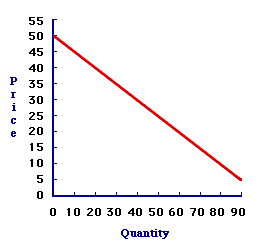
What does this curve represent?
a)
demand
b)
supply
c)
equilibrium
d)
shortage
6.
What does this curve represent?
a)
supply
b)
equilibrium
c)
demand
d)
surplus
7.
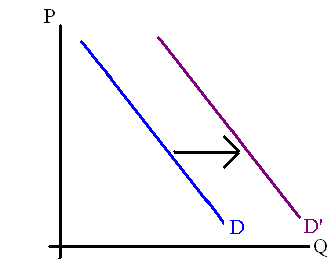
The diagram represents a
a)
increase in demand
b)
decrease in demand
c)
change in quantity demand
d)
none of the above
8.
Goods that are bought and used together are 
a)
complementary goods
b)
substitute goods
c)
income goods
d)
unrelated goods
9.
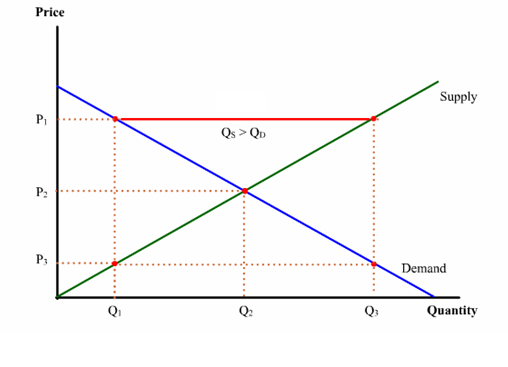
What does this graph show?
a)
Shortage
b)
Surplus
c)
Supply Table
d)
Equilibrium
10.
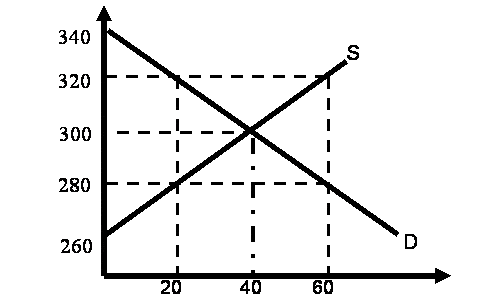
If a price floor was set at 320, what quantity would be purchased?
a)
20
b)
40
c)
60
d)
80
11.
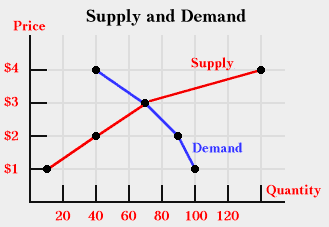
What is the Equilibrium Price?
a)
1
b)
2
c)
3
d)
4
12.
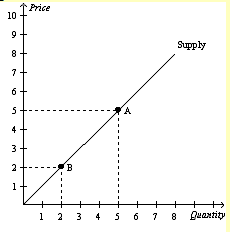
The movement from Point A to Point B represents a(n)
a)
increase in the price.
b)
decrease in the quantity supplied.
c)
shift in the supply curve.
d)
Both Orange and Blue are correct.
13.
Which of the following would not shift the supply curve for iphones?
a)
an increase in the price of iphones
b)
a decrease in the number of sellers of iphone
c)
an increase in the price of plastic, an input into the production of iphones
d)
an improvement in the technology used to produce iphones
14.

When MP is zero

a)

TP is maixmum

b)

TP starts falling

c)

AP becomes negative

d)

TP is zero

15.

Which stage represents the range of rational production decision?

a)

Stage III

b)

Stage I

c)

Stage II

16.

Law of variable proportion is the new name of the famous

a)

Production Function

b)

Law of Diminishing Returns

c)

Law of Demand

d)

Returns to Scale

17.

________ an addition to the total production by the employment of an extra unit of a factor.

a)

Average Product

b)

Total Product

c)

Marginal Product

d)

Output

18.

Output is the _________ variable

a)

Independent

b)

Dependent

19.

When more units of a factor are employed for producing a commodity , the average product first ______ then _______.

a)

falls,rises

b)

rises,falls

20.

Which of the following inputs are variable in the long run?

a)

Labour

b)

Capital and equipment

c)

Plant size

d)

all of above

21.
At 100 units of output, a firm's total cost is $10,000. If the firm's total fixed cost is $4,000, its average variable cost is equal to:
a)
$140
b)
$100
c)
$60
d)
$40
22.
As output of a firm increases, the difference between the firm’s average total cost and its average variable cost gets smaller because the firm’s
a)
total cost is increasing
b)
marginal cost is increasing
c)
average fixed cost is decreasing
d)
marginal product of labor is decreasing 
23.
A firm produces 400 books and sells each book for $15. If the explicit cost of producing the books is $4,500 and the implicit cost is $1,000, the firm’s economic profit is:
a)
$0
b)
$500
c)
$1,000
d)
$1,500
24.
Change in Total Revenue/Change in Quantity
ΔTR/ΔQ = _____
a)
Marginal cost
b)
Marginal Revenue
c)
Profit
d)
Marginal Profit
25.
The property whereby long-run average total cost falls as the quantity of output increases.
a)
Economies of Scale
b)
Efficient Scale
c)
Constant Returns to Scale
d)
Diseconomies of Scale
26.
The marginal cost curve typically does which of the following?
a)
Increases at a fixed rate.
b)
Decreases and eventually increases.
c)
Decreases at a decreasing rate.
d)
Increases and eventually decreases.
27.
The marginal cost curve typically does which of the following?
a)
Increases at a fixed rate.
b)
Decreases and eventually increases.
c)
Decreases at a decreasing rate.
d)
Increases and eventually decreases.
28.
What is the only curve that continues to fall as output increases?
a)
Average Fixed Cost
b)
Average Variable Cost
c)
Average Total Cost
d)
Marginal Cost
29.

The relationship between the factors of production and the output of goods and services.

a)

Theory of Production

b)

Law of Variable Proportions

c)

Production Function

d)

Stages of Production

e)

Marginal Product

30.

A graphic portrayal showing how a change in the amount of a single variable input affects total outputs.

a)

Theory of Production

b)

Law of Variable Proportions

c)

Production Function

d)

Stages of Production

e)

Marginal Product

31.

An extra output due to the addition of one more unit of input

a)

Theory of Production

b)

Law of Variable Proportions

c)

Production Function

d)

Stages of Production

e)

Marginal Product

32.

Production Period long enough to change the amount of variables and fixed inputs used in production.

a)

Diminishing Returns

b)

Long Run

c)

Short Run

d)

Stages of Production

e)

Raw Materials

33.
Costs that do not change when the quanity of output produced changes?
a)
Fixed Costs
b)
Variable Costs
c)
Explicit Costs
d)
Implicit Costs
34.
Input costs that may not have a direct outlay of money.  Value of the opportunity cost.
a)
Fixed Cost
b)
Variable Cost
c)
Implicit Cost
d)
Explicit Cost
35.
Measure of profit  which includes both explict and implicit costs.
a)
Economic Profit
b)
Accounting Profit
36.

If a higher level of production allows workers to

specialize in particular tasks, a firm will likely exhibit

________ of scale and ________ average total cost.

a)

economies, falling

b)

economies, rising

c)

diseconomies, falling

d)

diseconomies, rising

37.
The most profitable level of output for any firm operating in the short run is the level of output at which:
a)
marginal revenue exceeds marginal cost by the highest amount 
b)
marginal revenue equals marginal cost 
c)
price exceeds average cost by the highest amount
d)
price equals marginal cost 
38.
What is the definition of the economic term Opportunity Cost?
a)
the value of the next best alternative that is given up due to the choice you made 
b)
The price you pay to purchase something 
c)
The benefit you gain by making a decision 
d)
The amount of debt you take on by making a decision 
39.

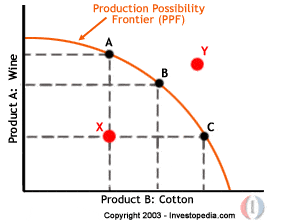
What does point B represent?

a)

Production at greater than the country's minimum potential

b)

Production is less than the country's minimum potential

c)

Production is greater than the country's maximum potential

d)

Production at the country's maximum potential
40.
What does point Y represent on the PPC?
a)
Efficiency
b)
Unattainable / impossible
c)
Inefficency
d)
Nothing
41.

What is the Opportunity Cost of moving from C to A? (Think in the terms of what do we have to forgo in the process.)

(a)  

42.

What does PPC show? Select Multiple options.

a)

Describes the production of only two products in economy.

b)

It explains the production when there is full and efficient utilisation all resources in economy

c)

It explains the consumption pattern in economy

d)

It is the combination of all possible output points of two goods given that technology and resources are fixed.

43.

The following diagram shows the production possibility frontier for an economy that produces bread and honey.


If the economy is initially at point W, then the opportunity cost of moving to point X is

a)

6 units of honey.

b)

8 units of honey.

c)

12 units of bread.

d)

23 units of bread.

44.

The table shows the production possibilities for a country. Based on the table, which of the following production combinations is a possibility?

a)

5 pairs of shoes and 28 pizzas

b)

3 pairs of shoes and 23 pizzas

c)

2 pairs of shoes and 20 pizzas

d)

4 pairs of shoes and 15 pizzas

45.
Suppose that elasticity of demand of socks is 0.7.  If the price of socks is reduced by 10%, how will sales be effected?
a)
sales will grow by more than 10%
b)
Sales will grow by 10%
c)
Sales will grow by less than 10%
d)
Sales will decrease by 10%
46.
The formula for calculating elasticity of demand is:
a)
The % change in price over the % change in quantity demanded
b)
The % change in quantity demanded over the % change in price
c)
The change in price over the change in quantity demaned
d)
The change in quantity demanded over the change in price
47.

What determines the market equilibrium price?

a)

Demand because of consumer sovereignty

b)

Supply because of inelasticity

c)

The balance between supply and demand.

48.

If the price of coffee goes up 1% and buyers buy 0.25% less. What is the demand for coffee?

a)

Elastic

b)

Inelastic

c)

Unit elastic

49.
A key determinant of the price elasticity of supply is
a)
the ability of sellers to change the price of the good they produce.
b)
the ability of sellers to change the amount of the good they produce.
c)
how responsive buyers are to changes in sellers' prices.
d)
the slope of the demand curve.
50.

Identify types of price elasticity of demand

a)

Elastic

b)

Inelastic

c)

Unitary Elastic

d)

Perfect Elastic

51.

Identify types of price elasticity of demand

a)

Elastic

b)

Inelastic

c)

Unitary Elastic

d)

Perfect Elastic

52.

Identify types of price elasticity of demand

a)

Elastic

b)

Inelastic

c)

Unitary Elastic

d)

Perfect Elastic

53.

Identify types of price elasticity of demand

a)

Elastic

b)

Inelastic

c)

Unitary Elastic

d)

Perfect Inelastic

54.

Identify types of price elasticity of demand

a)

Elastic

b)

Inelastic

c)

Unitary Elastic

d)

Perfect Elastic

55.

Identify degrees of price elasticity of demand

a)

Ed = 1

b)

Ed = 0

c)

0 < Ed < 1

d)

Ed = ∞

56.

What is a perfect market?

a)

A perfect market is a situation where products are unique and not interchangeable.

b)

A perfect market is characterized by high barriers to entry and limited competition.

c)

A perfect market is a theoretical market structure where competition is at its highest level, with many buyers and sellers, identical products, and no barriers to entry.

d)

A perfect market is one with only one seller and many buyers.

57.

Explain the concept of price elasticity in a perfect market.

a)

Price elasticity measures the total revenue of a company.

b)

Price elasticity in a perfect market refers to the responsiveness of quantity demanded to price changes, influenced by factors like substitutes and consumer preferences.

c)

Price elasticity refers to the fixed price of goods in a market.

d)

Price elasticity is only relevant in monopolistic markets.

58.

What is not an advantage of a monopoly?

a)

achieving economies of scale

b)

high level of research and development

c)

Producing a greater quantity at profit-maximizing level of output

d)

higher prices and lower output

59.

One of the requirements for a monopoly is that

a)

products are high priced

b)

there are several close substitutes for the product

c)

there is a unique product with no close substitutes

d)

the product cannot be produced by small firms

60.

The core problem in economics study is

a)

Money

b)

Scarcity

c)

Production

d)

Allocation

61.
The people who buy goods and services are called...
a)
producers
b)
consumers
c)
banker
d)
traders
62.

Explain diagrams a and b. (up to 3000 characters)

4 lines
63.

Explain diagrams a, b, and c.

4 lines
64.

Explain diagrams A and b. Provide your analysis of these two diagrams.

4 lines
65.

Write your analysis of these two diagrams.

4 lines