
NEW
Font size
 Worksheets
REPRODUCTION IN PLANTS
Total questions: 50
Worksheet time: 26mins
Part of the plant that take part in sexual reproduction is
seed
fruit
flower
branch
Vegetative propagation in sweet potato takes place by
root
leaves
seed
stem
The ‘eye’ of the potato plant is what
the root is to any plant
the bud is to a flower
the bud is to Bryophyllum leaf
the anther is to stamen
The zygote develops into
a seed
an ovule
a fruit
an embryo
Which of the following is a part of a pistil?
Stigma
Anther
Filament
Pollen
Transfer of pollen grains from anther to the stigma of a flower is called
pollination
fertilisation
reproduction
fruit
Winged seeds is a characteristic of seeds dispersed by
water
wind
animals
insect
Which of the following contains the egg cell in plants?
Anther
Stigma
Pollen grain
Ovule
In which of the following plants buds are present on the margins of leaves?
Bryophyllum
Touch me not
Sweet Potato
Coriander
Which of the following parts of a plant take part in sexual reproduction?(i) Flower(ii) Seed(iii) Fruit(iv) Branch
Choose the correct answer from below:
(i) and (ii)
(i), (ii) and (iii)
(iii) and (iv)
(ii), (iii) and (iv)
Which of the following statements is/are true for sexual reproduction in plants?(i) Plants are obtained from seeds(ii) Two plants are always essential(iii) Fertilisation can occur only after pollination(iv) Only insects are agents of pollination
Choose from the options given below:
(i) and (ii)
(i) only
(i) and (ii)
(i) and (iv)
Which of the following is bisexual flower
Ray floret of sunflower
Papaya
Hibiscus
All of the above
Which of the following is the correct sequence of events in the sexual reproduction of plant from the flowers?
Pollination, seed formation, fertilization, germination
Pollination, fertilization, seed formation, germination
Pollination, seed formation, germination, fertilization
Pollination, fertilization, germination, seed formation
The reproductive part of a plant is the
Leaf
Stem
Root
Flower
Reproduction is essential for living organism in order to
Keep individual organisms alive
Maintain growth
Fulfil their energy requirement
Continues species forever
Which of the following event in the reproduction in flowering plants can be carried out by a butterfly?
Germination
Fertilisation
Pollination
Seed formation
Fertilization is
Fusion of pollen and style
Fusion of pollen and ovule
Fusion of anther and style
Fusion of ovary and ovule
Pollination refers to the:
Transfer of pollen from anther to ovary
Transfer of male gametes from anther to stigma
Transfer of pollen from anther to stigma
Transfer of pollen from anther to ovule
What is the function of flowers in plants
Respiration
Transportation
Reproduction
Transpiration
Vegetative propagation in potato takes place by
leaves
stem
roots
seed

Why do living things reproduce?
Living things do not have a choice.
To ensure continuity of their kind.
To ensure consistency in their kind.
Which of the following is the right order?
Pollination -- Dispersal -- Germination -- Fertilisation
Pollination -- Fertilisation -- Germination -- Dispersal
Pollination -- Dispersal -- Fertilisation -- Germination
Pollination -- Fertilisation -- Dispersal -- Germination
Which is NOT a characteristic of flowers that are pollinated by wind?
feathery stigma
light
sweet nectar
small petals
When we prevent overcrowding of plants, we reduce the competition for ________________________________________.
Water, Minerals and Light
Water, Nutrients and Minerals
Water, Nutrients, Light and Minerals
Water, Light and Space
Which of the following consists of only parts of the female parts of the flower?
style, ovary, anther, pollen grain
anther. style, ovary, stigma, egg cell
egg cell, male reproductive cell, ovule
ovule, ovary, style, stigma, egg cell
Asexual reproduction does not involve gametes
True
False
The stamen is made of the
Anther & filament
Anther & petal
Fliament & ovary
Ovary & style
The carpel is made of the
Stigma & petals
Stigma, style & ovary
Filament & anther
Petals


Name the type of asexual reproduction observed in the image.
Binary fission
Multiple fission
budding
fragmentation

We have all seen bees fly around flowers. When a bee drinks nectar from one flower they sometimes brush up against the stamen. When they go to another flower, they can drop some pollen on the pistil. What process are the bees helping with?
pollination
germination
fertilization
seed dispersal

The petals job is not only to protect the reproductive parts of the plant, but also to
keep wind away from the stamen
attract pollinators with their colors
absorb sunlight
fall off and become food for bugs

Which of the following lists the processes in the order they need to occur, even though there is no start and no end.
pollination, fertilization, seed dispersal, germination
fertilization, pollination, seed dispersal, germination
germination, fertilization, pollination, seed dispersal
germination, seed dispersal, pollination, fertilization
Which is NOT a characteristic of flowers that are pollinated by wind?
feathery stigma
light
sweet nectar
small petals
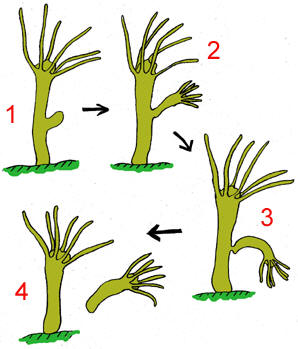
When an offspring grows off from the body of a parent organism it is called __________________.
budding
fission
fragmentation
sporulation

